Neyshabur (Nishapur) is a city of about 264,000 people in Razavi Khorasan province, some 120 km west of Mashhad, and was for centuries one of the great cities of the Islamic world. Founded by the Sasanians, it was the capital of the Tahirids and the first Seljuk capital, a centre of learning and pottery, until the Mongols destroyed it in 1221. It is best known today as the home and burial place of the poets Omar Khayyam and Attar.
| Persian name | نیشابور (Neyshâbur) |
|---|---|
| Province | Razavi Khorasan |
| Population | 264,375 (2016 census, Statistical Centre of Iran) |
| Founded | 3rd or 4th century CE, by a Sasanian king named Shapur |
| Known for | Tombs of Omar Khayyam, Attar and Kamal-ol-Molk; turquoise; medieval pottery |
| Distance | About 120 km west of Mashhad |

The city of Shapur
The name comes from Middle Persian Nev-Shabuhr, “the good (deed) of Shapur”. Most historians credit Shapur I in the 3rd century CE; some medieval writers name Shapur II in the 4th. The city sat in a fertile plain below the Binalud mountains, on the main road from the Iranian plateau to Central Asia. In the hills to the north-west stood one of the three great sacred fires of Sasanian Iran, Adur Burzen-Mihr, the fire of the farmers.
A capital of eastern Islam
After the Arab conquest Neyshabur grew into the leading city of Khorasan. The Tahirids, the first semi-independent Iranian dynasty of the Abbasid age, made it their capital in the 9th century, and it remained a seat of governors under the Samanids and Ghaznavids. In 1037 the Seljuk leader Tughril entered the city, and it was there that he was first proclaimed sultan, before his march west to Baghdad (see Tughril Beg).
At its height in the 10th and 11th centuries Neyshabur was one of the largest cities between Baghdad and China. It had a famous Nizamiyya college, where the theologian al-Juwayni taught and the young al-Ghazali studied. Its workshops produced a distinctive pottery: bowls painted in coloured slips under a clear glaze, many decorated with elegant bands of Arabic script giving proverbs and blessings. Much of what museums now hold came from excavations by the Metropolitan Museum of Art in New York between 1935 and 1940.
Earthquakes, raids and the Mongols
Neyshabur suffered repeatedly. Earthquakes damaged it badly in the 12th century, and in 1153 Oghuz tribesmen sacked it. The worst blow came in 1221. During an earlier siege a son-in-law of Genghis Khan, Toghachar, was killed by an arrow from the walls. When the Mongols took the city in April 1221 they killed almost all its inhabitants. Medieval chroniclers give death tolls of well over a million, figures modern historians regard as impossible for the city’s size, but there is no doubt the massacre was among the worst of the invasion. Our history page on the destruction of Nishapur, Merv and Herat discusses the sources and numbers.
The city was rebuilt on a new site, and the medieval ruins, known as Shadyakh and Kohandezh, lie on the edge of the modern town. Neyshabur never regained its old standing, and Mashhad, with its shrine, took its place as the main city of Khorasan.
The tomb of Omar Khayyam
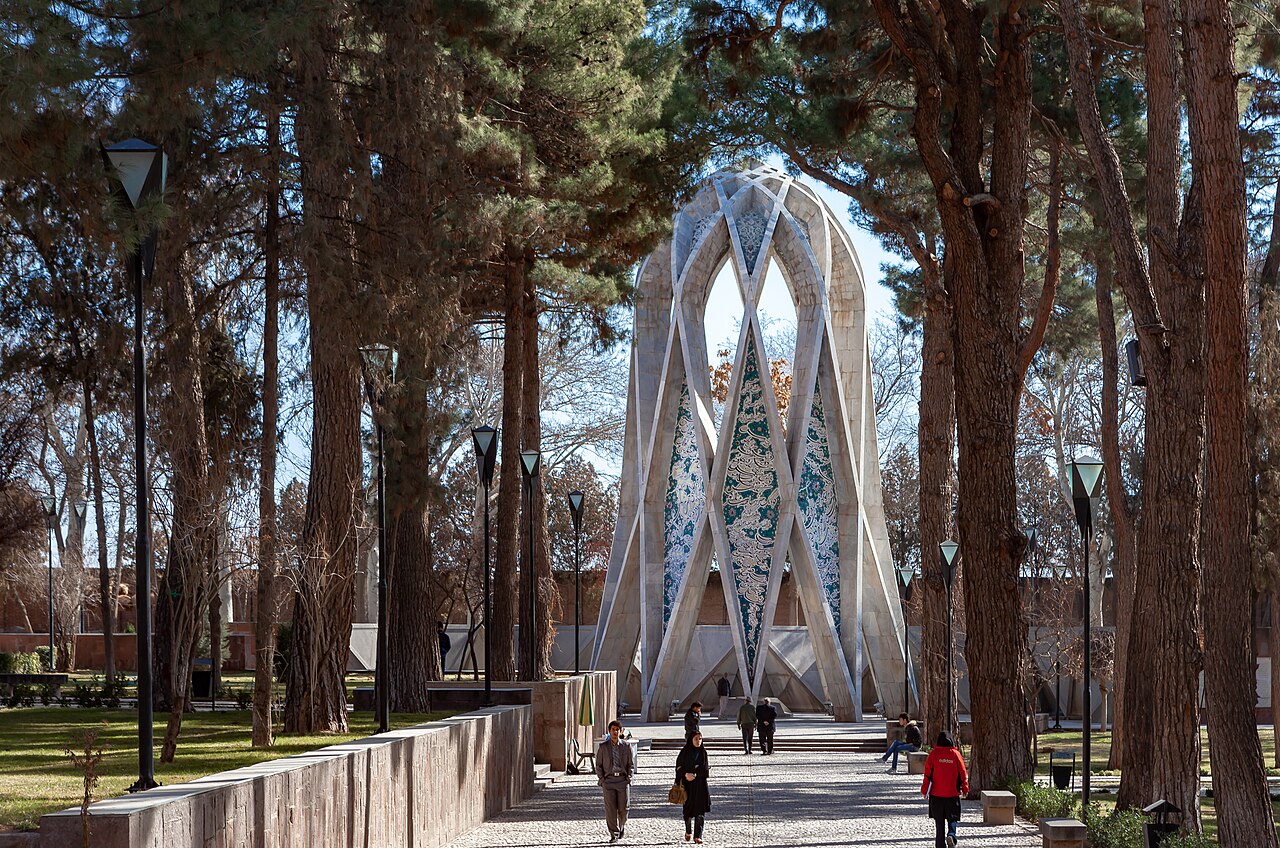
Omar Khayyam (1048–1131), mathematician, astronomer and poet of the quatrains (robâ’iyât), was born and died in Neyshabur. His grave lies in a garden in the south of the city, next to the Imamzadeh Mahruq shrine. The present monument, designed by the architect Houshang Seyhoun and finished in 1963, is a tall open structure of interlocking lattice ribs clad in tiles and inscribed with his verses, standing over the tomb in a garden of trees. See Tomb of Omar Khayyam for a visitor’s guide and Omar Khayyam: Poet and Scientist for his life and work.
Attar and Kamal-ol-Molk
A short distance from Khayyam’s garden is the tomb of Farid al-Din Attar (c. 1145–c. 1221), the mystical poet of The Conference of the Birds, who is said to have died in the Mongol massacre. His octagonal tomb with a blue-tiled dome was built in the Timurid period and later restored. Nearby is the tomb of the painter Mohammad Ghaffari, known as Kamal-ol-Molk (died 1940), the most famous Iranian painter of the late Qajar era, also designed by Seyhoun.
Turquoise and other sights
The hills about 50 km north-west of the city hold the turquoise mines that made “Nishapur turquoise” a byword for the finest blue stone, worked for at least two thousand years. Turquoise jewellery is sold in the city’s bazaar. About 24 km east, on the road to Mashhad, is Qadamgah, a small Safavid-era shrine in a garden that holds a stone said to bear the footprints of Imam Reza, a popular stop for pilgrims.
In February 2004 the city was hit by a different kind of disaster, when a train carrying fuel and chemicals derailed and later exploded near the town, killing about 300 people, many of them firefighters and rescuers.
Visiting
Neyshabur is an easy day trip from Mashhad by road or train, often combined with Qadamgah, and the tombs of Khayyam and Attar can be seen in a morning. Spring is the best season, when the gardens are in leaf. Check current opening times locally. Visitors to the region also go to Tus to see the tomb of Ferdowsi, and our blog post on Mashhad covers the pilgrimage city in more depth.
Persian words from this page
| نیشابور | Neyshâbur | Neyshabur |
| خیام | Khayyâm | Khayyam |
| عطار | Attâr | Attar (“perfumer, druggist”) |
| رباعی | robâ’i | quatrain |
| فیروزه | firuze | turquoise |
| سفال | sofâl | pottery |
| آرامگاه | ârâmgâh | tomb, mausoleum |
| قدمگاه | Qadamgâh | “place of the footstep” |
Sources and further reading
- Encyclopaedia Iranica, article “Nishapur”.
- Richard W. Bulliet, The Patricians of Nishapur: A Study in Medieval Islamic Social History (Harvard University Press, 1972).
- Charles K. Wilkinson, Nishapur: Pottery of the Early Islamic Period (Metropolitan Museum of Art, 1973).
- ‘Ata-Malik Juvaini, The History of the World-Conqueror, trans. J. A. Boyle (Manchester, 1958).
- Statistical Centre of Iran, 2016 National Population and Housing Census.
Want to learn Persian? Get the free Starter Pack
Get the 14-page printable Starter Pack (all 32 letters, a 7-day reading plan, 100 core words and 20 survival phrases) and a short 5-email course. Free.
More in Cities of Iran
- Tehran: Iran’s Capital
- Mashhad
- Isfahan
- Shiraz
- Tabriz
- Yazd
- Kashan
- Kerman
- Hamadan
- Qom
- Ahvaz
- Rasht
- Kermanshah
- Urmia
- Ardabil
- Zanjan
- Qazvin
- Sanandaj
- Khorramabad
- Bandar Abbas
- Bushehr
- Zahedan
- Birjand
- Gorgan
- Sari
- Semnan
- Arak
- Ilam
- Yasuj
- Shahr-e Kord
- Bojnurd
- Karaj
- Abadan and Khorramshahr
- Kish Island
- Qeshm Island
- Hormuz Island
- Masuleh
- Abyaneh
- Kandovan
- Bam
- Neyshabur (Nishapur)
- Shush (Susa) Today