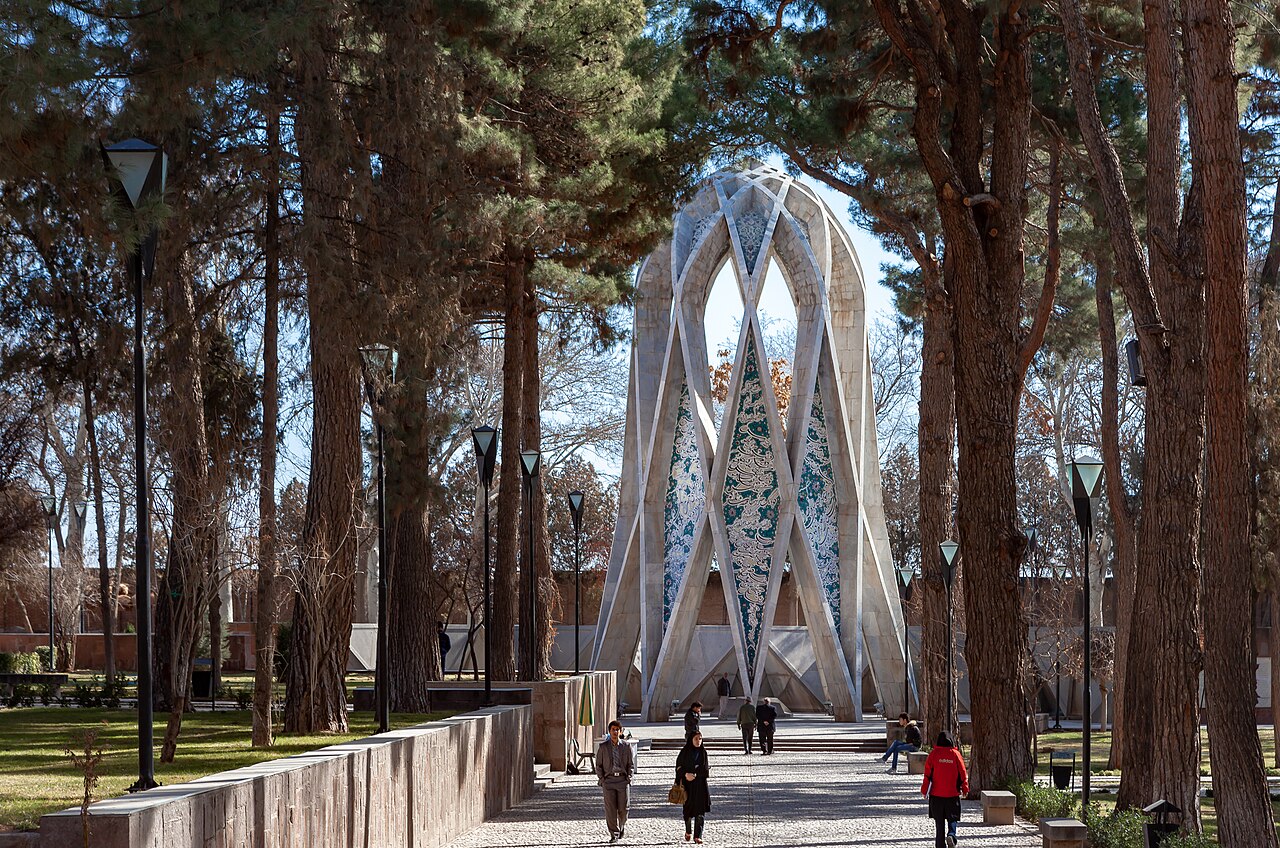
The Tomb of Omar Khayyam (آرامگاه خیام, Ârâmgâh-e Khayyâm) in Neyshabur is a 22-metre open lattice of concrete and tile, designed by the architect Houshang Seyhoun and opened in 1963. It stands in a garden on the south-eastern edge of the city, over the grave of the 11th–12th-century mathematician, astronomer and poet, and it is one of the best-known works of modern Iranian architecture.
| Who is buried here | Omar Khayyam (1048 – c. 1131), mathematician, astronomer and poet |
|---|---|
| Location | South-east Neyshabur, Razavi Khorasan |
| Architect | Houshang Seyhoun |
| Opened | 2 April 1963 |
| Height | About 22 m |

“Where the north wind scatters blossoms”
The oldest description of Khayyam’s grave comes from his pupil Nezami Aruzi, author of the Chahar Maqala. In Balkh, he writes, he heard his master predict that his grave would lie where the north wind would scatter flowers over it every spring. Visiting Neyshabur some years after Khayyam’s death, he found the grave at the foot of a garden wall in the Hira cemetery, with pear and apricot trees leaning over it and so many petals fallen on the ground that the grave was hidden. Nezami says he wept.
That small scene shaped everything that came later. Khayyam’s grave survived earthquakes and the Mongol sack of Neyshabur in 1221. Over the centuries it came to stand in the garden of the shrine of Imamzadeh Mohammad Mahruq, a descendant of the Shi’a Imams, whose turquoise-domed tomb still stands beside it. Western visitors in the early 20th century, drawn by Edward FitzGerald’s famous English version of the Rubaiyat, found only a plain brick and plaster case without an inscription.
Three versions of a tomb
In 1934 delegates on their way to the opening of the Tomb of Ferdowsi stopped at Neyshabur, and the Society for National Heritage soon built a simple stone memorial for Khayyam, designed by Karim Taherzadeh Behzad, next to the Mahruq shrine. It carried a quatrain by the poet Malek o-Sho’ara Bahar.
The present monument replaced it. With the Society’s approval, Seyhoun had the grave opened, the remains studied and reburied in a garden beside the Mahruq shrine, and the entrance turned so that the main path now leads to Khayyam rather than to the shrine. He is reported to have said that Iran had thousands of imamzadehs but only one Khayyam and built over it a structure that tries to express all three sides of Khayyam: the poet, the mathematician and the astronomer. The monument was finished in 1962 and inaugurated on 2 April 1963.
Reading the design
- Tall lattice ribs rise from a low base and lean together like the poles of a tent, a play on the name Khayyam, “tent-maker”.
- Geometry: the ribs form rhombuses and star shapes, a tribute to Khayyam’s work on algebra and geometry. Look up from beneath: the open top forms a star against the sky.
- Tilework: the panels between the ribs are filled with turquoise tiles carrying quatrains attributed to Khayyam, written in a flowing shekasteh nastaliq calligraphy.
- Openness: the structure is not closed. Wind, light and, in spring, falling petals reach the grave, just as in Nezami Aruzi’s story.
Not all the quatrains on the tomb are certainly by Khayyam. Scholars have long debated how many of the hundreds of robâ’i attributed to him are genuine; the history page on Omar Khayyam: Poet and Scientist explains the problem.
What else is in the garden
The garden is laid out with long paths, pools and trees, and is especially beautiful when the fruit trees flower in spring. Next to the tomb stands the Imamzadeh Mohammad Mahruq, with its tiled dome. Khayyam the astronomer is remembered here too: he worked on the Jalali calendar reform for the Seljuk sultan Malekshah, explained on our page about the history of the Iranian calendar. Neyshabur also has the tombs of the Sufi poet Attar and of the painter Kamal-ol-Molk, a short drive from Khayyam’s garden.
Practical notes
- Getting there: Neyshabur is roughly 120 km west of Mashhad. Most visitors come on a day trip by car or train from Mashhad.
- Best time: April, when the fruit trees blossom and the garden looks as Nezami Aruzi described it. 18 May (28 Ordibehesht) is marked in Iran as Khayyam Day.
- Tickets and hours: check current official information.
- Safety: follow your own government’s travel advice for Iran.
For the city, see our guide to Neyshabur; for the region, Mashhad.
Persian words from this page
| خیام | Khayyâm | tent-maker; the poet’s name |
| رباعی | robâ’i | quatrain |
| نیشابور | Neyshâbur | Khayyam’s city |
| شکوفه | shekufeh | blossom |
| امامزاده | emâmzâdeh | shrine of an Imam’s descendant |
| کاشی | kâshi | tile |
Sources and further reading
- Nezami Aruzi, Chahar Maqala (Four Discourses), trans. E. G. Browne (1921), the account of Khayyam’s grave.
- Encyclopaedia Iranica, “KHAYYAM, OMAR i. LIFE“.
- Talinn Grigor, Building Iran: Modernism, Architecture, and National Heritage under the Pahlavi Monarchs (Periscope, 2009).
- A. V. Williams Jackson, From Constantinople to the Home of Omar Khayyam (Macmillan, 1911), describing the grave before the modern tomb.
Love Persian poetry? Learn to read it: free Starter Pack
Get the 14-page printable Starter Pack (all 32 letters, a 7-day reading plan, 100 core words and 20 survival phrases) and a short 5-email course. Free.
More in Top Places to Visit in Iran
- Naqsh-e Jahan Square
- Shah (Imam) Mosque, Isfahan
- Sheikh Lotfollah Mosque
- Ali Qapu Palace
- Jameh Mosque of Isfahan
- Si-o-se Pol and Khaju Bridge
- Vank Cathedral
- Hasht Behesht Palace
- Naqsh-e Rostam
- Eram Garden, Shiraz
- Nasir al-Molk (Pink) Mosque
- Tomb of Hafez (Hafezieh)
- Tomb of Saadi (Saadieh)
- Shah Cheragh Shrine
- Arg of Karim Khan
- Fin Garden, Kashan
- Historic Houses of Kashan
- Jameh Mosque of Yazd
- Yazd Fire Temple and Towers of Silence
- Dowlatabad Garden and Windcatcher
- Amir Chakhmaq Complex
- Golestan Palace
- National Museum of Iran
- Treasury of National Jewels
- Tehran Grand Bazaar
- Milad Tower
- Imam Reza Shrine, Mashhad
- Tomb of Ferdowsi, Tus
- Tomb of Omar Khayyam, Neyshabur
- Tomb of Avicenna, Hamadan
- Ganjnameh Inscriptions, Hamadan
- Behistun (Bisotun): Visiting the Site
- Taq-e Bostan: Visiting the Site
- Tabriz Historic Bazaar
- Takht-e Soleyman
- Armenian Monastic Ensembles of Iran
- Sheikh Safi al-Din Shrine, Ardabil
- Dome of Soltaniyeh
- Alamut Castle
- Falak-ol-Aflak Castle
- Shushtar Historical Hydraulic System
- Chogha Zanbil: Visiting the Ziggurat
- Susa Archaeological Site
- Arg-e Bam
- Ganjali Khan Complex, Kerman
- Shazdeh Garden, Mahan
- Rayen Castle
- Dasht-e Lut (Lut Desert)
- Maranjab Desert and Caravanserai
- Varzaneh Desert
- Mount Damavand
- Hyrcanian Forests
- Lake Urmia
- Badab-e Surt Springs
- Ali Sadr Cave
- The Kaluts of Shahdad
- Qeshm Geopark
- Hormuz Island Colours
- Visiting Persepolis: A Day Trip from Shiraz
- Visiting Pasargadae
- Persian Caravanserais
- The Qanat of Gonabad
- Meymand Village
- Sasanian Sites of Fars: Firuzabad, Bishapur and Sarvestan
- Gonbad-e Qabus: Visiting the Tower
- Zayandeh Rud and Isfahan’s Bridges
- Tochal and Darband: Hiking Above Tehran
- Mount Sabalan
- Skiing in Iran: Dizin and Shemshak
- Golestan National Park