The Khwarazmian Empire was a Turkic-ruled state centred on Khwarazm, the delta of the Amu Darya south of the Aral Sea, whose rulers, the Khwarazmshahs of the Anushtegin dynasty, rose from Seljuk governors in the late eleventh century to masters of Iran by 1200. Under Tekish (1172–1200) they took Khorasan and destroyed the last Seljuk sultan of Iran in 1194, preparing the short-lived empire of his son Ala al-Din Muhammad that collapsed before Genghis Khan.
| Dynasty | Anushtegin dynasty, of Turkic slave-soldier origin |
|---|---|
| Period | c. 1077–1231 (as vassals until the 1140s; independent power from Tekish) |
| Capital | Gurganj (Urgench), in today’s Turkmenistan; later also Samarkand |
| Key rulers | Qutb al-Din Muhammad (1097–1127), Atsiz (1127–1156), Il-Arslan (1156–1172), Tekish (1172–1200), Ala al-Din Muhammad (1200–1220) |
| Language of government | Persian, with Arabic; Turkic in the army |
| Persian name | خوارزمشاهیان (Khârazmshâhiyân) |
Khwarazm and its old title
Khwarazm is an oasis of irrigated land where the Amu Darya, the Oxus of the Greeks, breaks into channels before reaching the Aral Sea, today divided between Uzbekistan and Turkmenistan. Surrounded by desert, it had its own Iranian language, Khwarazmian, and an old line of kings who bore the title Khwarazmshah, “king of Khwarazm”, long before Islam. The scholar al-Biruni was born there in 973. In 1017 Mahmud of Ghazni conquered it, and after 1040 it passed to the Seljuks.
From washbasin-keeper to Khwarazmshah
The founder of the new dynasty was Anushtegin Gharchai, a Turkish slave bought from the region of Gharchistan in Afghanistan, who rose in the Seljuk household to the office of keeper of the sultan’s washbasins. Under Malik Shah the revenues of Khwarazm were assigned to pay for that office, and Anushtegin became its governor. In 1097, after a rebel governor was killed, Sanjar’s officials gave Khwarazm to Anushtegin’s son Qutb al-Din Muhammad, who took the old title of Khwarazmshah and ruled loyally for thirty years.

Atsiz: rebellion and survival
His son Atsiz (1127–1156) was ambitious and patient. Sanjar’s defeat at Qatwan in 1141 gave him room to act, and he rebelled several times, occupying Merv and Nishapur for short periods and taking the cities of the lower Syr Darya. Each time Sanjar returned, Atsiz submitted, apologised and survived. After Qatwan he also paid tribute to the Qara Khitai, the new power of the steppe, whose overlordship the Khwarazmshahs accepted for the next seventy years. The great defeat is told on the page on Sultan Sanjar and the Qara Khitai.
Atsiz’s court was a centre of Persian letters. His secretary, the poet and stylist Rashid al-Din Vatvat, wrote a well-known handbook of poetic figures. A famous story tells that during Sanjar’s siege of the Khwarazmian fortress of Hazarasp in 1147, Sanjar’s poet Anvari and Vatvat traded insulting verses across the walls, tied to arrows.
Il-Arslan and the scramble for Khorasan
Sanjar died in 1157, a year after Atsiz, and Khorasan fell into the hands of former Seljuk commanders and Oghuz chiefs. Il-Arslan (1156–1172) took advantage of the vacuum to extend his rule into parts of Khorasan, while remaining a tributary of the Qara Khitai. His death in 1172 set off a long civil war between two of his sons.
Tekish, the true founder of the empire
Tekish (تکش) won the throne of Khwarazm with Qara Khitai help in 1172, but his brother Sultan Shah held out in Merv and Sarakhs, also using steppe allies, until his death in 1193. Tekish meanwhile took Nishapur in 1187 and gradually brought Khorasan under his control.
The chance to go further came from Baghdad. The caliph al-Nasir wanted to be rid of the Seljuk sultan Toghrul III, who still claimed authority over the caliph, and he invited Tekish west. In 1194 Tekish defeated and killed Toghrul near Rey, ending Seljuk rule in Iran, and took Rey and Hamadan. The background is told on the page on Seljuk decline and the atabegs.
The alliance with the caliph broke at once. Tekish now wanted to be recognised as sultan in Baghdad with the same powers the Seljuks had held, and al-Nasir refused. Caliphal forces and the Khwarazmians fought in western Iran in the following years, and the quarrel passed to Tekish’s son as a lasting enmity. Tekish also fought the Nizari Ismailis, besieging their castles in Quhistan and the Alborz. He died in 1200, on his way to a campaign, and was buried at Gurganj.
How the state worked
The Khwarazmian state had a Persian bureaucracy on the Seljuk model, with viziers, chancery secretaries and judges, and its official language was Persian. Its army, however, depended heavily on the Qangli and Kipchak Turks of the steppe north of Khwarazm. Tekish married Terken Khatun, a princess of these tribes, and her kinsmen held commands and governorships. They made the army formidable but also unruly, and Terken Khatun became a power in her own right. The nomad troops were a burden on the settled population, and their loyalty was to their own chiefs as much as to the shah, a weakness that showed itself fatally in 1220.
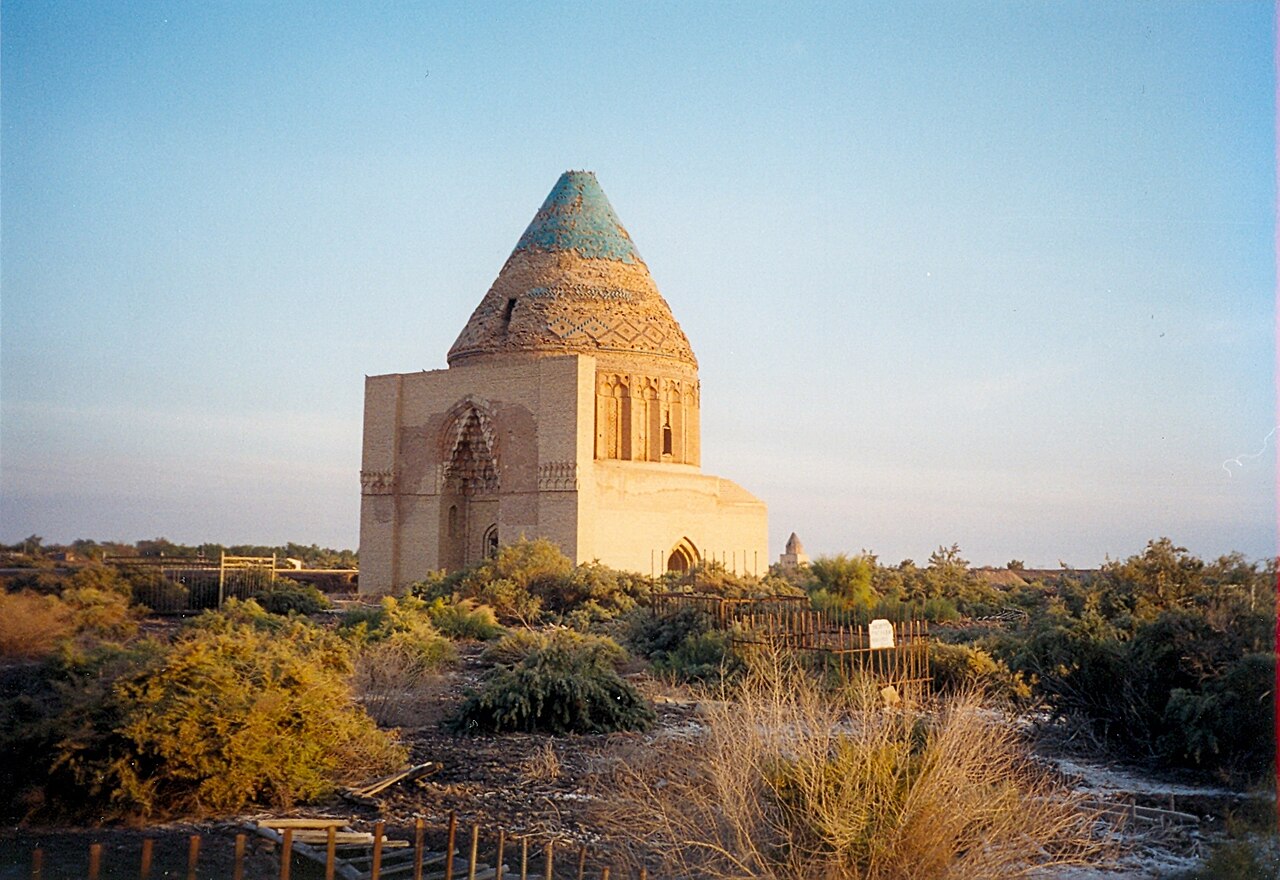
Gurganj grew into a large and wealthy city, a stop on the trade routes between the Volga, the steppe and Khorasan. Its surviving monuments at Kunya-Urgench, including the conical-roofed tomb attributed to Tekish and a tall minaret, are part of the Kunya-Urgench World Heritage site.
From Tekish to the Mongols
In 1200 the Khwarazmshah ruled from the Aral Sea to the Zagros, but still paid tribute to the Qara Khitai and faced the rival Ghurids in Afghanistan. His son Ala al-Din Muhammad would defeat both, double the empire’s size, and then lose it all; his reign is told on the page on Ala al-Din Muhammad II. The Mongol conquest that followed is described on the page on Genghis Khan’s invasion of Iran, and the last Khwarazmian resistance on the page on Jalal al-Din Mingburnu.
Persian words from this page
| خوارزم | Khârazm | Khwarazm (the w is written but not pronounced) |
| خوارزمشاه | Khârazmshâh | king of Khwarazm |
| گرگانج | Gorgânj | Gurganj, the capital |
| تکش | Tekesh | Tekish |
| جیحون | Jeyhun | the Amu Darya (Oxus) |
| ترکان خاتون | Torkân Khâtun | Terken Khatun |
Sources and further reading
- Ata-Malik Juvayni, Tarikh-i Jahangushay, trans. J. A. Boyle, The History of the World-Conqueror (Manchester, 1958), vol. 1, the history of the Khwarazmshahs.
- W. Barthold, Turkestan down to the Mongol Invasion (1900; English edition London, 1928).
- C. E. Bosworth, “The Political and Dynastic History of the Iranian World (A.D. 1000–1217)”, in The Cambridge History of Iran, vol. 5 (Cambridge, 1968).
- Michal Biran, The Empire of the Qara Khitai in Eurasian History (Cambridge, 2005).
- Encyclopaedia Iranica, “Khwarazmshahs”.
- UNESCO World Heritage Centre, Kunya-Urgench.
Want to learn Persian? Get the free Starter Pack
Get the 14-page printable Starter Pack (all 32 letters, a 7-day reading plan, 100 core words and 20 survival phrases) and a short 5-email course. Free.
More in Ghaznavids, Seljuks and Khwarazmshahs (977–1231)
- The Ghaznavid Empire
- Mahmud of Ghazni
- The Rise of the Seljuks
- The Battle of Dandanaqan (1040)
- Tughril Beg Enters Baghdad
- Alp Arslan
- Seljuk Architecture: Tomb Towers and Caravanserais
- The Battle of Manzikert (1071)
- Malik Shah I
- The Seljuks of Kerman
- Nizam al-Mulk and the Siyasatnama
- The Seljuk Domes of Isfahan’s Jameh Mosque
- Omar Khayyam: Poet and Scientist
- Al-Ghazali
- Sana’i of Ghazni
- Hassan-i Sabbah and the Fortress of Alamut
- The Nizari Ismailis and the “Assassins” Legend
- Sultan Sanjar and the Qara Khitai
- The Battle of Qatwan (1141)
- Anvari and Seljuk Court Poetry
- Seljuk Decline and the Atabegs
- The Ghurids
- Attar of Nishapur
- Nizami Ganjavi
- The Khwarazmian Empire
- Ala al-Din Muhammad II
- The Otrar Incident (1218): How Khwarazm Provoked Genghis Khan
- Jalal al-Din Mingburnu