The Otrar incident was the killing of a large Mongol-sponsored trade caravan at the Khwarazmian frontier town of Otrar in 1218, followed by the murder of an envoy Genghis Khan sent to demand justice. The governor Inalchuq and his master, the Khwarazmshah Ala al-Din Muhammad II, turned a commercial dispute into a war, and the Mongol invasion that followed in 1219 devastated Transoxiana and eastern Iran.
| Date | 1218 (caravan seized); envoy killed later the same year or early 1219 |
|---|---|
| Place | Otrar, on the middle Syr Darya (in today’s southern Kazakhstan) |
| Khwarazmian side | Inalchuq, titled Ghayir Khan, governor of Otrar; Sultan Ala al-Din Muhammad II |
| Victims | About 450 merchants and attendants, by Juvayni’s count |
| Consequence | Genghis Khan’s invasion of the Khwarazmian Empire, 1219–1221 |

A frontier town on the Syr Darya
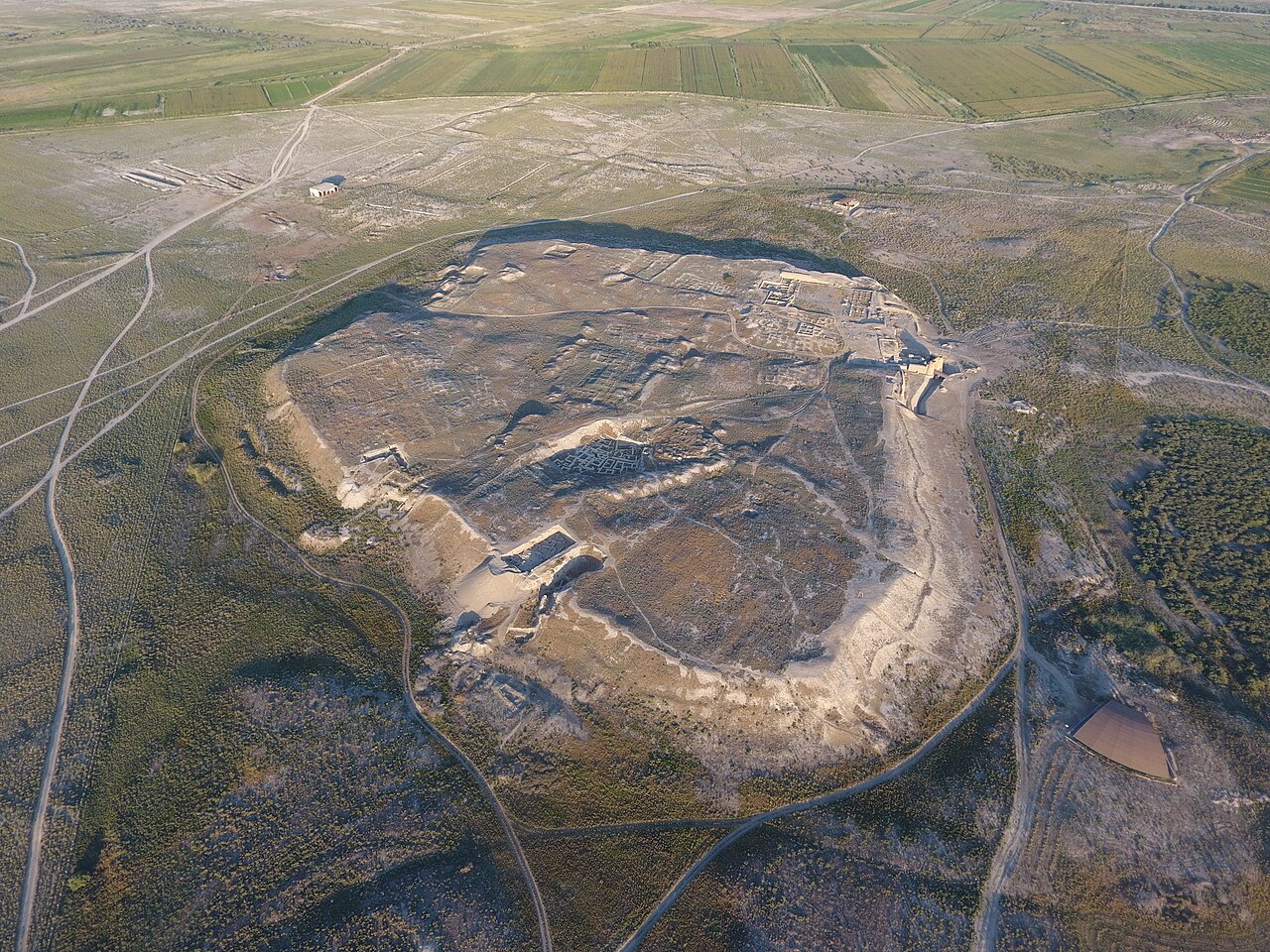
Otrar stood near the point where the Arys river joins the Syr Darya, at the edge of the settled world. It controlled one of the routes by which caravans came from the steppe and Mongolia into Transoxiana, and its ruins, a great mound called Otrar-tobe, can still be seen in southern Kazakhstan. In 1218 it belonged to the Khwarazmian Empire, which under Ala al-Din Muhammad II stretched from the Syr Darya to western Iran (see the page on Ala al-Din Muhammad II).
Its governor, Inalchuq, held the title Ghayir Khan. He was a relative of the shah’s mother, Terken Khatun, whose Qipchaq kinsmen formed the core of the army and who often acted independently of her son. That family link matters, because it helps explain why a provincial governor could act as boldly as he did.
Envoys before the caravan
The two powers had only just come into contact. According to Juzjani, the shah sent an embassy led by Baha al-Din Razi to Genghis Khan in northern China around 1215, after the Mongols had taken the Jin capital near modern Beijing. Genghis replied with an embassy of his own, led by three Muslim merchants from Central Asia: Mahmud Yalavach of Khwarazm, Ali Khwaja of Bukhara and Yusuf Kanka of Otrar. They met the shah at Bukhara in 1218 with gifts and a letter proposing peace and trade.
The letter called the shah the khan’s “son”. In the language of steppe diplomacy this could mean that he was expected to accept a junior place, and Nasawi, the shah’s later court secretary, says Muhammad was angered by it. He questioned Mahmud Yalavach privately about Genghis’s strength, was reassured, and agreed to a treaty.
What happened at Otrar
Soon afterwards a much larger caravan reached Otrar. Juvayni, writing in Mongol service a generation later, says it numbered 450 Muslims, and that Genghis’s family and commanders had each sent agents with capital to trade on their behalf. They brought gold, silver, Chinese silks and furs. Nasawi names four of the leading merchants.
Inalchuq arrested them as spies, seized the goods and, with the shah’s consent, had them killed. Sources differ on his motives. Juvayni suggests greed, and adds that one of the merchants, an old acquaintance, addressed him by his plain name instead of his title. Ibn al-Athir, writing in Mosul, places more of the responsibility on the shah himself. According to Juvayni a single man, a camel driver, escaped and carried the news back to the Mongols.
The second outrage
Genghis Khan did not go to war at once. He sent envoys to demand that Inalchuq be handed over for punishment. Their leader was a Muslim, Ibn Kafraj Bughra, whose father had served the shah’s father Tekish, and he was accompanied by two Mongols. Muhammad had Ibn Kafraj Bughra executed and the beards of his companions shaved off before sending them back. Killing an envoy was, in Mongol eyes, an unforgivable crime. Juvayni says that when the news arrived Genghis went up a mountain alone, bareheaded, and prayed for three days before deciding on war.
Spies, merchants or both?
Inalchuq’s charge may not have been entirely invented. Genghis Khan relied on Muslim merchants for information about the lands to the west, and his embassy had included men who knew the region intimately. Historians generally accept that the caravan could have carried informers as well as traders. The point is that it also carried a great deal of Mongol aristocratic money under an agreement the shah had just accepted.
Several weaknesses of the Khwarazmian state came together at Otrar. The shah had recently quarrelled with the caliph in Baghdad, had overrun the Qara Khitai and the Ghurid lands, and seems to have underestimated a power he knew mostly by report. Terken Khatun’s faction protected its own men. Whether Muhammad ordered the killing or merely approved it after the fact, he chose to stand by his governor and then to kill an ambassador, which left no room for a settlement.
Some modern writers argue that a Mongol attack would have come sooner or later anyway, given the expansion of Genghis’s empire and the value of Central Asian trade. That cannot be proved either way. The medieval sources, both Mongol-friendly and Khwarazmian, agree on one thing: the immediate cause of the war was Otrar.
Otrar pays the price
When the Mongols invaded in 1219, Otrar was among the first places attacked. Genghis’s sons Chagatai and Ögedei besieged it while their father moved on Bukhara. Inalchuq knew he could expect no mercy and held out for about five months, until a commander named Qaracha went over to the Mongols with part of the garrison. The Mongols executed Qaracha for his disloyalty to his own master. Inalchuq retreated into the citadel with his last troops and fought on for roughly another month.
He was finally taken alive and sent to Genghis Khan, who had him put to death. Popular accounts add that molten silver was poured into his eyes and ears to repay his greed; that detail is best treated as legend. The wider campaign, from Bukhara and Samarkand to the flight and death of the shah, is told on the page on Genghis Khan’s invasion of Iran.
Otrar was rebuilt and remained a town of some importance. Timur died there in February 1405, at the start of a campaign against China.
- c. 1215 Khwarazmian embassy of Baha al-Din Razi to Genghis Khan
- 1218 Mongol embassy received at Bukhara; treaty of peace and trade
- 1218 Caravan of about 450 men killed at Otrar
- 1218–1219 Envoy Ibn Kafraj Bughra executed
- 1219 Mongol army reaches Otrar; siege begins
- 1220 Otrar falls; Inalchuq executed
Persian words from this page
| اترار | Otrâr | Otrar |
| چنگیز خان | Changiz Khân | Genghis Khan |
| کاروان | kârvân | caravan |
| بازرگان | bâzargân | merchant |
| سفیر | safir | ambassador, envoy |
| جاسوس | jâsus | spy |
The shah’s son, who fought on after the empire collapsed, has his own page: Jalal al-Din Mingburnu.
Sources and further reading
- Ata-Malik Juvayni, Tarikh-i Jahangushay, translated by J. A. Boyle as The History of the World-Conqueror.
- Shihab al-Din Muhammad al-Nasawi, Sirat al-Sultan Jalal al-Din Mankubirni.
- Ibn al-Athir, al-Kamil fi’l-Tarikh, years 616–617 AH.
- Minhaj al-Siraj Juzjani, Tabaqat-i Nasiri, translated by H. G. Raverty.
- W. Barthold, Turkestan down to the Mongol Invasion.
- Encyclopaedia Iranica, “Otrār”.
Want to learn Persian? Get the free Starter Pack
Get the 14-page printable Starter Pack (all 32 letters, a 7-day reading plan, 100 core words and 20 survival phrases) and a short 5-email course. Free.
More in Ghaznavids, Seljuks and Khwarazmshahs (977–1231)
- The Ghaznavid Empire
- Mahmud of Ghazni
- The Rise of the Seljuks
- The Battle of Dandanaqan (1040)
- Tughril Beg Enters Baghdad
- Alp Arslan
- Seljuk Architecture: Tomb Towers and Caravanserais
- The Battle of Manzikert (1071)
- Malik Shah I
- The Seljuks of Kerman
- Nizam al-Mulk and the Siyasatnama
- The Seljuk Domes of Isfahan’s Jameh Mosque
- Omar Khayyam: Poet and Scientist
- Al-Ghazali
- Sana’i of Ghazni
- Hassan-i Sabbah and the Fortress of Alamut
- The Nizari Ismailis and the “Assassins” Legend
- Sultan Sanjar and the Qara Khitai
- The Battle of Qatwan (1141)
- Anvari and Seljuk Court Poetry
- Seljuk Decline and the Atabegs
- The Ghurids
- Attar of Nishapur
- Nizami Ganjavi
- The Khwarazmian Empire
- Ala al-Din Muhammad II
- The Otrar Incident (1218): How Khwarazm Provoked Genghis Khan
- Jalal al-Din Mingburnu