The Jameh Mosque of Isfahan (مسجد جامع اصفهان) is the city’s old Friday mosque, in the historic centre about two kilometres north-east of Naqsh-e Jahan Square. Begun in the 8th century and rebuilt and added to by almost every dynasty that ruled Isfahan until the 18th, it is a walk through a thousand years of Iranian architecture in one building. UNESCO listed it as a World Heritage Site in 2012.
| Persian name | Masjed-e Jâme’-e Esfahân, also Masjed-e Atiq (“the old mosque”) |
|---|---|
| Founded | 8th century; main surviving work from the 10th to 18th centuries |
| Key dates | South dome 1086–87; north dome 1088–89; four-iwan court 12th century; Oljeitu mihrab 1310 |
| Area | About 2 hectares, one of the largest mosques in Iran |
| UNESCO | Masjed-e Jāmé of Isfahan, inscribed 2012 |
The mosque’s Seljuk heart, the two great domes and the four-iwan plan, has its own history page: The Seljuk Domes of Isfahan’s Jameh Mosque. This page is a guide to the whole complex as you see it, layer by layer.

How to read the building
The Jameh Mosque is not one design. It is a large courtyard with a shabestân, a forest of brick piers and small domes, wrapped around it on all sides. Over the centuries, rulers knocked through, rebuilt, added halls and refaced walls, but rarely cleared away what was there before. The result can be confusing at first, so it helps to look for five layers:
- 8th–10th centuries An early Arab-style mosque of columns around a courtyard, rebuilt larger under the Abbasids and the Buyids. Little of it shows today, but excavations have found its foundations and some early brick columns survive inside later halls.
- 1086–1089 The Seljuk vizier Nizam al-Mulk builds the great south dome in front of the mihrab; his rival Taj al-Mulk builds the smaller north dome, the Gonbad-e Khaki.
- 12th century After a fire, the courtyard is rebuilt with four iwans, a plan that became the model for Iranian mosques.
- 1310 The Ilkhan Oljeitu adds a carved stucco mihrab in a hall on the west side.
- 15th–18th centuries Timurid and Turkmen rulers add a winter prayer hall; the Safavids reface the courtyard iwans in tile.
The courtyard and the four iwans
Start in the courtyard. Each side has a tall iwan, and each is different. The south iwan, leading to the Nizam al-Mulk dome, has a towering muqarnas vault and a pair of minarets added later. The west iwan, sometimes called the master’s iwan, is faced in Safavid tile. The east and north iwans show more of the plain Seljuk brick underneath. Around the courtyard runs a two-storey arcade with Safavid tiling. Unlike the Shah Mosque, which was built and tiled in one campaign, here you can see the joins between periods, sometimes within a single wall.
The brick halls
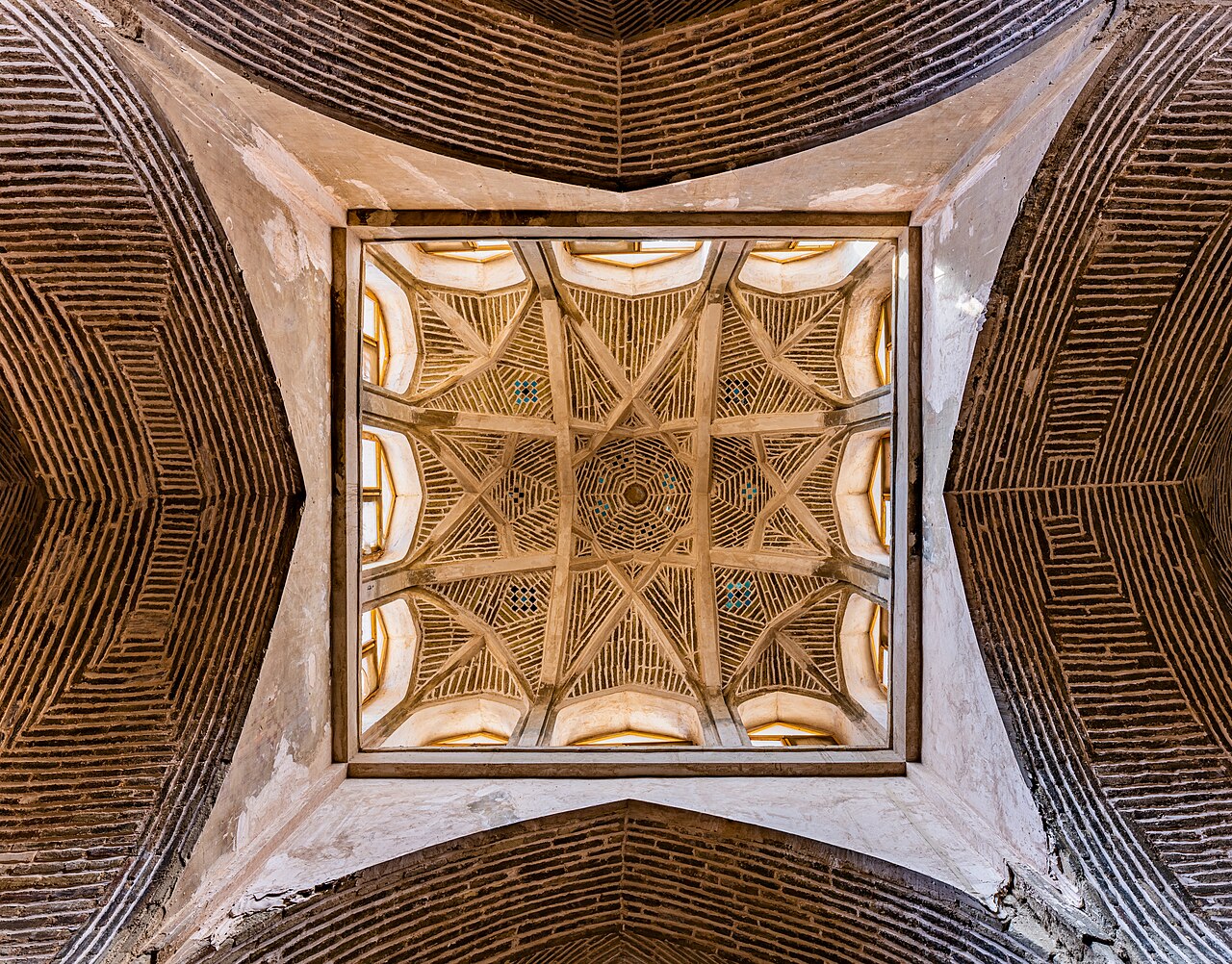
The most memorable part for many visitors is not the courtyard but the prayer halls behind it. Walk into the hypostyle halls on the east and west, and you are under dozens of small brick domes, each resting on four piers and each laid in a different pattern: spirals, stars, ribs, interlaced bands. Built mostly in the Seljuk and later periods, they are a catalogue of what Iranian builders could do with plain fired brick. Light comes in from small openings at the top of some domes, and the effect is quiet and cool.
The two Seljuk domes
The south dome over the main mihrab, built for Nizam al-Mulk, is one of the earliest great domes of Iran. Inside, look at how the square chamber turns into the round dome through deep corner niches (squinches), a problem Iranian builders had been working on since the Sasanian period.
The north dome, the Gonbad-e Khaki, is smaller but has long been admired as one of the most perfectly proportioned brick domes in the Islamic world. Its interior is a pattern of interlaced ribs forming a five-pointed star. The design, the people who built the domes and the rivalry between the two viziers are covered on the Seljuk history page; see also Nizam al-Mulk.
The Oljeitu mihrab and the winter hall
In a hall off the west iwan stands the mihrab added in 1310 for the Mongol ruler Oljeitu, a convert to Islam (see Oljeitu and Soltaniyeh). It is carved in stucco, deep and lacy, with floral scrolls and inscriptions layered over each other. It is one of the finest works of Ilkhanid stucco carving anywhere.
Nearby is the winter prayer hall (beyt al-shetâ) of the 15th century, a long, low space of heavy piers and arches. It was lit by thin slabs of translucent alabaster set in the roof, which give a soft yellowish light.
Visiting
- Getting there: the most interesting route from Naqsh-e Jahan Square is on foot through the Grand Bazaar, about two kilometres, entering at the Qeysariyeh gate. The mosque stands by the old square (Meydan-e Atiq or Meydan-e Kohne), the commercial centre of Isfahan before the Safavids.
- Time: allow at least an hour and a half. The halls are large and it is easy to miss the domes and the mihrab without a plan or a guide.
- Light: morning light suits the courtyard; the brick halls look good at any time of day and are cool in summer.
- It is a working mosque. Dress modestly, and expect some areas to close at prayer times. Opening hours and tickets change; check current information locally.
Some lists of sites damaged in the March 2026 strikes on Isfahan included the Jameh Mosque, though early reports concentrated on the buildings around Naqsh-e Jahan Square. Check current information, and your own government’s travel advice, before you go. For the rest of the city, see our Isfahan city guide.
Persian words from this page
| مسجد جامع | masjed-e jâme’ | Friday (congregational) mosque |
| شبستان | shabestân | covered prayer hall |
| گنبد خاکی | Gonbad-e Khâki | “the earthen dome”, the north dome |
| آجر | âjor | fired brick |
| ایوان | eyvân | iwan |
| عتیق | atiq | old, ancient |
Sources and further reading
- UNESCO World Heritage Centre, Masjed-e Jāmé of Isfahan.
- Oleg Grabar, The Great Mosque of Isfahan (New York University Press, 1990).
- Encyclopaedia Iranica, “Isfahan: Monuments” (the Masjed-e Jāmeʿ).
- Robert Hillenbrand, Islamic Architecture: Form, Function and Meaning (Edinburgh University Press, 1994).
Want to learn Persian? Get the free Starter Pack
Get the 14-page printable Starter Pack (all 32 letters, a 7-day reading plan, 100 core words and 20 survival phrases) and a short 5-email course. Free.
More in Top Places to Visit in Iran
- Naqsh-e Jahan Square
- Shah (Imam) Mosque, Isfahan
- Sheikh Lotfollah Mosque
- Ali Qapu Palace
- Jameh Mosque of Isfahan
- Si-o-se Pol and Khaju Bridge
- Vank Cathedral
- Hasht Behesht Palace
- Naqsh-e Rostam
- Eram Garden, Shiraz
- Nasir al-Molk (Pink) Mosque
- Tomb of Hafez (Hafezieh)
- Tomb of Saadi (Saadieh)
- Shah Cheragh Shrine
- Arg of Karim Khan
- Fin Garden, Kashan
- Historic Houses of Kashan
- Jameh Mosque of Yazd
- Yazd Fire Temple and Towers of Silence
- Dowlatabad Garden and Windcatcher
- Amir Chakhmaq Complex
- Golestan Palace
- National Museum of Iran
- Treasury of National Jewels
- Tehran Grand Bazaar
- Milad Tower
- Imam Reza Shrine, Mashhad
- Tomb of Ferdowsi, Tus
- Tomb of Omar Khayyam, Neyshabur
- Tomb of Avicenna, Hamadan
- Ganjnameh Inscriptions, Hamadan
- Behistun (Bisotun): Visiting the Site
- Taq-e Bostan: Visiting the Site
- Tabriz Historic Bazaar
- Takht-e Soleyman
- Armenian Monastic Ensembles of Iran
- Sheikh Safi al-Din Shrine, Ardabil
- Dome of Soltaniyeh
- Alamut Castle
- Falak-ol-Aflak Castle
- Shushtar Historical Hydraulic System
- Chogha Zanbil: Visiting the Ziggurat
- Susa Archaeological Site
- Arg-e Bam
- Ganjali Khan Complex, Kerman
- Shazdeh Garden, Mahan
- Rayen Castle
- Dasht-e Lut (Lut Desert)
- Maranjab Desert and Caravanserai
- Varzaneh Desert
- Mount Damavand
- Hyrcanian Forests
- Lake Urmia
- Badab-e Surt Springs
- Ali Sadr Cave
- The Kaluts of Shahdad
- Qeshm Geopark
- Hormuz Island Colours
- Visiting Persepolis: A Day Trip from Shiraz
- Visiting Pasargadae
- Persian Caravanserais
- The Qanat of Gonabad
- Meymand Village
- Sasanian Sites of Fars: Firuzabad, Bishapur and Sarvestan
- Gonbad-e Qabus: Visiting the Tower
- Zayandeh Rud and Isfahan’s Bridges
- Tochal and Darband: Hiking Above Tehran
- Mount Sabalan
- Skiing in Iran: Dizin and Shemshak
- Golestan National Park