Zanjan is the capital of Zanjan province in north-western Iran, a city of about 430,000 people on the main road and railway between Tehran and Tabriz. It is best known in Iran for its hand-made knives and silver filigree, for the Saltmen, ancient bodies preserved in a nearby salt mine, and as the base for visiting the Dome of Soltaniyeh, the giant Mongol-era mausoleum 40 km away.
| Persian name | زنجان (Zanjân) |
|---|---|
| Province | Zanjan (capital) |
| Population | 430,871 (city, 2016 census, Statistical Centre of Iran) |
| Elevation | About 1,650 m |
| Climate | Warm, dry summers; cold winters with snow |
| Main language | Azerbaijani Turkish, with Persian |
| UNESCO site nearby | Soltaniyeh (2005) |
| Distance | About 330 km north-west of Tehran; about 290 km south-east of Tabriz |
A town on the high road
Zanjan lies in the valley of the Zanjan river, on the natural route from the central plateau to Azerbaijan. Medieval geographers describe it as a modest town on this road. Its fortunes rose and fell with its neighbours: it was overshadowed in the fourteenth century by the new Mongol capital at Soltaniyeh, and later by Qazvin and Tabriz. In the nineteenth century it was a prosperous Qajar market town, and most of its historic bazaar and houses date from this period.
The siege of 1850 and 1851
Zanjan was the scene of one of the major Babi uprisings. In 1850 the followers of the Babi preacher Mulla Mohammad Ali Zanjani, known as Hujjat, held a fortified quarter of the city for months against government troops. The siege ended early in 1851 with Hujjat’s death and the killing of many of his followers. Accounts by Babi and Baha’i writers and by Qajar chroniclers differ on the numbers involved.
The Saltmen of Chehrabad
In 1993 miners at the Chehrabad salt mine, west of Zanjan, found a body preserved by the salt, with long hair, a beard, a leather boot and iron knives. More remains were found over the following years, bringing the total to at least six individuals. Radiocarbon dating and the objects found with them showed that the miners had lived at different times, from the Achaemenid period to the Sasanian, and some appear to have died when tunnels collapsed. The Saltmen are among the best-preserved ancient human remains from Iran. Several are displayed in Zanjan, in the archaeology museum in the Qajar Zolfaghari House, and one is in the National Museum of Iran in Tehran.

The Rakhtshuy-khaneh
The building Zanjanis are proudest of is a laundry. The رختشویخانه (rakhtshuy-khâneh), “clothes-washing house”, was built in the early twentieth century by two local brothers, an architect and a stonemason, so that the women of the city could wash clothes in warm, clean water indoors instead of in the river in winter. It has a domed brick hall with stone pools, channels that brought water in and drained it away, and a system to warm it. Today it is the Zanjan anthropology museum, with life-size figures of women at work and displays on traditional life.
Knives, filigree and shoes
Zanjan’s crafts are its trademark, and the bazaar, a long brick Qajar arcade, is the place to see them.
- Knives. چاقو (châghu) making has been the city’s specialist trade for generations. Workshops make folding pocket knives, kitchen knives and decorative blades with carved horn and wood handles, and a Zanjan knife is a standard souvenir across Iran.
- Malileh. ملیله (malileh) is silver filigree: fine silver wire twisted and soldered into bowls, trays, jewellery and frames.
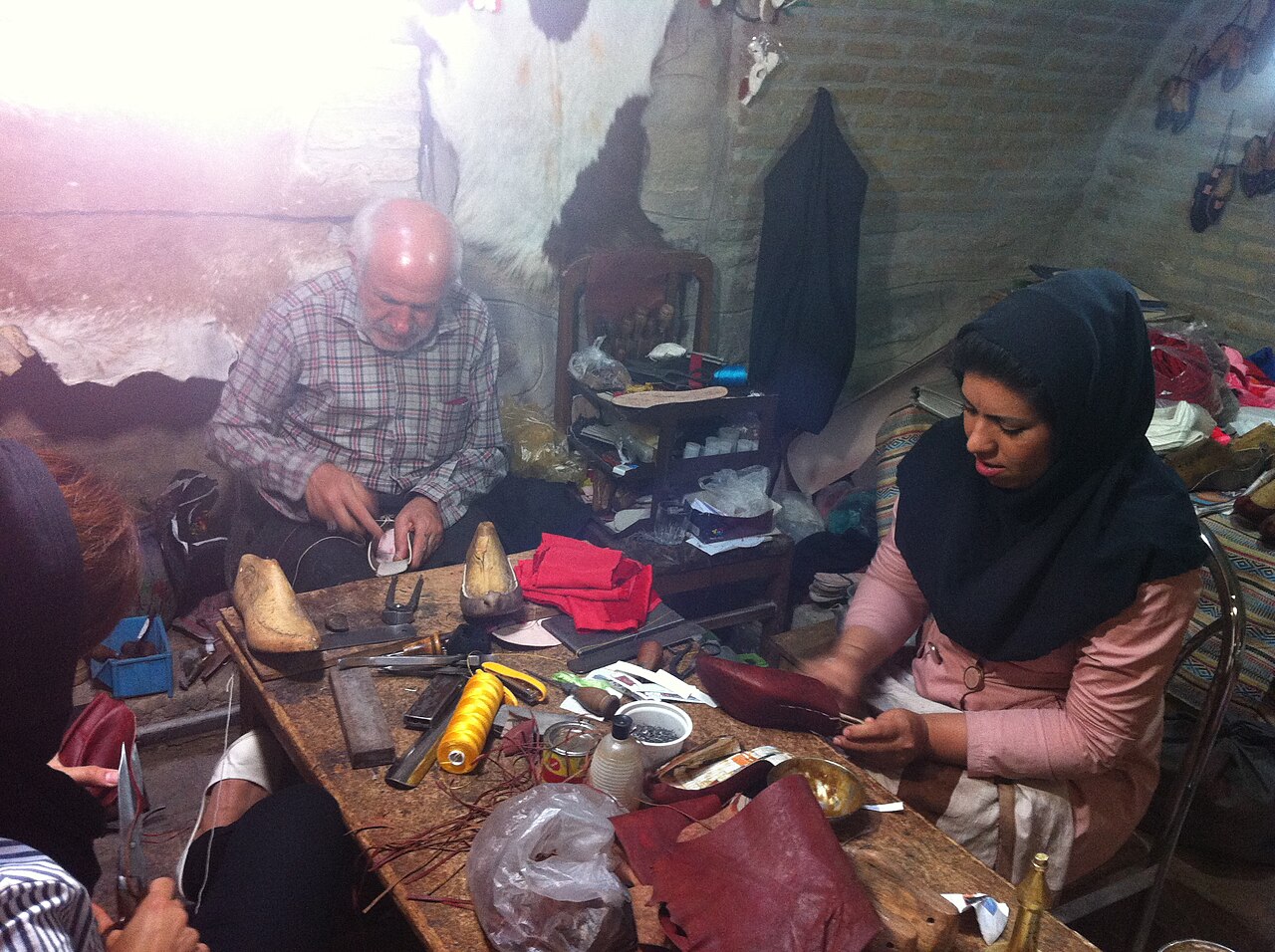
- Charoq. Charoq are soft, hand-stitched leather slippers with a pointed toe, still made in a few workshops.
More on Iranian crafts is on the page about Iranian handicrafts.
Zanjan today
Modern Zanjan is a university and industrial city. The province holds some of Iran’s main lead and zinc deposits, including the Angouran mine, and the city has smelting and processing plants on its outskirts. Its universities, including the Institute for Advanced Studies in Basic Sciences, draw students from across the north-west. Most people speak Azerbaijani Turkish at home, and the city shares much of its food and music with Tabriz. Muharram is observed with particular intensity here, and the processions of the ninth and tenth days, Tasua and Ashura, are among the largest in the region.
Soltaniyeh
About 40 km south-east of Zanjan stands the Dome of Soltaniyeh, the mausoleum of the Ilkhanid ruler Öljaitü, built between 1302 and 1312 when he made Soltaniyeh his capital. Its double-shelled dome, about 50 m high, is one of the largest brick domes in the world, and the interior keeps two layers of decoration, the first glazed tile and brick and the second painted plaster. Little remains of the city around it. UNESCO listed the site in 2005. See visiting the Dome of Soltaniyeh and Öljaitü and the Dome of Soltaniyeh for its history.
Other trips from Zanjan
- Katale Khor cave, a limestone cave with stalactites, south of the city near Garmab.
- Takht-e Soleyman, the Sasanian fire-temple sanctuary around a crater lake, reached from Zanjan by a mountain road through Dandi.
- Gavazang, a valley on the edge of the city with a lake and park popular with families.
Getting there
Zanjan is on the Tehran to Tabriz motorway and railway, and many travellers break the journey here. Soltaniyeh is easily visited as a half-day trip by taxi. Summers are pleasant, and winter nights are cold. For opening hours, transport and safety, check current official information and your own government’s travel advice. Nearby cities on the same route are Qazvin to the south-east and Tabriz to the north-west.
Persian words from this page
| زنجان | Zanjân | Zanjan |
| سلطانیه | Soltâniyeh | Soltaniyeh, “the royal (city)” |
| چاقو | châghu | knife |
| ملیله | malileh | silver filigree |
| رخت | rakht | clothes |
| نمک | namak | salt |
| گنبد | gonbad | dome |
Sources and further reading
- UNESCO World Heritage List, Soltaniyeh (whc.unesco.org/en/list/1188).
- Thomas Stöllner, Abolfazl Aali and others, publications of the Chehrabad Salt Mine project (Deutsches Bergbau-Museum Bochum and Zanjan cultural heritage office).
- Encyclopaedia Iranica, “Zanjān” and “Bābism”.
- Sheila Blair, “The Mongol Capital of Sulṭāniyya, ‘The Imperial'”, Iran 24 (1986).
- Statistical Centre of Iran, General Population and Housing Census 2016 (1395).
Want to learn Persian? Get the free Starter Pack
Get the 14-page printable Starter Pack (all 32 letters, a 7-day reading plan, 100 core words and 20 survival phrases) and a short 5-email course. Free.
More in Cities of Iran
- Tehran: Iran’s Capital
- Mashhad
- Isfahan
- Shiraz
- Tabriz
- Yazd
- Kashan
- Kerman
- Hamadan
- Qom
- Ahvaz
- Rasht
- Kermanshah
- Urmia
- Ardabil
- Zanjan
- Qazvin
- Sanandaj
- Khorramabad
- Bandar Abbas
- Bushehr
- Zahedan
- Birjand
- Gorgan
- Sari
- Semnan
- Arak
- Ilam
- Yasuj
- Shahr-e Kord
- Bojnurd
- Karaj
- Abadan and Khorramshahr
- Kish Island
- Qeshm Island
- Hormuz Island
- Masuleh
- Abyaneh
- Kandovan
- Bam
- Neyshabur (Nishapur)
- Shush (Susa) Today