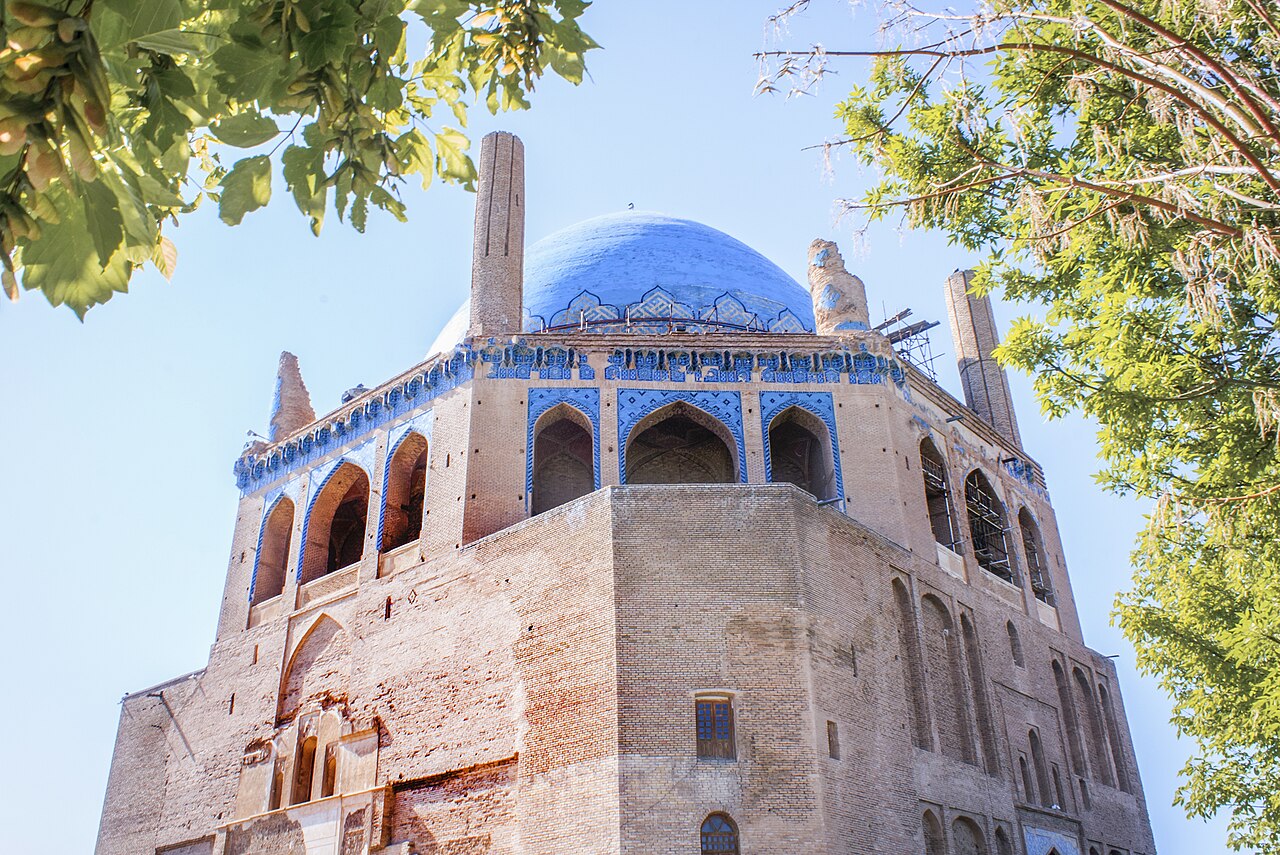
The Dome of Soltaniyeh is the mausoleum of the Mongol ruler Öljaitü, built c. 1307–1313 at his new capital of Soltaniyeh, about 40 km south-east of Zanjan. Its double-shelled brick dome, some 25 metres across and about 50 metres high, is one of the largest brick domes ever built, and the building has been a UNESCO World Heritage Site since 2005.
| Persian name | گنبد سلطانیه (Gonbad-e Soltâniye) |
|---|---|
| Built | c. 1307–1313, for the Ilkhan Öljaitü (r. 1304–1316) |
| Dome | About 25 m in diameter, about 50 m high, double shell |
| Location | Soltaniyeh, Zanjan province, on the plain beside the Tehran–Tabriz road |
| UNESCO | World Heritage List, 2005 |

A capital that disappeared around its tomb
Soltaniyeh, “the imperial”, was founded on a high summer pasture that the Mongol rulers already used for their camps. Öljaitü made it his capital, and for a few decades it was one of the largest cities in western Asia, with palaces, markets and the houses of officials and merchants. After the Ilkhanate broke up in the 1330s the city declined, and today only the mausoleum, a few later tombs and the outline of the citadel walls are left on the plain beside a small modern town. The reign and the politics behind the building are covered on our page on Öljaitü and the Dome of Soltaniyeh.
The ruler who built it went through several religious phases, from Christian baptism as a child to Sunni Islam and finally Twelver Shi’ism. A well-known story says he meant the tomb to receive the remains of Ali and Husayn from Iraq, then changed his mind and chose it for himself. Historians treat this as possible but not proven. Öljaitü was buried here after his death in 1316.
What to look at
The dome and the octagon
The building is an octagon of fired brick. From a distance the eye goes first to the egg-shaped dome, faced with turquoise glazed tiles, and to the stumps of the eight minarets that once rose from the corners of the roof. Walk around the outside to see the scale: each side of the octagon is a deep arched bay, and the walls are thick enough to carry the dome without buttresses. The dome has two shells, an inner and an outer, tied together by brick ribs. This double structure saved weight and allowed the great height, and art historians often see it as a forerunner of later Timurid and Safavid domes in Samarkand and Isfahan.
The upper gallery
If it is open, climb the stairs inside the walls to the gallery that runs around the outside of the building below the dome. Its vaults are covered with patterns in cut and carved brick, painted plaster and tile, in dozens of different geometric designs. This is where you can get closest to the decoration and see how the builders combined plain brick with colour. The gallery also gives the best views over the plain and the remains of the old city.
Two layers of decoration
Inside, the main hall rises the full height of the dome. Look closely and you will see two decorative schemes. The first used patterned brick and glazed tile. Within a few years, still in Öljaitü’s reign, much of it was covered with a coat of plaster painted with geometric and inscription panels. Restorers have uncovered parts of both layers, so in some bays you can see the older tile work showing through the later paint. The meaning of the change is debated; some scholars connect it with the ruler’s religious change, others with simple changes in taste.
Scaffolding
Restoration has gone on for decades, and much of the interior has been filled with scaffolding for long periods. Visitors are sometimes disappointed by this, but the scaffolding is part of the building’s recent history, and it often still allows a good view of the dome from below.
Nearby
A short distance from the mausoleum are two smaller monuments of the town’s later life: the tomb of Mullah Hasan Kashi, a 16th-century octagonal tomb with tilework, and the Chalabi Oghlu complex, a 14th-century dervish tomb and lodge. Most visitors come on a half-day trip from Zanjan, or stop on the way between Qazvin and Tabriz.
Practical notes
- Soltaniyeh lies just off the old Tehran–Tabriz road. Taxis and tours run from Zanjan; the drive takes well under an hour.
- The plain is high and windy. Bring a jacket outside summer.
- Opening hours, access to the gallery and tickets vary, so check current official information before you go.
Persian words from this page
| سلطانیه | Soltâniye | Soltaniyeh (“the imperial”) |
| گنبد | gonbad | dome |
| الجایتو | Oljâytu | Öljaitü |
| مناره | menâre | minaret |
| کاشی | kâshi | glazed tile |
| زنجان | Zanjân | Zanjan |
Sources and further reading
- UNESCO World Heritage Centre, Soltaniyeh.
- Sheila S. Blair, “The Epigraphic Program of the Tomb of Uljaytu at Sultaniyya: Meaning in Mongol Architecture”, Islamic Art 2 (1987).
- Sheila S. Blair and Jonathan M. Bloom, The Art and Architecture of Islam 1250–1800 (Yale, 1994).
- Linda Komaroff and Stefano Carboni (eds), The Legacy of Genghis Khan: Courtly Art and Culture in Western Asia, 1256–1353 (Metropolitan Museum of Art, 2002).
- Encyclopaedia Iranica, “Solṭāniya”.
Want to learn Persian? Get the free Starter Pack
Get the 14-page printable Starter Pack (all 32 letters, a 7-day reading plan, 100 core words and 20 survival phrases) and a short 5-email course. Free.
More in Top Places to Visit in Iran
- Naqsh-e Jahan Square
- Shah (Imam) Mosque, Isfahan
- Sheikh Lotfollah Mosque
- Ali Qapu Palace
- Jameh Mosque of Isfahan
- Si-o-se Pol and Khaju Bridge
- Vank Cathedral
- Hasht Behesht Palace
- Naqsh-e Rostam
- Eram Garden, Shiraz
- Nasir al-Molk (Pink) Mosque
- Tomb of Hafez (Hafezieh)
- Tomb of Saadi (Saadieh)
- Shah Cheragh Shrine
- Arg of Karim Khan
- Fin Garden, Kashan
- Historic Houses of Kashan
- Jameh Mosque of Yazd
- Yazd Fire Temple and Towers of Silence
- Dowlatabad Garden and Windcatcher
- Amir Chakhmaq Complex
- Golestan Palace
- National Museum of Iran
- Treasury of National Jewels
- Tehran Grand Bazaar
- Milad Tower
- Imam Reza Shrine, Mashhad
- Tomb of Ferdowsi, Tus
- Tomb of Omar Khayyam, Neyshabur
- Tomb of Avicenna, Hamadan
- Ganjnameh Inscriptions, Hamadan
- Behistun (Bisotun): Visiting the Site
- Taq-e Bostan: Visiting the Site
- Tabriz Historic Bazaar
- Takht-e Soleyman
- Armenian Monastic Ensembles of Iran
- Sheikh Safi al-Din Shrine, Ardabil
- Dome of Soltaniyeh
- Alamut Castle
- Falak-ol-Aflak Castle
- Shushtar Historical Hydraulic System
- Chogha Zanbil: Visiting the Ziggurat
- Susa Archaeological Site
- Arg-e Bam
- Ganjali Khan Complex, Kerman
- Shazdeh Garden, Mahan
- Rayen Castle
- Dasht-e Lut (Lut Desert)
- Maranjab Desert and Caravanserai
- Varzaneh Desert
- Mount Damavand
- Hyrcanian Forests
- Lake Urmia
- Badab-e Surt Springs
- Ali Sadr Cave
- The Kaluts of Shahdad
- Qeshm Geopark
- Hormuz Island Colours
- Visiting Persepolis: A Day Trip from Shiraz
- Visiting Pasargadae
- Persian Caravanserais
- The Qanat of Gonabad
- Meymand Village
- Sasanian Sites of Fars: Firuzabad, Bishapur and Sarvestan
- Gonbad-e Qabus: Visiting the Tower
- Zayandeh Rud and Isfahan’s Bridges
- Tochal and Darband: Hiking Above Tehran
- Mount Sabalan
- Skiing in Iran: Dizin and Shemshak
- Golestan National Park