Sana’i of Ghazni (Abu’l-Majd Majdud ibn Adam Sana’i, died c. 1131) was the first major Sufi poet of Persian literature. A court poet of the late Ghaznavids who turned to religious verse, he wrote the Hadiqat al-Haqiqa (“The Walled Garden of Truth”), the first great Persian mystical masnavi, and showed Attar and Rumi how the long rhyming poem and the ghazal could carry Sufi teaching.
| Full name | Hakim Abu’l-Majd Majdud ibn Adam Sana’i Ghaznavi |
|---|---|
| Persian | سنایی غزنوی (Sanâyi Ghaznavi) |
| Lived | Born at Ghazni in the second half of the 11th century; died c. 1131 (some sources give 1141 or later) |
| Patron | The Ghaznavid sultan Bahram Shah (r. 1117–1157) |
| Main works | Hadiqat al-Haqiqa; Sayr al-‘ibad ila’l-ma’ad; a large Divan of qasidas and ghazals |
| Tomb | Ghazni, Afghanistan |
A poet of shrinking Ghazni
Sana’i grew up in Ghazni after the city’s great age. The Ghaznavids had lost Khorasan and western Iran to the Seljuks in 1040 (see the Battle of Dandanaqan) and now ruled the Afghan highlands and the Punjab. From 1117 Sultan Bahram Shah held his throne with the support of the Seljuk sultan Sanjar. The court still wanted Persian poets, and Sana’i began his career writing praise poems for it.
The details of his life are thin and come mostly from his own poems. He spent long years in Khorasan, in Balkh, Sarakhs, Merv and Nishapur, living off the generosity of local patrons, religious scholars and Sufi circles rather than one royal court. There, it seems, his poetry turned from praise of rulers toward preaching, ascetic warning and mystical love. He returned to Ghazni late in life, and the Hadiqa, finished around the time of his death, was dedicated to Bahram Shah.
The drunkard’s rebuke
Later Persian biographers, among them Jami in the fifteenth century, told a famous story about his conversion. Sana’i was following the sultan on a winter campaign to India with a poem in praise of him, and passed a tavern where a drunkard nicknamed Lay-khur, “dreg-drinker”, was calling for wine. The drunkard toasted the blindness of the sultan, who left his own kingdom to conquer another, and then the blindness of Sana’i, who wasted his gifts flattering such a man. The poet, ashamed, gave up court service.
Modern scholars treat this as a legend. It does not fit what Sana’i’s own poems say about his slow change of direction, and he continued to address rulers to the end. The story is still worth knowing, because it shows how later readers saw him: as the poet who turned Persian verse from the court to the soul.
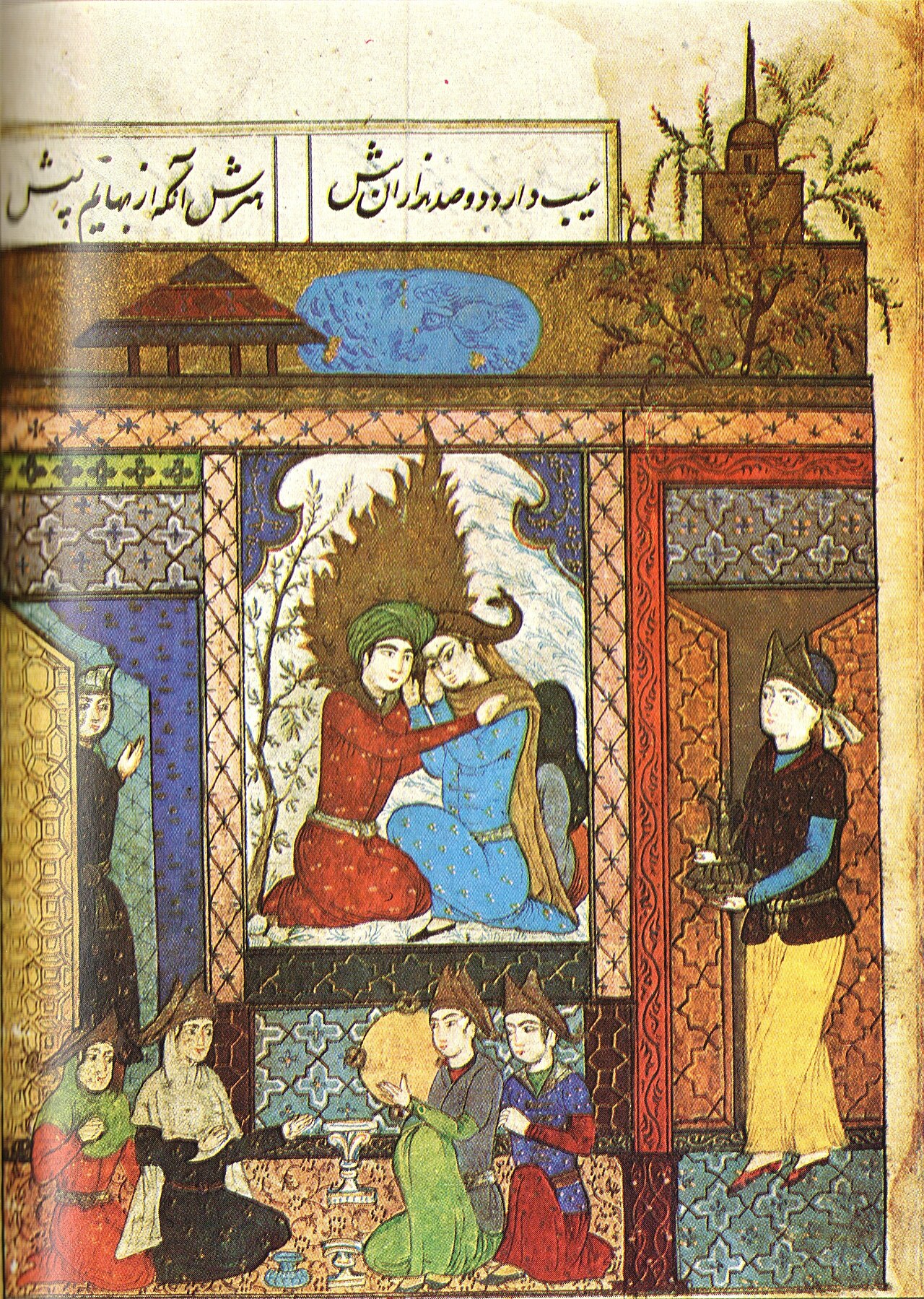

The Walled Garden of Truth
The Hadiqat al-Haqiqa wa Shari’at al-Tariqa, also called the Fakhri-nama, is a long didactic poem of around 10,000 couplets, in rhyming couplets (masnavi) in the khafif metre. It moves through praise of God and the Prophet, reason, knowledge, love and the soul’s detachment from the world, with ethical advice and satire on hypocrites, and ends with praise of the sultan. It is loosely organised, more a garden of sermons and anecdotes than a single story.
Many of its anecdotes became part of the shared stock of Sufi teaching. The best known is the elephant brought to a city of the blind: each person touches one part, the ear, the trunk or the leg, and describes the whole animal by it. For Sana’i it shows how human beings grasp only fragments of God. Rumi retold the parable in the Masnavi, set in a dark room instead of a city of the blind.
Other works
Sayr al-‘ibad ila’l-ma’ad (“The Journey of God’s Servants to the Place of Return”) is a shorter allegorical poem about the soul’s journey through the levels of creation, guided by an old man, and has often been compared to Dante. The Divan holds qasidas, many of them sombre sermons, and ghazals, including the qalandariyat, poems that praise the tavern and the wandering qalandar dervish as images of freedom from religious hypocrisy. This daring imagery became a standard part of the Persian ghazal, from Attar to Hafez.
“The two eyes”
Sana’i’s influence on later mystical poetry is hard to overstate. Attar’s Conference of the Birds and Rumi’s Masnavi belong to the tradition of the didactic Sufi masnavi that the Hadiqa began, and both poets acknowledged him. A verse often attributed to Rumi says that Attar was the spirit and Sana’i its two eyes, and that he himself came after them both. Through these heirs the questions Sana’i asked about reason and love, outward law and inner truth, stayed at the centre of Persian poetry for centuries.
His style can be hard. The Hadiqa is dense with Arabic learning and allusions, and its loose structure frustrated some later readers. In the twentieth century the Dutch scholar J. T. P. de Bruijn reconstructed much of his biography from the Divan, and his work remains the starting point for anyone studying the poet in English.
Persian words from this page
| حدیقه | hadiqe | walled garden |
| حقیقت | haqiqat | truth |
| غزنین | Ghaznin | Ghazni |
| عرفان | ‘erfân | mysticism |
| قلندر | qalandar | wandering dervish |
| پیل | pil | elephant (poetic; everyday Persian فیل fil) |
Read next: Attar of Nishapur, Rumi, and the very different court poetry of Sana’i’s Seljuk contemporaries on the page on Anvari and Seljuk court poetry.
Sources and further reading
- J. T. P. de Bruijn, Of Piety and Poetry: The Interaction of Religion and Literature in the Life and Works of Hakim Sana’i of Ghazna (Brill, 1983).
- J. Stephenson (trans.), The First Book of the Hadiqatu’l-Haqiqat or The Enclosed Garden of the Truth (1910).
- Jami, Nafahat al-Uns, entry on Sana’i.
- J. Rypka, History of Iranian Literature (Reidel, 1968).
- C. E. Bosworth, The Later Ghaznavids: Splendour and Decay (1977).
Want to learn Persian? Get the free Starter Pack
Get the 14-page printable Starter Pack (all 32 letters, a 7-day reading plan, 100 core words and 20 survival phrases) and a short 5-email course. Free.
More in Ghaznavids, Seljuks and Khwarazmshahs (977–1231)
- The Ghaznavid Empire
- Mahmud of Ghazni
- The Rise of the Seljuks
- The Battle of Dandanaqan (1040)
- Tughril Beg Enters Baghdad
- Alp Arslan
- Seljuk Architecture: Tomb Towers and Caravanserais
- The Battle of Manzikert (1071)
- Malik Shah I
- The Seljuks of Kerman
- Nizam al-Mulk and the Siyasatnama
- The Seljuk Domes of Isfahan’s Jameh Mosque
- Omar Khayyam: Poet and Scientist
- Al-Ghazali
- Sana’i of Ghazni
- Hassan-i Sabbah and the Fortress of Alamut
- The Nizari Ismailis and the “Assassins” Legend
- Sultan Sanjar and the Qara Khitai
- The Battle of Qatwan (1141)
- Anvari and Seljuk Court Poetry
- Seljuk Decline and the Atabegs
- The Ghurids
- Attar of Nishapur
- Nizami Ganjavi
- The Khwarazmian Empire
- Ala al-Din Muhammad II
- The Otrar Incident (1218): How Khwarazm Provoked Genghis Khan
- Jalal al-Din Mingburnu