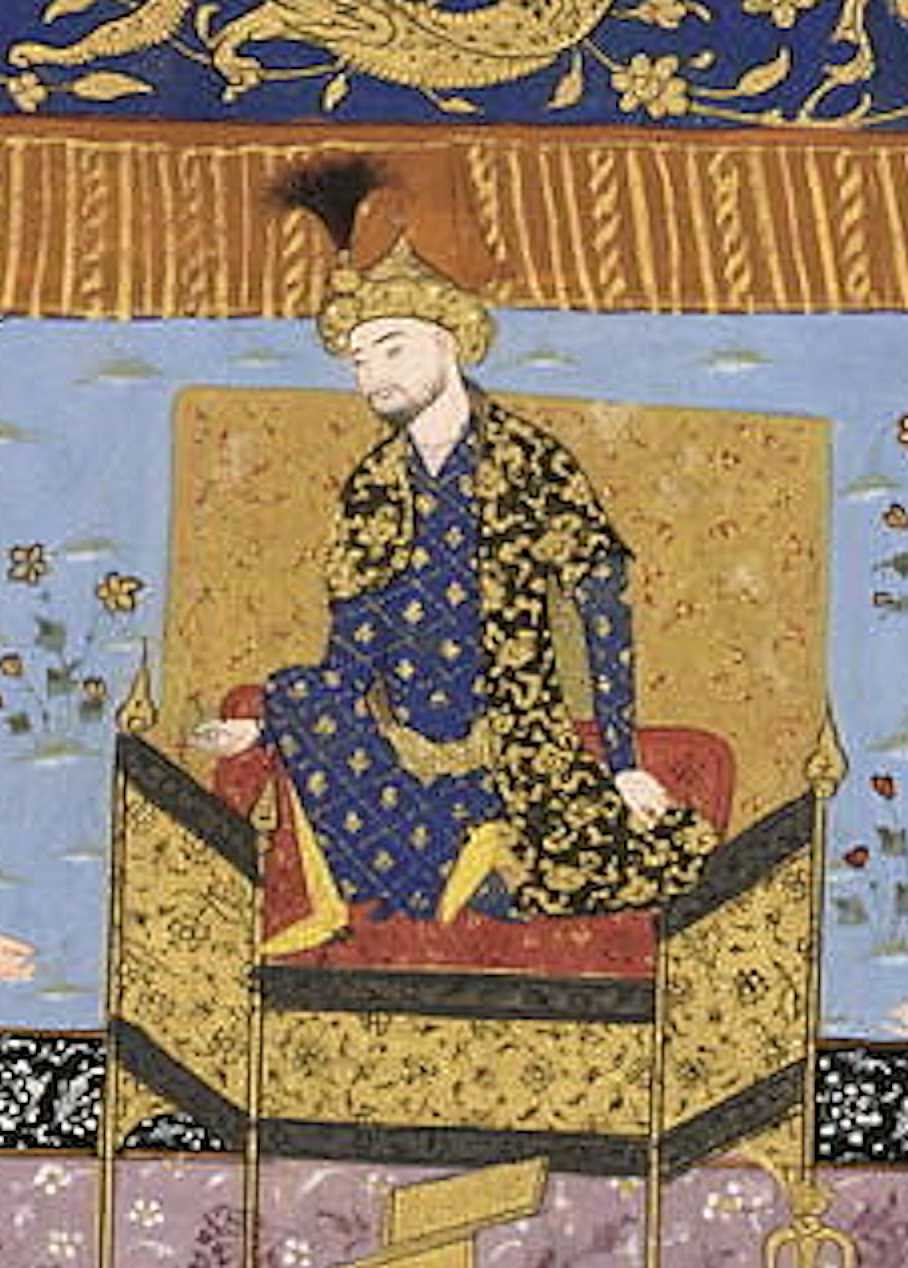
Shah Ismail I (1487–1524) founded the Safavid dynasty. Crowned in Tabriz in 1501 when he was about fourteen, he conquered most of the Iranian plateau within a decade and made Twelver Shi’ism the religion of his state, two decisions that still shape the borders and identity of modern Iran.
| Born | 17 July 1487, Ardabil |
|---|---|
| Reigned | 1501–1524 |
| Father | Sheikh Haydar, head of the Safaviyya Sufi order |
| Mother | Halima Begum (also called Alamshah), daughter of the Aq Qoyunlu ruler Uzun Hasan |
| Capital | Tabriz |
| Pen name | Khata’i (Turkic and Persian poetry) |
| Died | 23 May 1524, near Tabriz; buried at the family shrine in Ardabil |
| Successor | His son Tahmasp I |
Heir to a militant Sufi order
Ismail was born into a family that had led a Sufi brotherhood at Ardabil since Sheikh Safi al-Din (died 1334). Under his grandfather Junayd and his father Haydar, the Safaviyya order turned from a mystical fraternity into an armed movement. Its followers were Turkmen tribesmen, many of them from eastern Anatolia, who wore a red cap with twelve folds in honour of the twelve Shi’a Imams. Their enemies called them Qizilbash, “red heads”, and the name stuck.
The family was also tied by marriage to the ruling Turkmen dynasty. Ismail’s mother was a daughter of Uzun Hasan of the Aq Qoyunlu and of his Christian wife Theodora, a princess of Trebizond. That kinship did not protect the boy. In July 1488, when Ismail was a year old, his father was killed fighting the Shirvanshah and Aq Qoyunlu forces near Darband. Ismail and his brothers were then held for about two years in the fortress of Estakhr in Fars. After their release, his elder brother Ali was killed by pursuing Aq Qoyunlu troops, and the leadership of the order passed to the seven-year-old Ismail.
Five years hidden in Gilan
Safavid loyalists smuggled him to Gilan, the rainy province on the Caspian coast, where the local ruler Kar Kiya Mirza Ali protected him and refused to hand him over to the Aq Qoyunlu. Gilan had a Shi’a ruling house, and later Safavid writers say Ismail received religious teaching there. In 1499, aged twelve, he left his refuge with a small band of followers and sent word to the Qizilbash tribes that their sheikh had come out.
From Erzincan to Tabriz, 1500–1501
In the summer of 1500 about 7,000 tribesmen gathered to him at Erzincan in eastern Anatolia. The Shamlu, Ustajlu, Rumlu, Takkalu, Afshar, Qajar and Dhu’l-Qadr tribes would supply the Safavid officer class for the next century. His first target was the Shirvanshah Farrukh Yasar, whose forces had killed his father and grandfather: Farrukh Yasar was defeated and killed. Ismail then turned on the Aq Qoyunlu prince Alvand and beat a far larger army at Sharur, in Nakhchivan. He entered Tabriz and was proclaimed shah in 1501. One of his first acts there was to declare Twelver Shi’ism the official faith, a step explored on the page about Shi’ism as Iran’s state religion.

A decade of conquest
The Aq Qoyunlu realm was already divided among rival princes, and Ismail took it piece by piece. In 1503 he defeated Sultan Murad near Hamadan, which opened central Iran and Fars to him. Campaigns followed in Mazandaran, Yazd and Kerman, then westward into the Dhu’l-Qadr lands and Diyarbakir, and in 1508 he took Baghdad. In 1510 he marched east and destroyed the Uzbek ruler Shaybani Khan at the Battle of Marv, bringing Herat and much of Khorasan under Safavid rule.
The conquests were violent even by the standards of the time. Iranica notes that after one campaign in 1503–1504 Ismail had the officers of a captured rebel, Hosayn Kia Cholavi, roasted as a warning. Sunni scholars who refused to accept the new creed were executed or fled. Chroniclers writing for later Safavid shahs present these acts as righteous; Sunni writers in the Ottoman and Uzbek lands present them as proof of heresy. Both kinds of source have to be read with their purpose in mind.
Shah, holy guide and poet
For his Qizilbash followers Ismail was not only a king. He was their morshed-e kamel, the “perfect guide” of the order, and many believed he carried a spark of the divine. His own poems, written in Azerbaijani Turkic under the pen name Khata’i, use the language of Sufi ecstasy and at times identify the poet with Ali and with God. Vladimir Minorsky’s study of these poems in 1942 made them central to how historians understand the early Safavid movement. Italian merchants who visited Tabriz reported that his soldiers went into battle without armour, trusting in his protection.
Ismail governed with two groups that rarely trusted each other: the Turkmen tribal chiefs who led his armies and the Persian-speaking bureaucrats, known as Tajiks, who ran his treasury and chancery. He tried to balance them by giving the post of vakil, his deputy, to Persians such as Najm-e Sani. The tension between “men of the sword” and “men of the pen” ran through the whole dynasty.
Chaldiran and the last ten years
Ismail’s support among Anatolian Turkmen made him a direct threat to the Ottomans. In 1514 Sultan Selim I invaded, and on 23 August his army, with its cannon and musket-armed Janissaries, defeated Ismail at the Battle of Chaldiran. Ismail was wounded and escaped; Selim occupied Tabriz for a short time. Eastern Anatolia was lost for good.
After Chaldiran, Ismail never again led an army in person. Chroniclers describe him spending his time hunting and drinking, while the Qizilbash emirs grew more powerful. He exchanged letters with European rulers, including Charles V, in search of an alliance against the Ottomans, though nothing practical came of it. He died near Tabriz in May 1524, aged thirty-six, and was buried beside his ancestors in the Sheikh Safi al-Din shrine at Ardabil. His ten-year-old son Tahmasp I inherited a state whose army was strong enough to fight itself.
How historians see him
Older Iranian nationalist writing treated Ismail as the restorer of a united Iran after centuries of foreign rule. Historians today are more cautious. Ismail did not think in terms of a nation: he spoke Turkic and Persian, led a mainly Turkmen army, and ruled as the head of a religious movement as much as a king. Yet the frontiers he fought for, against the Ottomans in the west and the Uzbeks in the east, roughly match the borders of Iran today, and the Shi’a identity he imposed became the country’s majority faith. That is why many accounts of modern Iran begin with him.
Ismail lived in Tabriz rather than in the cities later linked to his dynasty; for the city today, see the guide to Tabriz.
Persian words from this page
| شاه اسماعیل | Shâh Esmâ’il | Shah Ismail |
| صفوی | Safavi | Safavid |
| قزلباش | Ghezelbâsh | Qizilbash, “red head” |
| اردبیل | Ardabil | Ardabil |
| تبریز | Tabriz | Tabriz |
| گیلان | Gilân | Gilan |
| خطایی | Khatâ’i | Ismail’s pen name |
Sources and further reading
- Roger M. Savory, “Esmāʿil I Ṣafawi”, Encyclopaedia Iranica: iranicaonline.org
- Roger Savory, Iran under the Safavids (Cambridge University Press, 1980)
- Andrew J. Newman, Safavid Iran: Rebirth of a Persian Empire (I.B. Tauris, 2006)
- V. Minorsky, “The Poetry of Shāh Ismāʿīl I”, Bulletin of the School of Oriental and African Studies 10 (1942)
- Kathryn Babayan, Mystics, Monarchs and Messiahs: Cultural Landscapes of Early Modern Iran (Harvard, 2002)
- The Cambridge History of Iran, vol. 6: The Timurid and Safavid Periods (1986)
Want to learn Persian? Get the free Starter Pack
Get the 14-page printable Starter Pack (all 32 letters, a 7-day reading plan, 100 core words and 20 survival phrases) and a short 5-email course. Free.
More in The Safavid Empire (1501–1736)
- Shah Ismail I
- The Qizilbash
- Twelver Shi’ism Becomes Iran’s State Religion
- The Battle of Marv and the Uzbeks
- The Battle of Chaldiran (1514)
- Shah Tahmasp I
- The Ottoman–Safavid War and the Peace of Amasya
- Humayun’s Exile in Persia
- Qazvin: The Second Safavid Capital
- Ismail II and Mohammad Khodabanda
- Shah Abbas the Great
- Shah Abbas’s Military Reforms and the Ghulams
- The Sherley Brothers in Persia
- Isfahan: “Half the World”
- The Building of Naqsh-e Jahan Square
- Shah Abbas Retakes the West: The Ottoman Wars of 1603–1618
- The Capture of Hormuz from the Portuguese (1622)
- New Julfa and the Armenian Merchants
- The Safavid Silk Trade and Europe
- Sheikh Baha’i
- Reza Abbasi
- Shah Safi and the Treaty of Zuhab
- Shah Abbas II
- The Fight for Kandahar
- Chehel Sotoun Palace and Its War Paintings
- Shah Suleiman
- European Travellers in Safavid Persia
- Shah Soltan Hoseyn
- Safavid Art: Carpets, Miniatures and Tiles
- Mulla Sadra and the School of Isfahan
- The Afghan Revolt and the Battle of Gulnabad
- The Siege and Fall of Isfahan (1722)
- Peter the Great’s Persian Campaign (1722–1723)
- Tahmasp II and Hotaki Rule (1722–1732)
- Women of the Safavid Court
- The Safavid Legacy