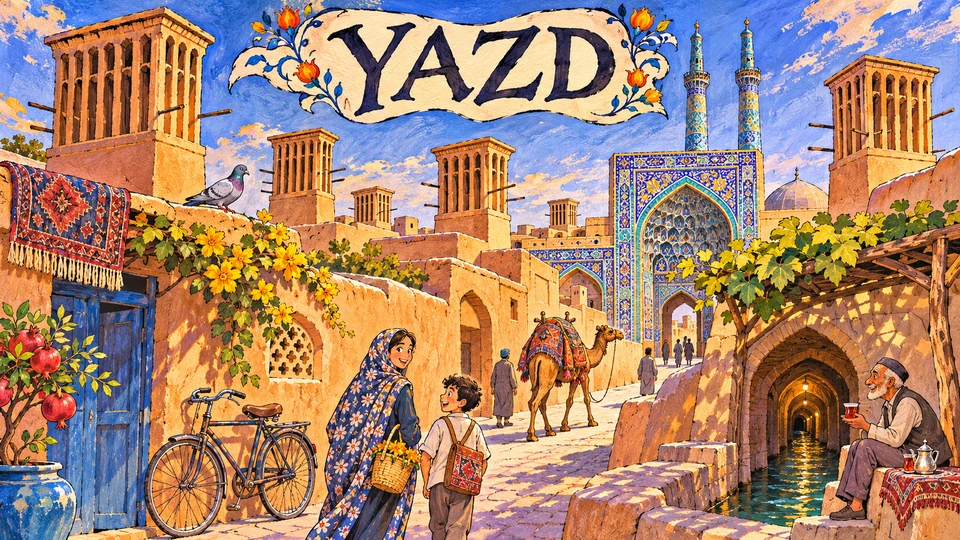
Yazd (یزد) is a desert city in central Iran, between the Dasht-e Kavir and the Dasht-e Lut, famous for its mud-brick old town, its windcatchers and underground water channels, and as the main centre of Iran’s Zoroastrian community. Its historic core became a UNESCO World Heritage Site in 2017. The city had 529,673 people at the 2016 census.
| Persian name | یزد (Yazd) |
|---|---|
| Province | Yazd (capital) |
| Population | 529,673 (city, 2016 census, Statistical Centre of Iran) |
| Elevation | About 1,200 m |
| Climate | Hot desert: very hot, dry summers, cold nights in winter, little rain |
| UNESCO site | Historic City of Yazd (2017) |
| Distance | About 630 km south-east of Tehran; about 300 km east of Isfahan |
A city that survived by staying out of the way
Yazd sits on an oasis at the foot of the Shirkuh mountains, far from the main invasion routes. It was never an imperial capital, and that has been its fortune. When the Mongols overran Iran in the 13th century, the local atabegs submitted and the city was spared; in the 14th century it was the starting point of the Muzaffarid dynasty, who later ruled Shiraz (see Injuids and Muzaffarids). Marco Polo, travelling through in the late 13th century, noted the silk cloth woven here. Silk weaving, including the brocade called termeh, is still a Yazdi craft.
The name Yazd comes from an old Iranian word meaning “worthy of worship” or “divine”, the same root found in yazdân, “God”.
Living with the desert: windcatchers and qanats
Yazd’s architecture is a set of answers to heat, dust and lack of water. Houses are built of sun-dried brick and plaster, with thick walls, small openings onto the lanes and courtyards sunk below street level. The lanes (kuche) are narrow and often roofed, so they stay in shade.
Windcatchers
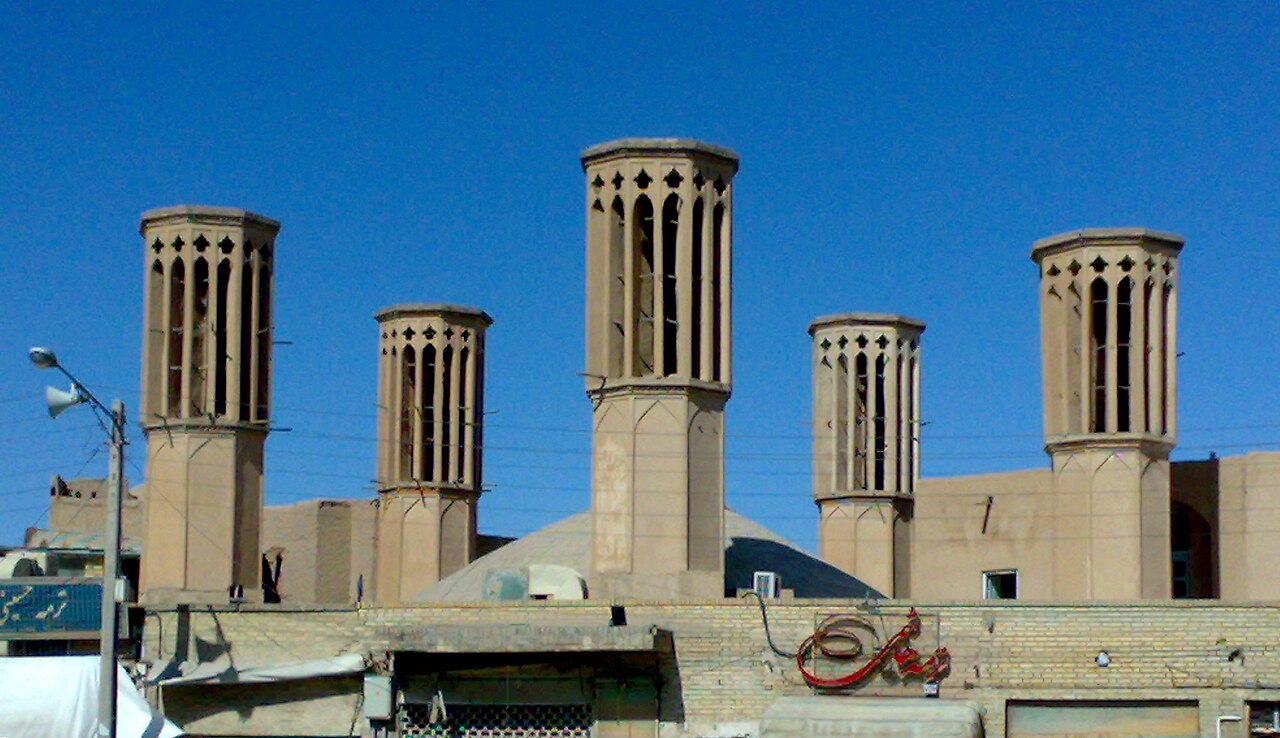
The most famous feature is the windcatcher, or bâdgir (بادگیر). These towers catch the slightest breeze and channel it down into the rooms, and they also work in reverse, drawing warm air up and out. Some sit over basements or pools, which cools the air further. Hundreds rise above the roofs of the old town. The tallest, in the Dowlatabad Garden, is about 33 metres high and was built in the mid-18th century for the governor Mohammad Taqi Khan. See the Dowlatabad Garden and Windcatcher.
Qanats and cisterns
Yazd’s water came from qanâts (قنات), gently sloping tunnels that carry groundwater from the foot of the mountains to the town, sometimes over tens of kilometres. Water was stored in domed cisterns (âb-anbâr), several of them cooled by windcatchers. The Water Museum in the old town explains the system and the trade of the qanat diggers, the moqanni. Our page on qanats covers their history across Iran.

The Zoroastrians of Yazd
After the Arab conquest, Iran’s population became Muslim over several centuries, but Zoroastrian communities held on longest in the Yazd and Kerman regions (see Zoroastrians after the Arab conquest). Today Yazd is still the main centre of the faith in Iran, with its own quarters, schools and temples.
The Atash Bahram, the city’s main fire temple, was completed in the 1930s with money from the Parsi Zoroastrians of India. It houses the only fire of the highest grade, an Atash Bahram, in Iran. Zoroastrian tradition says this fire has burned since about 470 CE and was carried from place to place, including the town of Ardakan, before reaching Yazd.
On two hills south of the city stand the dakhme, the “towers of silence”, round walled enclosures where the dead were once exposed to vultures so as not to pollute earth or fire. Their use ended in the 1960s and 1970s, and the community now buries its dead in a cemetery nearby. Every June, Zoroastrians from Iran and abroad make a pilgrimage to Chak Chak (Pir-e Sabz), a shrine in a cliff north-west of Yazd. Visit details are on the Yazd Fire Temple and Towers of Silence page, and the faith’s origins on Zoroaster and the Avesta.
Mosques, squares and the old quarters
Yazd is also a deeply religious Muslim city. The Friday Mosque (Masjed-e Jame), largely 14th century, has one of the tallest tiled portals in Iran, flanked by two slender minarets, and fine mosaic tilework in its prayer hall. Not far away is the Amir Chakhmaq complex, named after a Timurid governor of the 15th century and his wife Fatima Khatun. Its three-storey façade of recessed arches is the city’s best-known image. During the mourning month of Muharram, a huge wooden frame called a nakhl is carried round the square there. See the Jameh Mosque of Yazd and Amir Chakhmaq Complex pages.
The old town is best explored on foot. Fahadan, around the Friday Mosque, is the oldest and best-preserved quarter, with lanes leading to the so-called Alexander’s Prison, actually the domed courtyard of a medieval school. Many traditional courtyard houses are now guesthouses, and rooftop cafés look out over the windcatchers.
Sweets, crafts and the towns around Yazd
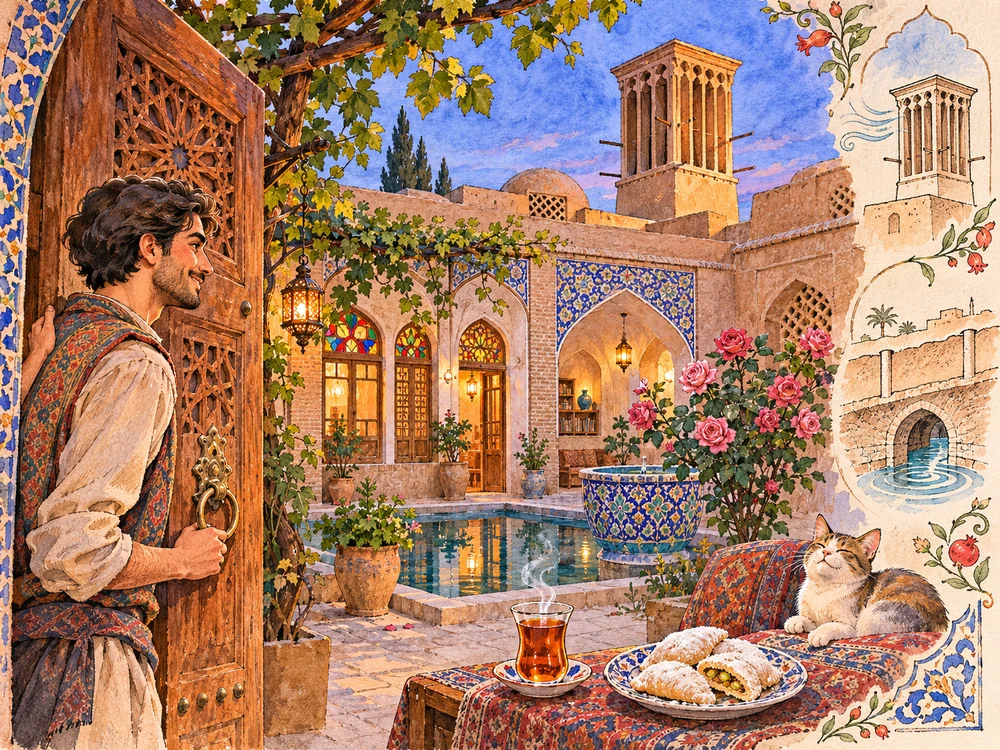
Iranians bring sweets back from Yazd: bâqlavâ, qottâb (fried pastries filled with almonds and cardamom) and pashmak, a candy floss made from sugar and sesame. Silk and cotton weaving and termeh are the traditional crafts.
Day trips go to Meybod, with its mud-brick citadel, ice house and pigeon tower; to the abandoned mud village of Kharanaq; and to Chak Chak. Further out lie the caravanserais of the old trade routes, several of which are on UNESCO’s 2023 list (see Persian caravanserais).
Getting there and getting around
Yazd has an airport with domestic flights, mostly to Tehran, and is on the railway line from Tehran to Kerman and Bandar Abbas. Buses link it with Isfahan, Shiraz and Kerman. The old town is compact and walkable, while the fire temple and the towers of silence are a short taxi ride away. Summers are fiercely hot, so spring and autumn are the comfortable seasons. Check current opening times with official sources and follow your own government’s travel advice.
Persian words from this page
| یزد | Yazd | Yazd |
| بادگیر | bâdgir | windcatcher |
| قنات | qanât | underground water channel |
| آبانبار | âb-anbâr | water cistern |
| آتشکده | âtashkade | fire temple |
| دخمه | dakhme | tower of silence |
| کوچه | kuche | lane, alley |
| ترمه | terme | termeh, woven brocade |
Sources and further reading
- Encyclopaedia Iranica, “Yazd” (history and monuments).
- Mary Boyce, A Persian Stronghold of Zoroastrianism (Oxford, 1977), based on her fieldwork in the Yazd villages.
- Mary Boyce, Zoroastrians: Their Religious Beliefs and Practices (Routledge, 1979).
- UNESCO World Heritage Centre, Historic City of Yazd.
- Statistical Centre of Iran, National Population and Housing Census 2016 (1395).
Want to learn Persian? Get the free Starter Pack
Get the 14-page printable Starter Pack (all 32 letters, a 7-day reading plan, 100 core words and 20 survival phrases) and a short 5-email course. Free.
More in Cities of Iran
- Tehran: Iran’s Capital
- Mashhad
- Isfahan
- Shiraz
- Tabriz
- Yazd
- Kashan
- Kerman
- Hamadan
- Qom
- Ahvaz
- Rasht
- Kermanshah
- Urmia
- Ardabil
- Zanjan
- Qazvin
- Sanandaj
- Khorramabad
- Bandar Abbas
- Bushehr
- Zahedan
- Birjand
- Gorgan
- Sari
- Semnan
- Arak
- Ilam
- Yasuj
- Shahr-e Kord
- Bojnurd
- Karaj
- Abadan and Khorramshahr
- Kish Island
- Qeshm Island
- Hormuz Island
- Masuleh
- Abyaneh
- Kandovan
- Bam
- Neyshabur (Nishapur)
- Shush (Susa) Today