Polo, called chowgan in Persian after the curved mallet, was the great court game of Sasanian Iran (224–651 CE). Middle Persian texts list it, with riding, archery and hunting, among the skills a young noble had to master, and with chess and nard (an ancestor of backgammon) among the games of the mind. Kings were shown hunting on rock reliefs and silver plates, and the Sasanian love of these pastimes passed to the Islamic courts, Byzantium and, through later Persian dynasties, to the modern world.
| Persian name of polo | Chowgan (Middle Persian čaugān), the mallet and the game |
|---|---|
| Key texts | Karnamag i Ardashir i Papakan; Khusraw ud Redag (“Khosrow and the Page”); Shahnameh |
| Hunting monuments | Taq-e Bostan reliefs (Khosrow II); royal silver hunting plates |
| Board games | Chess (chatrang) from India, nard (new-ardakhshir) |
| UNESCO | “Chogān” inscribed by Iran on the Intangible Cultural Heritage list, 2017 |
The education of a noble
A short Middle Persian text, Khusraw ud Redag, “Khosrow and the Page”, gives the best picture of what a well-born young man was expected to know. A page boy presents himself to King Khosrow and lists his accomplishments: he has studied the scriptures and writing, and he is skilled at riding, at archery from horseback, at the lance and at polo. He knows music, and he plays chess and nard better than his companions. The king then questions him about the finest foods, wines, perfumes, flowers and women, and the text becomes a catalogue of Sasanian court taste. It survives in a later manuscript tradition and was probably written down near the end of the dynasty, but its picture fits everything else we know.
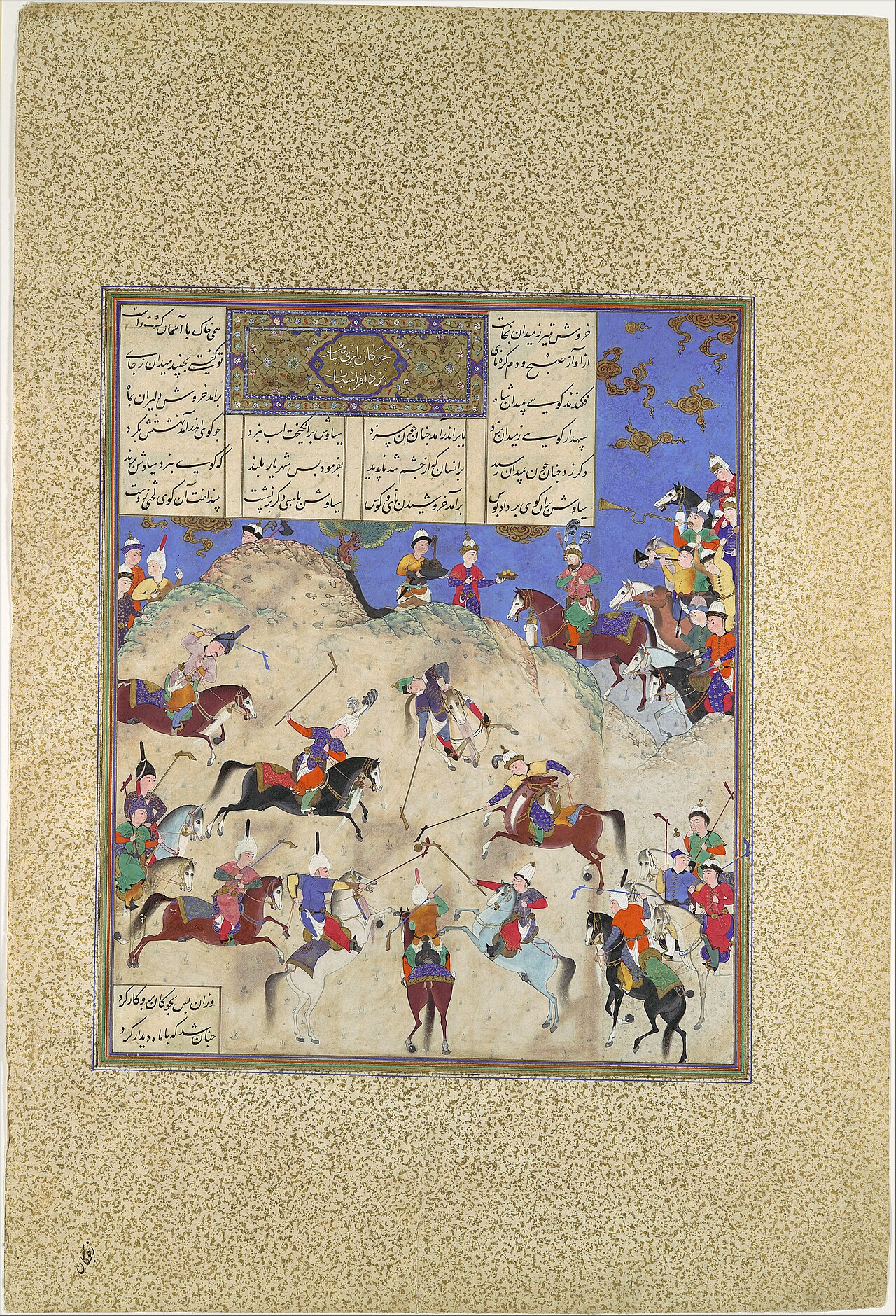
Chowgan: polo at court
How old polo is, and where it began, cannot be settled. A game on horseback with stick and ball was probably played on the Iranian plateau and in Central Asia well before the Sasanians, but the first texts that describe it in detail are Sasanian or draw on Sasanian sources.
Ardashir’s grandson on the polo field
The Karnamag i Ardashir i Papakan, the Middle Persian romance of the dynasty’s founder, uses polo to tell a story about royal blood. Ardashir’s son Shapur has a son, Ohrmazd, by a daughter of Ardashir’s enemy Mihrak, and keeps the boy hidden from his father. One day Ardashir watches a group of boys playing polo. When the ball flies close to the king, the other boys hold back, but one rides boldly up and takes it. Ardashir asks who he is, and so discovers his grandson. Ferdowsi tells the same story in the Shahnameh. The point is that a royal prince betrays himself by his courage on the polo field.
Polo in the Shahnameh and Nizami
Persian poets kept the game at the centre of court life. In the Shahnameh, the hero Siyavush shows his skill at polo before the Turanian king Afrasiyab. In Nizami’s 12th-century romance Khosrow and Shirin, set at the court of Khosrow II, Shirin and her ladies ride out to play polo against the king and his men. These are poems, not chronicles, but they reflect a long memory of the Sasanian court as a place where princes, and sometimes princesses, rode at the ball.

The royal hunt
Hunting was the king’s sport above all, and it was also a statement of power. The royal silver plates show the king at full gallop shooting lions, boars, rams or stags, and these images were sent as gifts across and beyond the empire (see Sasanian coins and silverwork and Sasanian art).
The fullest picture comes from the great arch at Taq-e Bostan near Kermanshah, carved for Khosrow II in the early 7th century. Its two side panels show hunts in an enclosed royal park. In one, elephants drive wild boar out of a marsh while the king, standing in a boat surrounded by women playing harps, draws his bow; in the other, deer are driven past the mounted king while musicians play. The scenes, with their beaters, elephants, boats and orchestras, show the hunt as a court spectacle as much as a sport.
The most famous hunter of all was Bahram V, known as Bahram Gur, “Bahram the wild ass”, from his love of hunting the onager. The legends of his skill, above all the story of his shot at the deer for his harpist Azadeh, are told on Bahram V Gur.
Chess and nard
The two board games of the court have a story of their own. According to a short Middle Persian text, the “Explanation of Chess and the Invention of Nard”, an Indian king sent Khosrow I a chess set as a challenge, and the minister Wuzurgmihr (Bozorgmehr) worked out the rules and replied with a new game, nard. Chess (Middle Persian chatrang, from Sanskrit) certainly reached Iran from India in the Sasanian period and passed from Iran to the Arabs and to Europe; the word “checkmate” comes from Persian شاه مات (shâh mât), “the king is helpless”. The story of the chess embassy and Borzuya’s journey to India is told on Borzuya, chess and Kalila wa Dimna.
How the court games travelled
Polo spread far beyond Iran. The Byzantine emperors had a polo ground, the tzykanisterion, in the Great Palace of Constantinople, and the Greek name of the game, tzykanion, comes from the Persian word. Polo was popular at the Tang court in China, where it probably arrived from Iran and Central Asia, and the Abbasid caliphs and later Muslim rulers played it. In Safavid Isfahan the great square of Naqsh-e Jahan was laid out in the early 17th century with stone goalposts for royal polo, which still stand at each end (see Naqsh-e Jahan Square, and the longer history on our Naqsh-e Jahan article). In 2017 chowgan, as a game played with music and storytelling, was inscribed by Iran on UNESCO’s list of Intangible Cultural Heritage.
What links all these is a Sasanian idea: that a king and his nobles proved their fitness to rule by their skill on horseback and their wit at the board. The modern sport of polo was codified by British players in India in the 19th century, but its ancestor was the game of the Persian court.
Persian words from this page
| چوگان | chowgân | polo, and the polo mallet |
| گوی | guy | ball |
| شکار | shekâr | hunting, the hunt |
| شطرنج | shatranj | chess |
| نرد | nard | nard, backgammon |
| میدان | meydân | square, field (also the polo ground) |
| سیاوش | Siyâvash | Siyavush, hero of the Shahnameh |
Sources and further reading
- Khusraw ud Redag, in Samra Azarnouche, Husraw ī Kawādān ud Rēdag-ē: Khosrow fils de Kawād et un page (Studia Iranica, 2013).
- Kārnāmag ī Ardaxšīr ī Pābagān, trans. Frantz Grenet, La geste d’Ardashir fils de Pâbag (Éditions A Die, 2003).
- Ferdowsi, Shahnameh, trans. Dick Davis (Viking, 2006).
- Encyclopaedia Iranica, “Čowgān” and “Chess”.
- UNESCO Intangible Cultural Heritage, “Chogān, a horse-riding game accompanied by music and storytelling” (Iran, 2017).
- Touraj Daryaee, Sasanian Persia: The Rise and Fall of an Empire (I.B. Tauris, 2009).
Want to learn Persian? Get the free Starter Pack
Get the 14-page printable Starter Pack (all 32 letters, a 7-day reading plan, 100 core words and 20 survival phrases) and a short 5-email course. Free.
More in The Sasanian Empire (224–651 CE)
- The Origins of the Sasanian Family
- Ardashir I, Founder of the Sasanian Empire
- Firuzabad: Ardashir’s Round City
- Shapur I, King of Kings of Iran and Non-Iran
- Bishapur: Shapur’s City
- The Battle of Edessa and the Capture of Valerian
- The Ka’ba-ye Zartosht Inscription of Shapur I
- Mani and Manichaeism
- Hormizd I and Bahram I
- Kartir and the Zoroastrian Church
- Bahram II
- Narseh and the Peace of Nisibis
- Shapur II the Great
- Julian’s Invasion of Persia (363)
- Christians in the Sasanian Empire
- Shapur III and the Partition of Armenia
- Yazdegerd I
- Bahram V Gur
- Yazdegerd II
- The Battle of Avarayr (451)
- The Hephthalites and Iran’s Eastern Frontier
- Peroz I and the Hephthalite Disaster
- Kavad I
- Zamasp and Kavad’s Return
- Mazdak and the Mazdakite Movement
- Khosrow I Anushirvan the Just
- The Sasanian–Byzantine Wars of the 6th Century
- The Battle of Dara (530)
- Khosrow I Sacks Antioch (540)
- The Lazic War (541–562)
- The Reforms of Khosrow I
- The Academy of Gondishapur: History and Legend
- Borzuya, Chess and Kalila wa Dimna
- Taq Kasra: The Arch of Ctesiphon
- The Sasanian Conquest of Yemen
- The Sasanians and the Western Turks
- Hormizd IV
- Bahram Chobin’s Rebellion
- Khosrow II Parviz
- The Last Great War: Byzantium and Persia, 602–628
- The Siege of Constantinople (626)
- Heraclius Strikes Back
- Shirin: Queen and Legend
- Shahrbaraz, the General Who Became King
- Civil War and the Queens Boran and Azarmidokht
- Yazdegerd III, the Last Sasanian King
- The Sasanian Army
- Sasanian Society and the Class System
- Zoroastrianism under the Sasanians
- Sasanian Art: Silver, Reliefs and Silk
- The Sasanian Reliefs of Naqsh-e Rostam
- Taq-e Bostan
- Sasanian Cities, Palaces and Bridges
- Middle Persian (Pahlavi) Language and Literature
- Sasanian Coins and Silverwork
- Women in the Sasanian Empire
- Polo, Hunting and Games at the Sasanian Court
- The Sasanian Legacy