Sport in Iran has a long and unusual history. Ancient Persian nobles were trained in riding, archery and hunting; polo, chowgan, was the court game of Sasanian and Safavid kings; and the zurkhaneh, the “house of strength”, joined wrestling and club-swinging with poetry and religious devotion. Modern sports arrived in the early 20th century, and since then wrestling and football have become the two great sporting passions of the country.
For the sports Iranians play and watch today, see sports in Iran. This page tells the history.
Riding, archery and the truth
Herodotus says that Persian boys were taught only three things between the ages of five and twenty: to ride, to shoot the bow and to speak the truth. Xenophon’s idealised account of Persian education in the Cyropaedia adds hunting as training for war. Achaemenid kings advertised their own skill: Darius I says on his tomb at Naqsh-e Rostam that he was a good horseman, a good bowman and a good spearman. Royal hunting parks, the paradaida, were game reserves as well as gardens (see Achaemenid gardens and paradise).
Chowgan: the game of kings
Polo is the most famous Iranian contribution to world sport. Its Persian name, chowgan چوگان, is the word for the curved mallet. Middle Persian texts list it among the skills of a young noble, and in the Shahnameh the hero Siyavash plays a match against the Turanians at the court of Afrasiab. The page on polo and Sasanian sports covers the game at the Sasanian court.
From Iran the game spread west to Byzantium, where emperors built a polo ground in Constantinople, and east to Central Asia, China and India. In Safavid Isfahan the great square, Naqsh-e Jahan, served as a polo field, and its stone goalposts still stand at either end. Shah Abbas watched matches from the Ali Qapu palace. The game survived in north-eastern India, where British officers learned it in Manipur and Assam in the mid-19th century and carried the modern form around the world. In 2017 UNESCO inscribed Iranian chowgan, played with music and storytelling, on its list of intangible cultural heritage.
Chess and nard
Board games were the sports of the mind. Chess came to Sasanian Iran from India in the 6th century as chatrang, and Persian gave the game words it still uses worldwide: shâh, king, and shâh mât, “the king is helpless”, which became checkmate. A Middle Persian text tells how the minister Bozorgmehr solved the riddle of chess sent by an Indian king and in reply invented nard, the ancestor of backgammon. Far older gaming boards survive from Bronze Age Iran, including one with pieces and dice from Shahr-e Sukhteh.
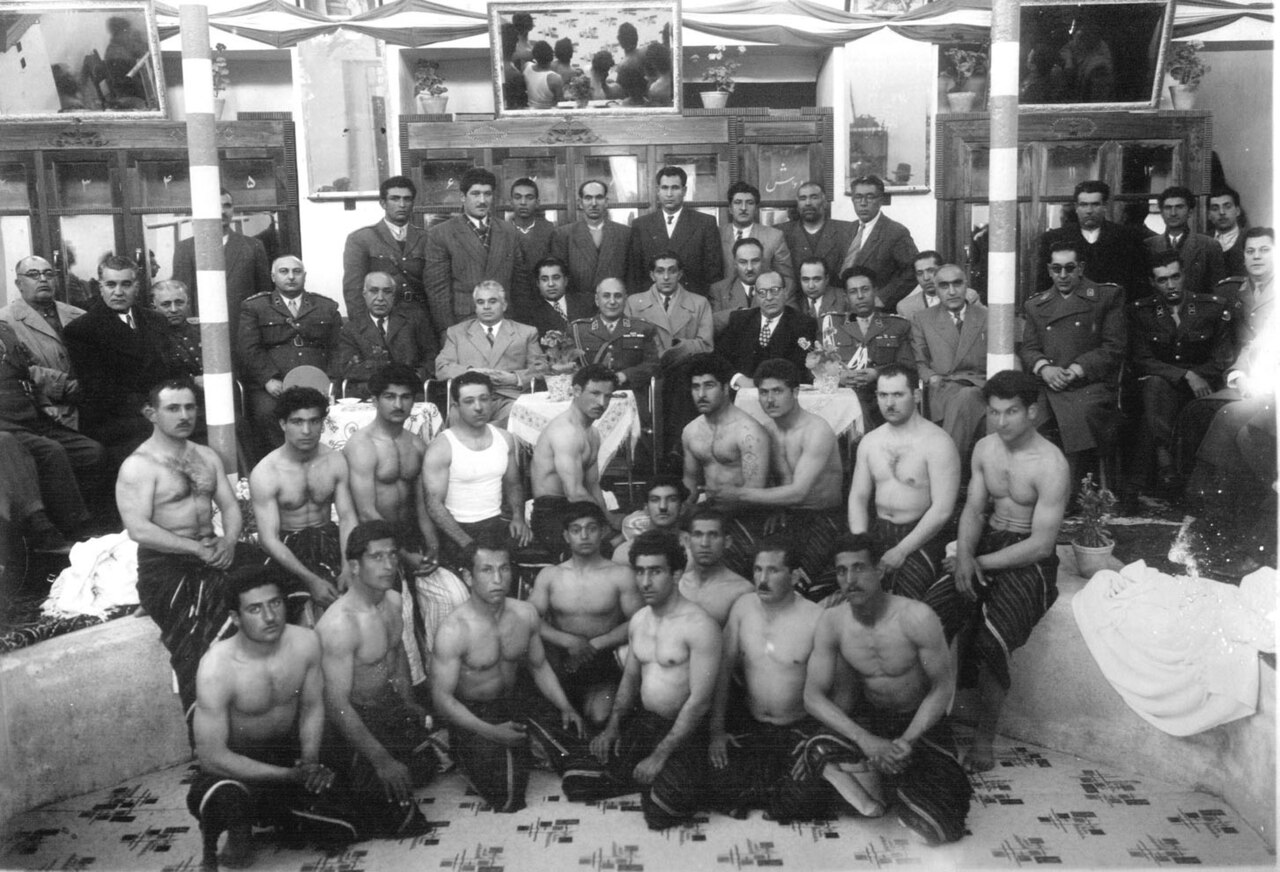

The zurkhaneh: house of strength
The zurkhaneh زورخانه is a low, domed gym with a sunken octagonal pit, the gowd. Its athletes, the pahlavâns, train together to the beat of a drum and the chanting of the morshed, who sits in a raised alcove and recites the Shahnameh, Sufi verse and praise of Imam Ali. The exercises use heavy wooden clubs (mil), an iron bow hung with chains (kabbâde) and wooden shields, and they end with spinning (charkh) and wrestling.
Its origins are debated. Some Iranian writers trace it to pre-Islamic warrior training or to resistance against Arab rule, but there is no direct evidence for this. Most historians link it to the urban brotherhoods of chivalry, javânmardi (Arabic futuwwa), of the later Middle Ages. Its patron is Pahlavan Mahmud, known as Puriya-ye Vali, a 14th-century wrestler and poet from Khwarazm. Zurkhanehs are clearly documented from the Safavid period and were common in Qajar towns, where a pahlavan was expected to be not only strong but modest and generous. UNESCO inscribed the Pahlavani and zurkhanei rituals in 2010.
Wrestling: koshti
Wrestling, koshti کشتی, grew from the zurkhaneh and from regional folk styles such as the belt wrestling of Khorasan and Gilan. When Iran turned to international freestyle and Greco-Roman wrestling after the Second World War, it found its greatest sporting success. Gholamreza Takhti (1930–1968) won Olympic gold at Melbourne in 1956 and silver in 1952 and 1960, but Iranians remember him as much for his modesty and his help for earthquake victims; his death in 1968, officially a suicide, is still mourned and debated. Wrestling has brought Iran more Olympic medals than any other sport.
Modern sport arrives
Football, gymnastics and athletics came in the early 20th century through mission schools, the British oil company in Khuzestan and Iranians educated abroad. An Iranian fencer competed in the Paris Olympics of 1900. Under Reza Shah’s reforms physical education became part of state schooling and scouting was promoted as part of building a modern nation. Iran has sent teams to every Summer Olympics since 1948, apart from the boycotted Games of 1980 and 1984, and Jafar Salmasi won the country’s first medal, a bronze in weightlifting, in London that year.
The late Pahlavi state invested heavily. Tehran hosted the 1974 Asian Games, the first held in West Asia, at the new Aryamehr stadium, renamed Azadi after 1979. The national football team won the Asian Cup in 1968, 1972 and 1976 and reached its first World Cup in 1978. Skiing developed at resorts such as Dizin, opened in 1969.
Sport in the Islamic Republic
After the revolution sport was reorganised under Islamic rules. Women continued to compete in some sports with full covering, but were barred from watching men’s football in stadiums from the early 1980s. After the death of Sahar Khodayari, a fan who set herself on fire in 2019 after being charged for trying to enter a stadium, FIFA pressed Iran to admit women, and limited access followed. Kimia Alizadeh became the first Iranian woman to win an Olympic medal, a bronze in taekwondo at Rio in 2016; she later left Iran and competed for the Refugee Olympic Team.
Football remains the great national passion. The 2–1 victory over the United States at the 1998 World Cup in Lyon set off street celebrations across Iran, and the team has qualified for several World Cups since. Weightlifting (Hossein Rezazadeh, gold in 2000 and 2004), wrestling and taekwondo have provided most Olympic medals. Sport has also become a stage for politics, from celebrations that turned into protests to players declining to sing the anthem during the “Woman, Life, Freedom” protests of 2022.
Persian words from this page
| ورزش | varzesh | sport |
| چوگان | chowgân | polo |
| زورخانه | zurkhâne | house of strength |
| پهلوان | pahlavân | champion, hero |
| کشتی | koshti | wrestling |
| مرشد | morshed | leader who chants in the zurkhaneh |
| شطرنج | shatranj | chess |
Sources and further reading
- Herodotus, Histories 1.136; Xenophon, Cyropaedia book 1.
- Encyclopaedia Iranica, articles “Čowgān”, “Zūr-ḵāna” and “Chess”.
- UNESCO Intangible Cultural Heritage: “Pahlevani and Zoorkhanei rituals” (2010) and “Chogān, a horse-riding game accompanied by music and storytelling” (2017).
- H. E. Chehabi, “The Juggernaut of Globalization: Sport and Modernization in Iran”, International Journal of the History of Sport 19 (2002).
- Philippe Rochard, “The Identities of the Iranian Zūrkhānah”, Iranian Studies 35 (2002).
Want to learn Persian? Get the free Starter Pack
Get the 14-page printable Starter Pack (all 32 letters, a 7-day reading plan, 100 core words and 20 survival phrases) and a short 5-email course. Free.
More in Themes Across Iranian History (3000 BCE–today)
- A History of the Persian Language
- Zoroastrianism through the Ages
- Shi’a Islam in Iranian History
- The Jews of Iran
- The Armenians of Iran
- Christians of Iran
- The Baha’i Faith in Iran
- The Kurds in Iranian History
- Azerbaijanis in Iranian History
- The History of the Iranian Calendar
- Nowruz through History
- The Persian Garden (Pardis) through History
- Qanats: Iran’s Ancient Water Tunnels
- A History of Persian Carpets
- A History of Persian Architecture
- A History of Persian Painting
- A History of Persian Music
- Science in Iranian History
- Women in Iranian History
- Iran and the Silk Road
- Iran and China through History
- Iran and India through History
- Iran and Greece: Perceptions and Exchanges
- Persia and Rome: Seven Centuries of Rivalry
- Iran and the Ottoman Empire
- Iran and Russia through History
- Iran and Britain through History
- Iran and the United States
- How Iran’s Borders Changed
- The Capitals of Iran through History
- Coins of Iran through History: From the Daric to the Rial
- Flags and Symbols of Iran through History
- Myth and History in the Shahnameh: The Epic’s Kings and the Real Past
- Timeline of Iranian History: Key Dates from Elam to Today
- A History of Persian Cuisine: From Royal Banquets to Chelow Kabab
- A History of Persian Poetry: From Rudaki to Forough
- Wine in Iranian History: From Hajji Firuz to Hafez and Prohibition
- Sports in Iranian History: Polo, the Zurkhaneh and Wrestling
- List of Iranian Dynasties and Rulers