The Battle of Gaugamela, fought on 1 October 331 BCE on a plain in northern Mesopotamia, was the last great battle of the Achaemenid Empire. Darius III chose and prepared the ground, brought scythed chariots, elephants and the cavalry of the whole eastern empire, and still lost to Alexander. The royal army scattered, Babylon and Susa surrendered, and the Persian heartland lay open.
| Date | 1 October 331 BCE (fixed by a Babylonian astronomical diary) |
|---|---|
| Place | Gaugamela, on the plain north-east of modern Mosul, Iraqi Kurdistan; often called the battle of Arbela after the city (Erbil) where Darius fled |
| Persian commanders | Darius III; Bessus (left wing); Mazaeus (right wing) |
| Persian numbers | Ancient: 245,000 (Curtius) to about 1,000,000 (Diodorus, Arrian). Modern guesses: roughly 50,000 to 120,000 |
| Macedonian numbers | About 40,000 infantry and 7,000 cavalry (Arrian) |
| Result | Decisive Macedonian victory |
| Persian name | نبرد گوگمل (nabard-e Gugamel) |
Darius prepares a battlefield
After Issus and the loss of Phoenicia and Egypt, Darius III spent almost two years raising a new army at Babylon. This time it came mainly from the Iranian plateau and Central Asia: Persians, Medes, Parthians, Bactrians, Sogdians, Arachosians, Saka horse archers from the steppe, Armenians and Cappadocians, with some Indian troops and fifteen elephants. Heavy cavalry, some on armoured horses, was its strength. Darius also had about 200 chariots fitted with blades on the wheels and axles.
The lesson of Issus was that the Persian army needed space. Darius moved north and camped on the open plain near the village of Gaugamela, east of the Tigris, and had the ground levelled so that his chariots and horsemen could charge. Mazaeus, the satrap who had watched the Euphrates crossing, fell back before Alexander, burning the land, and Alexander crossed the Tigris unopposed in September 331.
An eclipse and a sleepless night
On the night of 20 September 331 there was a total eclipse of the moon. Babylonian astronomers recorded it in their diary, and Greek writers say it alarmed the Macedonian army. The diary is the nearest thing to a Persian-side document about the battle. It records the clash of the two kings’ armies, a heavy defeat, and that the king’s troops deserted him and fled to their homes. It is a record from Babylon, written by temple scholars, but it is not filtered through Greek eyes.
Darius expected a night attack. Arrian says Parmenion did propose one, and Alexander refused to “steal the victory”. The Persians, unable to fortify an open camp, stood in battle order through the whole night, so they went into battle tired.

The Persian battle order
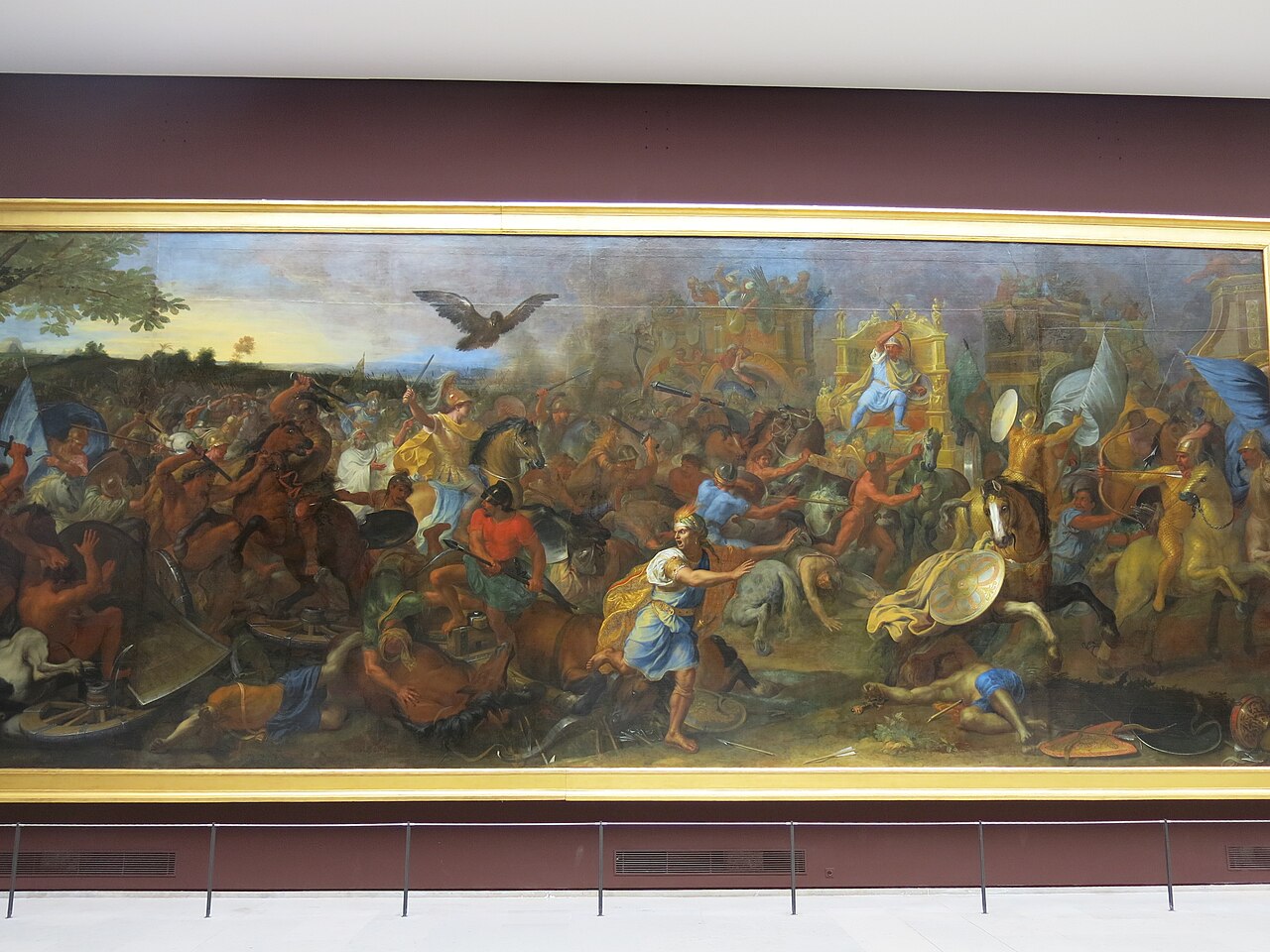
Arrian’s description of the Persian line is unusually detailed, because the Macedonians later captured Darius’s written order of battle. Darius stood in the centre with his kinsmen, his guard of Persian spearmen whose spear butts were shaped like apples, Indian and Carian contingents, and the Greek mercenaries who were left to him. Bessus, satrap of Bactria, held the left with the Bactrian, Saka, Dahae and Arachosian cavalry. Mazaeus commanded the right with Syrians, Mesopotamians, Medes, Parthians, Armenians and Cappadocians. Chariots and elephants stood in front.
The battle
Alexander, outnumbered and facing a much longer line, advanced at an angle towards his right, edging away from the levelled ground. Darius sent cavalry from his left to stop him extending further, and fierce cavalry fighting began on that flank, where the Saka and Bactrians did well.
Then Darius launched the scythed chariots. Light infantry and javelin men in front of the Macedonian line shot the horses and pulled down the drivers, and the infantry opened lanes to let the remaining chariots run through harmlessly. The weapon that the field had been prepared for achieved little.
As more Persian cavalry moved to the left, a gap opened in the Persian line near the centre. Alexander turned his Companion cavalry and the nearest infantry battalions into it in a wedge and drove straight at Darius. Arrian says the king, seeing danger everywhere, was the first to turn and flee. Diodorus and Curtius tell it differently: Darius’s charioteer was killed by a javelin, his guards thought the king had fallen and began to break, and Darius was carried away in the dust and confusion.
The Persian right nearly wins
On the other wing the battle was going Persia’s way. Mazaeus pressed Parmenion so hard that the Macedonian left was close to breaking. A body of Persian and Indian cavalry rode through a gap in the phalanx and reached the Macedonian baggage camp, where Darius’s captured mother Sisygambis was held. Curtius says they called on her to come away, and she refused. Parmenion sent urgent messages for help, and Alexander turned back from the pursuit of Darius. On his way he collided with retreating Parthian, Indian and Persian cavalry in the hardest fighting of the day. When news of the king’s flight spread, Mazaeus withdrew, and Bessus led the Bactrians away in good order.
Losses and aftermath
Arrian claims 300,000 Persian dead, Diodorus 90,000 and Curtius 40,000. Macedonian losses are given as a few hundred. The Persian figures are guesses, but the defeat was total in its effect.
Darius rode through the night to Arbela, then fled across the mountains to Ecbatana in Media (modern Hamadan). Bessus and the eastern cavalry went with him. Alexander took the camp and the treasure at Arbela, and his army proclaimed him king of Asia. Within weeks Mazaeus surrendered Babylon and was made its satrap, and in December Susa opened its gates. What followed in Iran, from the Persian Gate to the burning of Persepolis, is summarised on Alexander the Great in Iran.
Why Darius lost
Historians usually point to three things. The Persian army was a collection of contingents that spoke different languages and fought in different ways, while the Macedonian army was a single professional force. Alexander’s movement to the right pulled the Persian line out of shape and created the gap he had waited for. And, as at Issus, the flight of the king ended resistance in the centre, because Persian armies were organised around the person of the king. Whether Darius fled first, as Arrian insists, or was swept away, as Diodorus and Curtius say, the result was the same.
Persian words from this page
| گوگمل | Gugamel | Gaugamela |
| اربیل | Arbil | Arbela, Erbil |
| فیل | fil | elephant |
| ماهگرفتگی | mâh-gereftegi | lunar eclipse |
| باختر | Bâkhtar | Bactria |
| بابل | Bâbel | Babylon |
Sources and further reading
- Arrian, Anabasis of Alexander 3.7 to 3.16
- Diodorus of Sicily 17.53 to 17.61; Quintus Curtius Rufus, Book 4; Plutarch, Life of Alexander 31 to 34
- Babylonian astronomical diary for 331 BCE, in A. J. Sachs and H. Hunger, Astronomical Diaries and Related Texts from Babylonia, vol. 1 (1988)
- Pierre Briant, Darius in the Shadow of Alexander (2015)
- Encyclopaedia Britannica, “Battle of Gaugamela“
Want to learn Persian? Get the free Starter Pack
Get the 14-page printable Starter Pack (all 32 letters, a 7-day reading plan, 100 core words and 20 survival phrases) and a short 5-email course. Free.
More in The Achaemenid Empire (550–330 BCE)
- Achaemenes, Teispes and the Early Persian Kings of Anshan
- Cyrus the Great: Birth, Legends and Rise to Power
- Cyrus Conquers Lydia: Croesus and the Battle of Thymbra
- The Persian Conquest of Ionia and Asia Minor
- Cyrus Takes Babylon (539 BCE)
- The Cyrus Cylinder
- Cyrus and the Return of the Jews
- The Death of Cyrus and the Massagetae
- Pasargadae: Cyrus’s Capital and Tomb
- The Tomb of Cyrus through History
- Cambyses II
- Cambyses Conquers Egypt: The Battle of Pelusium
- Bardiya and Gaumata: The Usurper Question
- Darius the Great Takes the Throne
- The Great Revolts of 522–521 BCE
- The Behistun Inscription
- The Persian Conquest of the Indus Valley
- Darius’s Scythian Campaign
- Darius’s Canal from the Nile to the Red Sea
- Darius’s Reforms: Satrapies, Taxes and Law
- The Royal Road and the Persian Postal System
- The Daric: Achaemenid Coinage and Economy
- The Ionian Revolt (499–493 BCE)
- The Greco-Persian Wars: An Overview
- Mardonius and the First Persian Expedition to Greece (492 BCE)
- The Battle of Marathon (490 BCE)
- The Death of Darius I and the Succession of Xerxes
- The Royal Tombs of Naqsh-e Rostam
- Xerxes I: King of Kings (486–465 BCE)
- Xerxes’ Invasion of Greece (480–479 BCE)
- The Battle of Thermopylae (480 BCE)
- The Battle of Artemisium (480 BCE)
- The Persian Capture of Athens (480–479 BCE)
- The Battle of Salamis (480 BCE)
- The Battle of Plataea and the End of the Invasion (479 BCE)
- The Palace of Darius at Susa
- Building Persepolis: How Darius and Xerxes Built Parsa
- The Persepolis Fortification and Treasury Tablets
- Herodotus and the Persians
- The Apadana Reliefs: Nations Bringing Gifts
- The Achaemenid Paradise Gardens
- The Persian Immortals and the Achaemenid Army
- The Achaemenid Navy
- Religion of the Achaemenid Kings
- Women of the Achaemenid Court
- Old Persian Language and Cuneiform
- Egypt under Persian Rule
- Babylon under Persian Rule
- Artaxerxes I
- The Peace of Callias
- Darius II and the Peloponnesian War
- Famous Satraps of the Persian Empire
- Artaxerxes II Mnemon
- Cyrus the Younger and the Battle of Cunaxa
- The King’s Peace (387 BCE)
- The Great Satraps’ Revolt
- Artaxerxes III and the Reconquest of Egypt
- Darius III, the Last Achaemenid King
- The Battle of the Granicus (334 BCE)
- The Battle of Issus (333 BCE)
- Alexander Takes Tyre, Gaza and Egypt (332 BCE)
- The Battle of Gaugamela (331 BCE)
- Ariobarzanes and the Battle of the Persian Gate
- The Burning of Persepolis (330 BCE)
- The Death of Darius III and Bessus
- The Legacy of the Achaemenid Empire