In the spring of 330 BCE, after occupying Persepolis for about four months, Alexander set fire to the palaces on its great terrace. The ancient writers disagree about why: Arrian presents it as deliberate revenge for the Persian burning of Athens in 480 BCE, while Diodorus, Curtius and Plutarch describe a drunken feast at which the Athenian courtesan Thaïs urged the king on. Excavation has confirmed the fire, and shown which buildings it destroyed.
| Date | Spring (probably May) 330 BCE |
|---|---|
| Place | Persepolis (Parsa), Marvdasht plain, Fars province |
| Buildings burned | Apadana, Hall of a Hundred Columns, Treasury, palace of Xerxes and others |
| Main ancient sources | Arrian 3.18; Diodorus 17.70 to 72; Curtius 5.6 to 7; Plutarch, Alexander 37 to 38 |
| Excavated by | Ernst Herzfeld and Erich Schmidt for the Oriental Institute of Chicago, 1931 to 1939 |
| Persian name | تخت جمشید (Takht-e Jamshid) |
Alexander at Persepolis
After forcing the Persian Gate, Alexander reached Persepolis in late January or early February 330 BCE. The treasurer Tiridates handed over the city. Diodorus and Curtius say the treasury held about 120,000 talents, the largest hoard of precious metal in the ancient world, and Plutarch says 10,000 pairs of mules and 5,000 camels were needed to carry it away.
The town below the terrace was given to the soldiers to plunder. Diodorus calls Persepolis the most hateful of Asian cities to the Macedonians, and describes the men killed and the women carried off as slaves. The palaces on the terrace, the ceremonial centre that Darius I and Xerxes had built (see Building Persepolis), were spared for the time being. Alexander stayed through the winter and spring, partly waiting for the snow to clear from the roads north, and visited the tomb of Cyrus at Pasargadae.
Two stories of the fire
Arrian: a planned act of revenge
Arrian, following Alexander’s officers Ptolemy and Aristobulus, says Alexander burned the Persian palace on purpose, as punishment for the Persian invasion of Greece, the burning of Athens and the destruction of Greek temples. Parmenion urged him to save it, saying it was foolish to destroy what was now his own property, and that the Asians would see him as a passing raider rather than their ruler. Alexander refused. Arrian, writing 450 years later, adds his own opinion that this was not a wise decision. Elsewhere he says Alexander came to regret it when he returned to Persis in 324 BCE.
Diodorus, Curtius and Plutarch: the feast and Thaïs
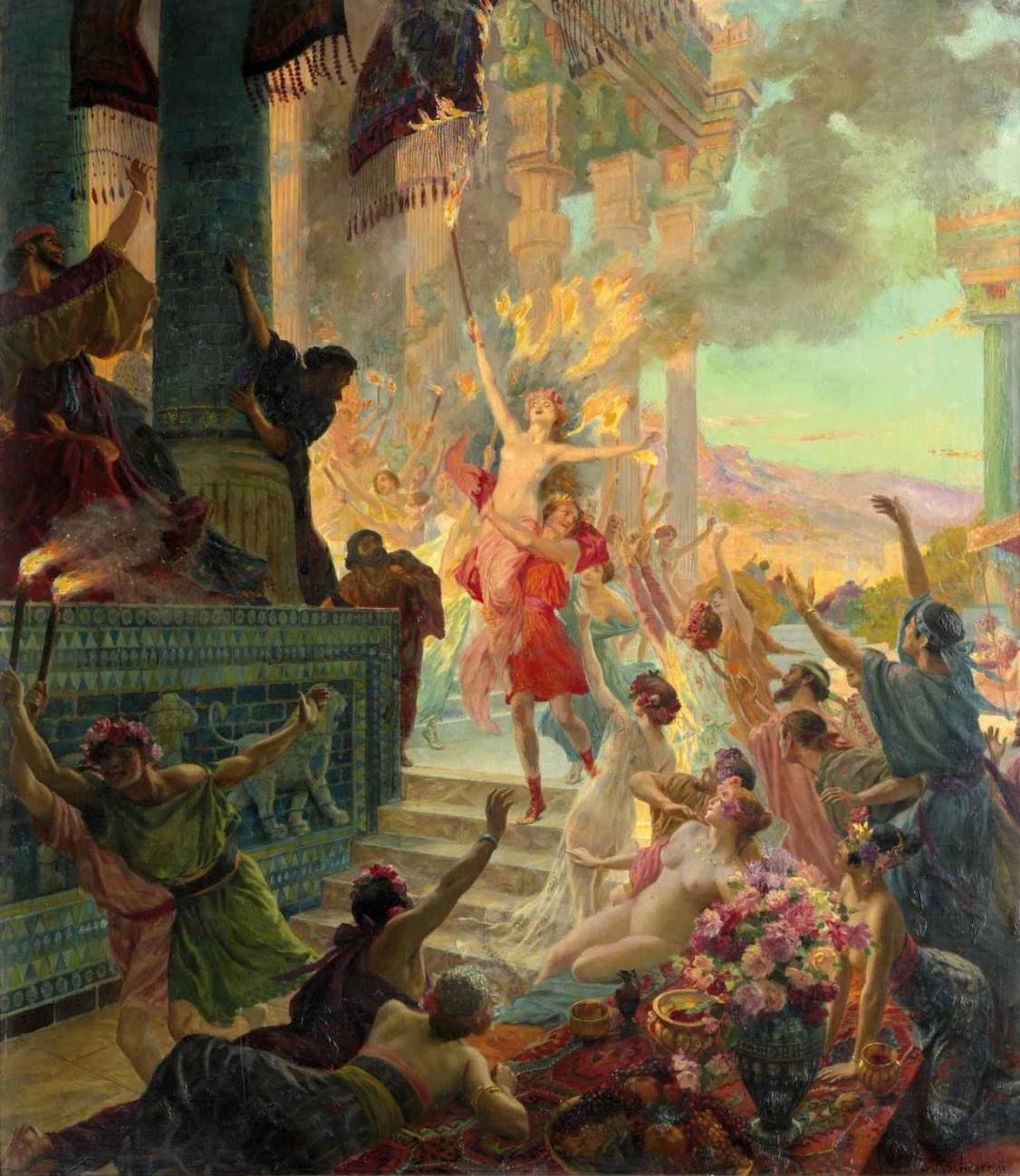
The other tradition, probably going back to the historian Cleitarchus, tells of a victory feast. When everyone was drunk, Thaïs, an Athenian courtesan and the companion of Ptolemy, said it would be the finest thing of all for a woman of Athens to set fire to the palace of the king who had burned her city. The revellers took up torches, Alexander threw the first, and Thaïs the second. Plutarch adds that Alexander soon regretted it and ordered the fire put out.
The two stories are not entirely opposed. A ritual revenge could have been staged at the end of a banquet. Ptolemy, the source behind Arrian, had good reason to leave out the role of his own mistress.

Why it happened: modern explanations
Historians have proposed several motives, and they can overlap.
A message to the Greeks. The war had been sold in Greece as revenge for 480 BCE. Burning the palace of Xerxes was the symbolic end of that war. A few weeks later, at Ecbatana, Alexander sent his Greek allied troops home.
A message to the Persians. Pierre Briant and others argue that the Persian nobility of Persis had not accepted Alexander as king, and that the long stay at Persepolis was partly a failed attempt to win them over. The fire told them that the Achaemenid monarchy, whose ceremonial centre this was, was finished, while Darius III was still alive in Media.
Chance and wine. Some historians accept the banquet story more or less as told, and see the fire as an impulsive act that was later given a political meaning.
What the archaeologists found
The excavations of the Oriental Institute of Chicago in the 1930s, led first by Ernst Herzfeld and then by Erich Schmidt, uncovered thick layers of ash and charred cedar wood from the roof beams. The fire hit the Apadana, the Hall of a Hundred Columns and the palace known as the Hadish of Xerxes hard. The Treasury was found almost empty, apart from broken and discarded objects, which fits the ancient accounts of its contents being removed before the fire. Among the finds left behind was a marble statue of a seated woman in Greek style, probably booty taken from a Greek city long before.
The palace of Darius, the Tachara, appears to have suffered less. Several scholars have noted that the buildings most closely linked with Xerxes, the king who burned Athens, were among the worst damaged, which would support a deliberate, selective fire rather than a random one. The evidence is debated, but it is clear the destruction was thorough.
After the fire
Persepolis was not abandoned overnight. In 317 BCE the Macedonian satrap Peucestas held a great sacrifice and feast there for the armies of Alexander’s successors. Local rulers of Persis under the Seleucids, the fratarakas, built nearby, and in the fourth century CE Sasanian princes carved inscriptions on the walls of the Tachara. By the Islamic period the ruins were known as Takht-e Jamshid, “the throne of Jamshid”, or Chehel Minar, “forty minarets”, after the standing columns, and the real builders had been forgotten.
Zoroastrian priests preserved a different memory. Middle Persian texts such as the Book of Arda Viraz say that the accursed Alexander burned the holy scriptures, which had been written in gold on prepared ox-hides and kept in a “fortress of writings” at Istakhr, near Persepolis. Whatever its historical basis, the story shows that the fire became, in Iranian tradition, the moment the old order was destroyed.
Today the ruins are a UNESCO World Heritage Site; for visiting, see Visiting Persepolis and the site’s own post on Persepolis.
Persian words from this page
| تخت جمشید | Takht-e Jamshid | Persepolis, “throne of Jamshid” |
| چهلمنار | Chehel Menâr | forty minarets, an old name for the ruins |
| آتش | âtash | fire |
| خزانه | khazâne | treasury |
| کاخ | kâkh | palace |
| استخر | Estakhr | Istakhr, the city near Persepolis |
| اوستا | Avestâ | the Zoroastrian scriptures |
Sources and further reading
- Arrian, Anabasis 3.18 and 6.30; Diodorus of Sicily 17.70 to 17.72; Curtius 5.6 to 5.7; Plutarch, Life of Alexander 37 to 38
- Erich F. Schmidt, Persepolis, vols. 1 to 3 (Oriental Institute, Chicago, 1953 to 1970)
- Encyclopaedia Iranica, “Persepolis“
- UNESCO World Heritage List, “Persepolis“
- Pierre Briant, From Cyrus to Alexander (2002), and Darius in the Shadow of Alexander (2015)
Want to learn Persian? Get the free Starter Pack
Get the 14-page printable Starter Pack (all 32 letters, a 7-day reading plan, 100 core words and 20 survival phrases) and a short 5-email course. Free.
More in The Achaemenid Empire (550–330 BCE)
- Achaemenes, Teispes and the Early Persian Kings of Anshan
- Cyrus the Great: Birth, Legends and Rise to Power
- Cyrus Conquers Lydia: Croesus and the Battle of Thymbra
- The Persian Conquest of Ionia and Asia Minor
- Cyrus Takes Babylon (539 BCE)
- The Cyrus Cylinder
- Cyrus and the Return of the Jews
- The Death of Cyrus and the Massagetae
- Pasargadae: Cyrus’s Capital and Tomb
- The Tomb of Cyrus through History
- Cambyses II
- Cambyses Conquers Egypt: The Battle of Pelusium
- Bardiya and Gaumata: The Usurper Question
- Darius the Great Takes the Throne
- The Great Revolts of 522–521 BCE
- The Behistun Inscription
- The Persian Conquest of the Indus Valley
- Darius’s Scythian Campaign
- Darius’s Canal from the Nile to the Red Sea
- Darius’s Reforms: Satrapies, Taxes and Law
- The Royal Road and the Persian Postal System
- The Daric: Achaemenid Coinage and Economy
- The Ionian Revolt (499–493 BCE)
- The Greco-Persian Wars: An Overview
- Mardonius and the First Persian Expedition to Greece (492 BCE)
- The Battle of Marathon (490 BCE)
- The Death of Darius I and the Succession of Xerxes
- The Royal Tombs of Naqsh-e Rostam
- Xerxes I: King of Kings (486–465 BCE)
- Xerxes’ Invasion of Greece (480–479 BCE)
- The Battle of Thermopylae (480 BCE)
- The Battle of Artemisium (480 BCE)
- The Persian Capture of Athens (480–479 BCE)
- The Battle of Salamis (480 BCE)
- The Battle of Plataea and the End of the Invasion (479 BCE)
- The Palace of Darius at Susa
- Building Persepolis: How Darius and Xerxes Built Parsa
- The Persepolis Fortification and Treasury Tablets
- Herodotus and the Persians
- The Apadana Reliefs: Nations Bringing Gifts
- The Achaemenid Paradise Gardens
- The Persian Immortals and the Achaemenid Army
- The Achaemenid Navy
- Religion of the Achaemenid Kings
- Women of the Achaemenid Court
- Old Persian Language and Cuneiform
- Egypt under Persian Rule
- Babylon under Persian Rule
- Artaxerxes I
- The Peace of Callias
- Darius II and the Peloponnesian War
- Famous Satraps of the Persian Empire
- Artaxerxes II Mnemon
- Cyrus the Younger and the Battle of Cunaxa
- The King’s Peace (387 BCE)
- The Great Satraps’ Revolt
- Artaxerxes III and the Reconquest of Egypt
- Darius III, the Last Achaemenid King
- The Battle of the Granicus (334 BCE)
- The Battle of Issus (333 BCE)
- Alexander Takes Tyre, Gaza and Egypt (332 BCE)
- The Battle of Gaugamela (331 BCE)
- Ariobarzanes and the Battle of the Persian Gate
- The Burning of Persepolis (330 BCE)
- The Death of Darius III and Bessus
- The Legacy of the Achaemenid Empire