Darius III, the last Achaemenid king, was killed in July 330 BCE by his own nobles as Alexander’s cavalry closed in on them in Parthia, in north-eastern Iran. The conspirators were led by Bessus, satrap of Bactria, who then claimed the throne as Artaxerxes V. His capture and execution in 329 BCE ended the last attempt to keep the Achaemenid monarchy alive.
| Date | July 330 BCE (Arrian: the Athenian month Hekatombaion, archonship of Aristophon) |
|---|---|
| Place | The road east of the Caspian Gates, probably near Hecatompylos (Shahr-e Qumis, between modern Semnan and Damghan) |
| Conspirators | Bessus, satrap of Bactria; Nabarzanes, the chiliarch (commander of the guard); Barsaentes, satrap of Arachosia and Drangiana; Satibarzanes, satrap of Areia |
| Darius’s age | About 50 (Arrian) |
| Burial | Sent by Alexander to Persepolis for royal burial |
The last army at Ecbatana
After Gaugamela, Darius III fled across the mountains to Ecbatana in Media, the modern Hamadan. With him were the Bactrian cavalry under Bessus, his loyal old general Artabazus, his remaining Greek mercenaries and the royal kinsmen. He spent the winter of 331/330 BCE trying to gather a new army from the eastern satrapies, while Alexander took Babylon, Susa and Persepolis.
In spring 330, when Alexander marched north, the reinforcements had not come. Arrian says Darius left Ecbatana with about 3,000 cavalry and 6,000 infantry, taking 7,000 talents from the Median treasury, and headed east towards Bactria, where Bessus’s power lay.
The arrest of the king
The retreat broke the king’s authority. Somewhere beyond the Caspian Gates, the pass east of Rhagae (near modern Rey), Bessus, Nabarzanes and Barsaentes arrested Darius. Curtius, whose account is the fullest, says they bound him with golden chains, as his rank demanded, and carried him in a covered wagon so that the soldiers would not see. Artabazus and the Greek mercenaries refused to take part and left the column. Curtius adds that the Greek commander Patron warned Darius of the plot and offered him the protection of his men, and that Darius declined, saying he would not trust foreigners over his own Persians.
Why did the nobles turn on him? The sources suggest two motives. With Darius in their hands they could bargain with Alexander, or, if he kept coming, carry on the war in the east under a new leader. Bessus was himself a member of the royal family, and in Bactria he had an army and a base.

The chase
Alexander had pushed east at extraordinary speed. Arrian says he reached Rhagae from Ecbatana in eleven days, with men and horses dying on the road. Deserters from the Persian camp, among them a Babylonian named Bagistanes and Antibelus, a son of Mazaeus, told him of the king’s arrest. Alexander took a few hundred of his best horsemen and mounted infantry and rode through the night by a shorter, waterless route.
At dawn they caught the Persian column. Bessus and his companions, seeing that they could not escape with the king, stabbed him and left him, then scattered. Arrian names Satibarzanes and Barsaentes as the men who struck the blows. They fled with their own followers east to their satrapies.
How Darius died
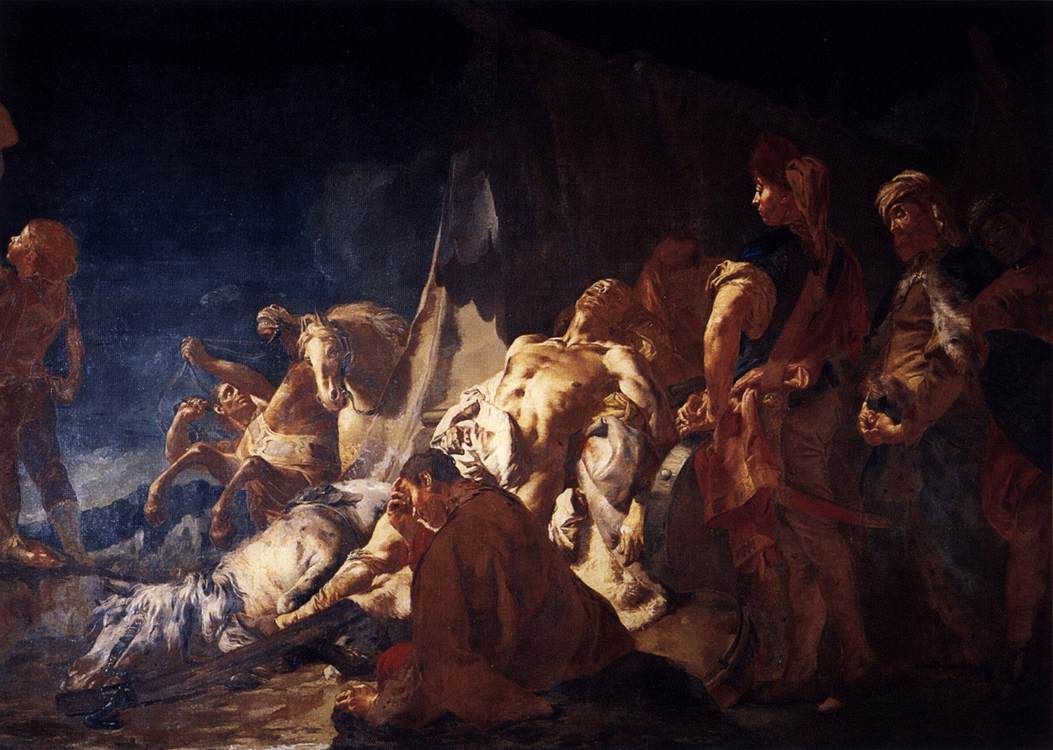
Arrian says Darius died of his wounds before Alexander reached him. Plutarch tells a more moving story: a Macedonian soldier named Polystratus found the king still alive in his wagon and gave him water, and Darius thanked him and asked him to tell Alexander that he was grateful for his kindness to his mother, wife and children. When Alexander arrived, Plutarch says, he took off his own cloak and laid it over the body.
Whatever the exact scene, Alexander made full use of the death. He sent the body to Persepolis to be buried among the kings, presented himself as Darius’s avenger, and treated the Achaemenid royal women as his own family. Arrian closes his account with a hard judgement on Darius as a soldier, but he also lists the misfortunes of a reign in which, he says, the king’s luck never once turned.
Bessus, the self-made Artaxerxes V
In Bactria, Bessus put on the upright tiara that only the Great King could wear and took the throne name Artaxerxes. For a year he was the Persian claimant, and Alexander had to fight his way through Areia, Drangiana and Arachosia, where Satibarzanes and Barsaentes resisted, before he could reach Bactria. When Alexander crossed the Hindu Kush in spring 329, Bessus retreated across the Oxus. His own allies, the Sogdian noble Spitamenes and Dataphernes, then handed him over to Alexander’s officer Ptolemy.
Arrian says Bessus was brought before Alexander naked and in a wooden collar, was whipped, and was sent to Bactra, where his nose and the tips of his ears were cut off. He was then taken to Ecbatana to be executed before an assembly of Medes and Persians. The mutilation followed Persian custom for rebels: the Behistun inscription describes Darius I inflicting the same punishment on the rebel Fravartish. Curtius and Plutarch give other, more gruesome versions of the execution. Spitamenes, who had betrayed Bessus, went on to lead a far more dangerous rising: see Spitamenes and the revolt of Bactria and Sogdiana.
The end of the dynasty
With Darius and Bessus dead, the house of the Achaemenids had no ruling king. In 324 BCE, at Susa, Alexander married Darius’s daughter Stateira, a link to the old dynasty that his successors could not use: after Alexander’s death in 323, Plutarch says, his widow Roxana had Stateira murdered. The empire passed to the Macedonians and then to the Seleucids, and the next Iranian dynasty to rule the plateau, the Parthians, came from outside the Achaemenid line, although later Parthian kings claimed descent from Artaxerxes II.
The Shahnameh’s version
The Persian epic remembers the scene with sympathy for both kings. In Ferdowsi’s Shahnameh, Dara is stabbed by two of his own ministers, Mahyar and Janushyar, who hope for a reward from Iskandar. Iskandar finds Dara dying, takes his head in his lap and weeps. The dying king asks him to marry his daughter Roshanak and to look after his family, and Iskandar has the two murderers hanged. The scene was one of the most often painted in Persian manuscripts; one example is shown on Alexander the Great in Iran.
Persian words from this page
| بسوس | Besus | Bessus |
| ماهیار | Mâhyâr | one of Dara’s murderers in the Shahnameh |
| جانوشیار | Jânushyâr | the other murderer in the Shahnameh |
| دامغان | Dâmghân | Damghan, near ancient Hecatompylos |
| خیانت | khiyânat | betrayal |
| زنجیر | zanjir | chain |
Sources and further reading
- Arrian, Anabasis of Alexander 3.19 to 3.22, 3.25, 3.29 to 3.30 and 4.7
- Quintus Curtius Rufus, History of Alexander, Book 5; Plutarch, Life of Alexander 42 to 43
- Encyclopaedia Iranica, “Bessos“
- Pierre Briant, Darius in the Shadow of Alexander (2015)
- Ferdowsi, Shahnameh, the reign of Dara
Want to learn Persian? Get the free Starter Pack
Get the 14-page printable Starter Pack (all 32 letters, a 7-day reading plan, 100 core words and 20 survival phrases) and a short 5-email course. Free.
More in The Achaemenid Empire (550–330 BCE)
- Achaemenes, Teispes and the Early Persian Kings of Anshan
- Cyrus the Great: Birth, Legends and Rise to Power
- Cyrus Conquers Lydia: Croesus and the Battle of Thymbra
- The Persian Conquest of Ionia and Asia Minor
- Cyrus Takes Babylon (539 BCE)
- The Cyrus Cylinder
- Cyrus and the Return of the Jews
- The Death of Cyrus and the Massagetae
- Pasargadae: Cyrus’s Capital and Tomb
- The Tomb of Cyrus through History
- Cambyses II
- Cambyses Conquers Egypt: The Battle of Pelusium
- Bardiya and Gaumata: The Usurper Question
- Darius the Great Takes the Throne
- The Great Revolts of 522–521 BCE
- The Behistun Inscription
- The Persian Conquest of the Indus Valley
- Darius’s Scythian Campaign
- Darius’s Canal from the Nile to the Red Sea
- Darius’s Reforms: Satrapies, Taxes and Law
- The Royal Road and the Persian Postal System
- The Daric: Achaemenid Coinage and Economy
- The Ionian Revolt (499–493 BCE)
- The Greco-Persian Wars: An Overview
- Mardonius and the First Persian Expedition to Greece (492 BCE)
- The Battle of Marathon (490 BCE)
- The Death of Darius I and the Succession of Xerxes
- The Royal Tombs of Naqsh-e Rostam
- Xerxes I: King of Kings (486–465 BCE)
- Xerxes’ Invasion of Greece (480–479 BCE)
- The Battle of Thermopylae (480 BCE)
- The Battle of Artemisium (480 BCE)
- The Persian Capture of Athens (480–479 BCE)
- The Battle of Salamis (480 BCE)
- The Battle of Plataea and the End of the Invasion (479 BCE)
- The Palace of Darius at Susa
- Building Persepolis: How Darius and Xerxes Built Parsa
- The Persepolis Fortification and Treasury Tablets
- Herodotus and the Persians
- The Apadana Reliefs: Nations Bringing Gifts
- The Achaemenid Paradise Gardens
- The Persian Immortals and the Achaemenid Army
- The Achaemenid Navy
- Religion of the Achaemenid Kings
- Women of the Achaemenid Court
- Old Persian Language and Cuneiform
- Egypt under Persian Rule
- Babylon under Persian Rule
- Artaxerxes I
- The Peace of Callias
- Darius II and the Peloponnesian War
- Famous Satraps of the Persian Empire
- Artaxerxes II Mnemon
- Cyrus the Younger and the Battle of Cunaxa
- The King’s Peace (387 BCE)
- The Great Satraps’ Revolt
- Artaxerxes III and the Reconquest of Egypt
- Darius III, the Last Achaemenid King
- The Battle of the Granicus (334 BCE)
- The Battle of Issus (333 BCE)
- Alexander Takes Tyre, Gaza and Egypt (332 BCE)
- The Battle of Gaugamela (331 BCE)
- Ariobarzanes and the Battle of the Persian Gate
- The Burning of Persepolis (330 BCE)
- The Death of Darius III and Bessus
- The Legacy of the Achaemenid Empire