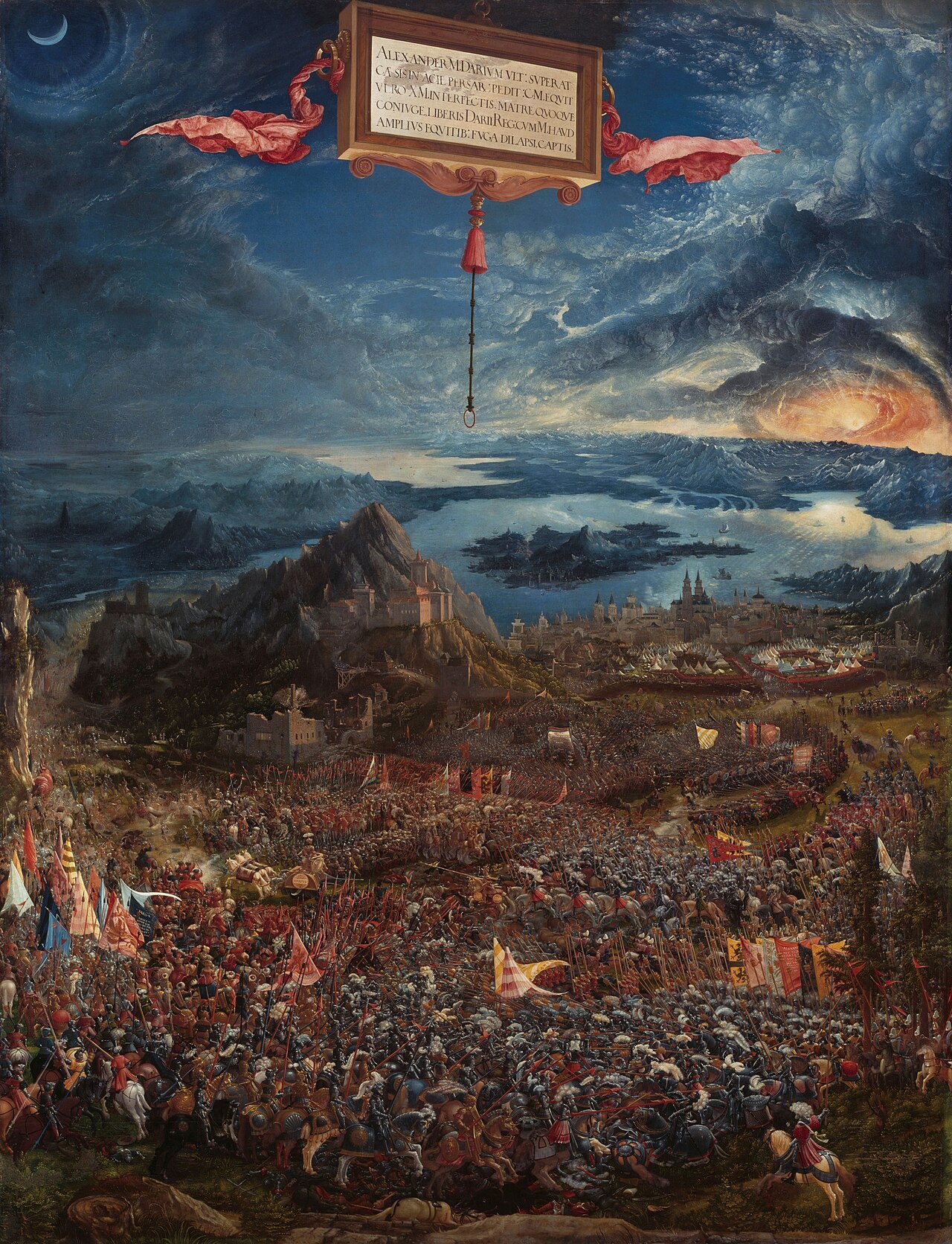
At Issus, in November 333 BCE, Darius III led the Persian royal army against Alexander for the first time and lost. The battle was fought on a narrow coastal plain at the corner of the Mediterranean, near the modern Turkish-Syrian border. Darius escaped, but his mother, wife and children were captured, and the road to Syria, Phoenicia and Egypt was open.
| Date | November 333 BCE |
|---|---|
| Place | River Pinarus, plain of Issus, near modern İskenderun, Turkey |
| Persian commander | Darius III, with Nabarzanes commanding the cavalry |
| Macedonian commander | Alexander III |
| Persian numbers | 600,000 (Arrian, Plutarch); about 250,000 (Curtius); modern guesses mostly 50,000 to 100,000 |
| Result | Macedonian victory; Persian royal family captured |
The king takes command
After the defeat of his satraps at the Granicus and the death of Memnon in 333 BCE, Darius III decided to fight Alexander himself. He assembled the army at Babylon and marched west to Sochi, an open plain in northern Syria east of the Amanus mountains. There his cavalry, the strongest arm of a Persian army, would have room to move.
Alexander was slow to come. He had fallen seriously ill at Tarsus, and then campaigned in Cilicia. Arrian says a Macedonian exile in Persian service, Amyntas, begged Darius to wait on the plain, but the king’s courtiers told him Alexander was afraid. Darius crossed the Amanus by a northern pass and came down to the coast at Issus, which put him behind Alexander, who had already marched south. The Persians killed or maimed the sick Macedonian soldiers left at Issus. The move cut Alexander’s communications, but it also put the Persian army on a strip of land between the sea and the mountains.
The battlefield
Alexander turned back and found the Persians drawn up behind the River Pinarus, which is usually identified with the Payas, though some scholars prefer the Deli Çay further north. The plain was only a few kilometres wide. The Greek historian Polybius, writing two centuries later, criticised Alexander’s court historian Callisthenes for describing a Persian army far too large to fit on it, which is one reason modern historians distrust the huge ancient figures.
Darius placed his Greek mercenaries in the centre, Arrian says about 30,000 of them, with Persian infantry called Cardaces on either side. Most of the Persian cavalry, under Nabarzanes, massed on the right by the sea. Troops posted on the foothills threatened Alexander’s right flank. Darius stood in the centre in his chariot, surrounded by his guard, as Persian custom required.

The fighting
The battle went well for Persia in two places. On the coast the Persian cavalry crossed the river and pressed the Thessalian horsemen hard. In the centre the Greek mercenaries caught the Macedonian phalanx as it broke formation crossing the stream, and killed one of its commanders, Ptolemy son of Seleucus, along with about 120 Macedonian officers.
The battle was decided on the other wing. Alexander led the Companion cavalry across the river against the Persian left, broke it, and turned towards Darius. Diodorus and Curtius describe a desperate fight around the king’s chariot, where his brother Oxathres led the defence. Alexander was wounded in the thigh. Darius turned his chariot and fled; when the ground grew rough he took to horseback, and Arrian says he left behind his shield, his bow and his royal cloak. Once the king’s flight was known, the Persian cavalry on the coast broke too, and the crowded retreat through the river beds caused heavy losses.
The Persian story of the battle has not survived. No Persian or Babylonian account of Issus is known, so we cannot tell how Darius explained his flight. To the Greek writers it was cowardice; to some modern historians it was the act of a king who knew that his death would end the empire, and who meant to raise another army.
The royal family captured
The Macedonians took the Persian camp, with Darius’s tent, his chariot and his household. Inside were his mother Sisygambis, his wife Stateira, his two daughters and his young son. Arrian and Curtius tell how the women mourned Darius as dead until Alexander sent word that he was alive, and how, when Alexander visited them, Sisygambis bowed to his friend Hephaestion, taller and more richly dressed, by mistake. Arrian is careful to add that he reports the story without vouching for it.
Alexander treated the women as royalty, kept their titles and servants, and later married Darius’s elder daughter. Their captivity gave him a powerful hold over the dynasty.
Soon afterwards Parmenion took Damascus, where Darius had sent his treasure and baggage. Besides thousands of talents in coin, he captured noble Persian women, including Barsine, widow of Memnon, and envoys from Athens, Sparta and Thebes who had come to negotiate with the king. A letter of Parmenion quoted by the later writer Athenaeus listed hundreds of the court’s musicians, cooks and perfume makers among the captives.
Losses and letters
Arrian claims 100,000 Persians died, including 10,000 cavalry, and that Macedonian losses were a few hundred. Neither figure should be trusted. What is certain is that the Persian army as a whole did not survive. About 8,000 Greek mercenaries escaped by sea, some ending in Egypt; Darius crossed the Euphrates with a few thousand men.
From the far side of the river he wrote to Alexander. Arrian gives his letter as a request for his family and an offer of friendship and alliance, king to king. Alexander’s answer told Darius to address him as lord of Asia. A second Persian offer followed during the siege of Tyre.
- Summer 333 BCE Darius gathers the royal army at Babylon
- Autumn 333 Persian camp at Sochi; Alexander delayed in Cilicia
- November 333 Darius crosses the Amanus and takes Issus; battle on the Pinarus
- Winter 333/332 Parmenion takes Damascus; Darius’s first letter to Alexander
The famous Alexander Mosaic from Pompeii, which shows Darius turning in his chariot as his army breaks, may show Issus or Gaugamela; a detail of it is on the page about Darius III. The decisive battle came two years later at Gaugamela.
Persian words from this page
| ارابه | arâbe | chariot |
| کمان | kamân | bow |
| سپر | separ | shield |
| مادر | mâdar | mother |
| دمشق | Dameshq | Damascus |
| فرات | Forât | the Euphrates |
Sources and further reading
- Arrian, Anabasis of Alexander 2.6 to 2.14
- Quintus Curtius Rufus, History of Alexander, Book 3; Diodorus of Sicily 17.32 to 17.39
- Polybius, Histories 12.17 to 12.22 (criticism of Callisthenes’ account)
- Pierre Briant, Darius in the Shadow of Alexander (2015)
- A. B. Bosworth, A Historical Commentary on Arrian’s History of Alexander, vol. 1 (1980)
Want to learn Persian? Get the free Starter Pack
Get the 14-page printable Starter Pack (all 32 letters, a 7-day reading plan, 100 core words and 20 survival phrases) and a short 5-email course. Free.
More in The Achaemenid Empire (550–330 BCE)
- Achaemenes, Teispes and the Early Persian Kings of Anshan
- Cyrus the Great: Birth, Legends and Rise to Power
- Cyrus Conquers Lydia: Croesus and the Battle of Thymbra
- The Persian Conquest of Ionia and Asia Minor
- Cyrus Takes Babylon (539 BCE)
- The Cyrus Cylinder
- Cyrus and the Return of the Jews
- The Death of Cyrus and the Massagetae
- Pasargadae: Cyrus’s Capital and Tomb
- The Tomb of Cyrus through History
- Cambyses II
- Cambyses Conquers Egypt: The Battle of Pelusium
- Bardiya and Gaumata: The Usurper Question
- Darius the Great Takes the Throne
- The Great Revolts of 522–521 BCE
- The Behistun Inscription
- The Persian Conquest of the Indus Valley
- Darius’s Scythian Campaign
- Darius’s Canal from the Nile to the Red Sea
- Darius’s Reforms: Satrapies, Taxes and Law
- The Royal Road and the Persian Postal System
- The Daric: Achaemenid Coinage and Economy
- The Ionian Revolt (499–493 BCE)
- The Greco-Persian Wars: An Overview
- Mardonius and the First Persian Expedition to Greece (492 BCE)
- The Battle of Marathon (490 BCE)
- The Death of Darius I and the Succession of Xerxes
- The Royal Tombs of Naqsh-e Rostam
- Xerxes I: King of Kings (486–465 BCE)
- Xerxes’ Invasion of Greece (480–479 BCE)
- The Battle of Thermopylae (480 BCE)
- The Battle of Artemisium (480 BCE)
- The Persian Capture of Athens (480–479 BCE)
- The Battle of Salamis (480 BCE)
- The Battle of Plataea and the End of the Invasion (479 BCE)
- The Palace of Darius at Susa
- Building Persepolis: How Darius and Xerxes Built Parsa
- The Persepolis Fortification and Treasury Tablets
- Herodotus and the Persians
- The Apadana Reliefs: Nations Bringing Gifts
- The Achaemenid Paradise Gardens
- The Persian Immortals and the Achaemenid Army
- The Achaemenid Navy
- Religion of the Achaemenid Kings
- Women of the Achaemenid Court
- Old Persian Language and Cuneiform
- Egypt under Persian Rule
- Babylon under Persian Rule
- Artaxerxes I
- The Peace of Callias
- Darius II and the Peloponnesian War
- Famous Satraps of the Persian Empire
- Artaxerxes II Mnemon
- Cyrus the Younger and the Battle of Cunaxa
- The King’s Peace (387 BCE)
- The Great Satraps’ Revolt
- Artaxerxes III and the Reconquest of Egypt
- Darius III, the Last Achaemenid King
- The Battle of the Granicus (334 BCE)
- The Battle of Issus (333 BCE)
- Alexander Takes Tyre, Gaza and Egypt (332 BCE)
- The Battle of Gaugamela (331 BCE)
- Ariobarzanes and the Battle of the Persian Gate
- The Burning of Persepolis (330 BCE)
- The Death of Darius III and Bessus
- The Legacy of the Achaemenid Empire