The Battle of the Granicus, fought in May 334 BCE on a river in north-west Anatolia, was the first clash between Alexander of Macedon and the Persian Empire. A coalition of satraps from Asia Minor tried to stop him at the riverbank and kill him in a cavalry fight. They failed, many of the Persian commanders died, and western Anatolia lay open to the invader.
| Date | May 334 BCE |
|---|---|
| Place | River Granicus (modern Biga Çayı), Hellespontine Phrygia, north-west Turkey |
| Persian commanders | Arsites, Spithridates, Mithridates, Rhoesaces and other satraps; Memnon of Rhodes with Greek mercenaries |
| Macedonian commander | Alexander III, with Parmenion |
| Result | Macedonian victory; Persian loss of Asia Minor |
Persia waits for the invasion
The war did not begin with Alexander. Philip II had already sent an advance army across the Hellespont in 336 BCE, and Memnon of Rhodes, a Greek commander in Persian service, had pushed it back to a small bridgehead. When Alexander crossed in spring 334, with roughly 30,000 infantry and 5,000 cavalry by Arrian’s count, King Darius III was far away in the heart of the empire. Defence was left to the satraps of Asia Minor, the governors of the western provinces, who gathered their cavalry at Zeleia, east of the Hellespont.
The council of Zeleia
Arrian reports a war council there. Memnon advised against a battle. The Macedonian infantry was better, he said, and Alexander had little money and few supplies. The Persians should burn the crops and villages, retreat, and starve the invader out, while the Persian fleet carried the war to Greece. Arsites, satrap of Hellespontine Phrygia, refused to see a single house of his province burned, and the other Persians backed him. Arrian adds that they distrusted Memnon, a Greek who seemed to want to drag out the war to keep his position.
The decision makes sense from the Persian side. A satrap’s duty was to defend the king’s land and its people, and the Persian nobility saw itself as a cavalry class that met enemies in the field. A scorched-earth retreat would have destroyed the estates that paid for their troops.
Forces on the riverbank
The Persians drew up on the east bank of the Granicus, a river with steep banks that Alexander would have to cross. Arrian gives them 20,000 cavalry and nearly 20,000 Greek mercenary infantry. Diodorus gives 10,000 cavalry and 100,000 infantry, and Justin far more. Modern historians think the Persian infantry figure is much too large, though the cavalry may have been close to Arrian’s number. The Persians placed their horsemen along the bank and kept the mercenary infantry in a second line behind, an unusual order that Arrian criticises. It may reflect a plan to fight Alexander with cavalry at the water’s edge.

The battle
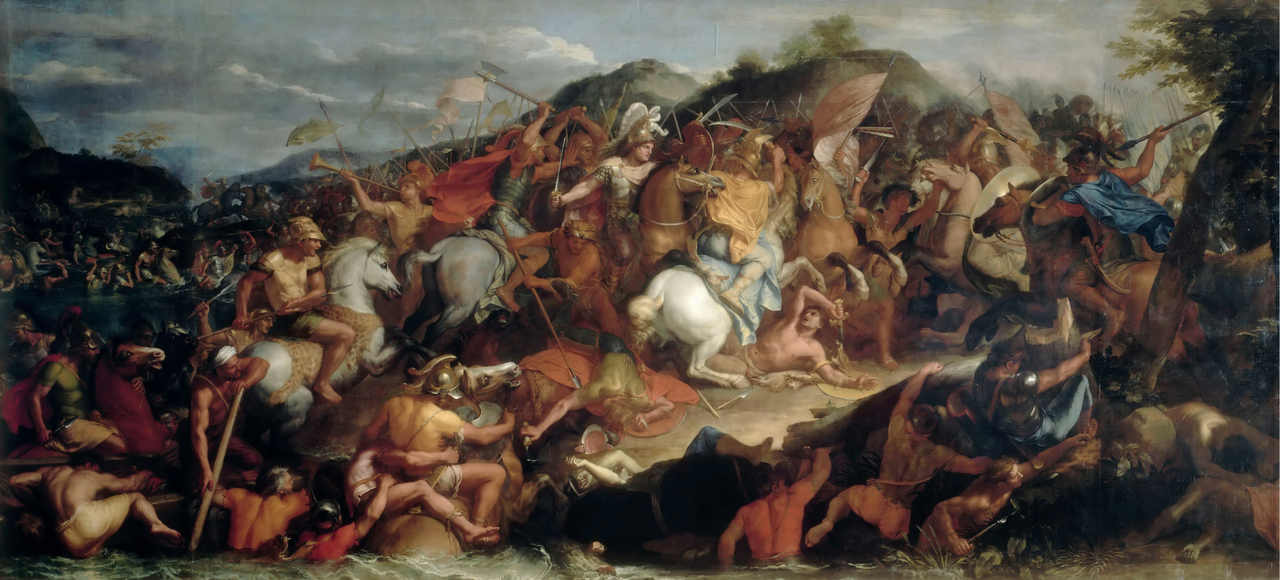
Arrian says Alexander attacked late in the day, against Parmenion’s advice to wait. A first force of cavalry and infantry went into the river on the right and took heavy losses from Persian javelins on the high bank. Then Alexander led the Companion cavalry across at an angle, so that his men came up the bank in a line.
What followed was a horseman’s fight on the bank. The Persian commanders threw themselves at Alexander, whose white plume made him easy to find. Alexander killed Mithridates, the son-in-law of Darius, with his lance. Rhoesaces struck Alexander’s helmet with his sword, and Spithridates, satrap of Lydia, raised his blade to finish him, but Cleitus the Black cut off Spithridates’ arm. Meanwhile the Macedonian infantry came across, and the Persian centre gave way.
The Greek mercenaries had not yet fought. They stood on a rise and, Plutarch says, asked for terms. Alexander refused, surrounded them and destroyed them. About 2,000 survivors were sent to Macedonia in chains to work as forced labourers, punished as Greeks who had fought for Persia against the Greek cause.
Two versions of the day
Diodorus tells a different story: Alexander camped for the night, crossed unopposed at dawn, and fought on the eastern bank. Some historians, such as Peter Green, think Arrian’s dramatic same-day assault hides a failed first attack, which Alexander’s court historians preferred to forget. The question is still open.
A heavy loss of Persian leaders
Arrian puts the Persian dead at about 1,000 cavalry; Plutarch gives 2,500 cavalry and 20,000 infantry. On the Macedonian side Arrian lists 25 Companions killed in the first charge, for whom Alexander ordered bronze statues from the sculptor Lysippus, and fewer than 100 others. The Macedonian figures are certainly too low.
The worst damage to Persia was among its leaders. Arrian names the dead: Spithridates; Mithridates; Mithrobuzanes, satrap of Cappadocia; Arbupales, a grandson of Artaxerxes II; Pharnaces, the brother of Darius’s wife; Niphates, Petenes, and Omares, commander of the mercenaries. Arsites escaped to Phrygia and, Arrian says, killed himself because the Persians blamed him for the defeat. So many senior nobles falling in a small cavalry action suggests they really did aim to kill Alexander personally, a gamble that nearly succeeded.
After the Granicus
Alexander sent 300 sets of Persian armour to Athens as an offering to Athena, with a dedication from “Alexander son of Philip and the Greeks, except the Spartans”. Sardis, the Persian capital of Lydia, surrendered without a fight; its commander Mithrenes later served Alexander. Miletus resisted and was taken by siege. At Halicarnassus Memnon and the Persian Orontobates held out for months before abandoning the city.
Darius now gave Memnon supreme command in the west. With the Persian fleet, Memnon took Chios and most of Lesbos in 333 and threatened to move the war into Greece, where Sparta was ready to rise. He died of illness while besieging Mytilene, and the naval strategy faded. The decisive battle on land came that autumn at Issus.
For the background to the satraps’ power in Anatolia, see the Great Satraps’ Revolt; for the overall story of the war, start with Darius III.
Persian words from this page
| رود | rud | river |
| سواره | savâre | cavalry, horseman |
| پیاده | piyâde | infantry, on foot |
| نبرد | nabard | battle |
| سارد | Sârd | Sardis |
| مزدور | mozdur | mercenary, hired man |
Sources and further reading
- Arrian, Anabasis of Alexander 1.12 to 1.16
- Diodorus of Sicily, Library of History 17.18 to 17.21; Plutarch, Life of Alexander 16
- Pierre Briant, Darius in the Shadow of Alexander (2015)
- Peter Green, Alexander of Macedon, 356 to 323 B.C.: A Historical Biography (1991)
- A. B. Bosworth, Conquest and Empire: The Reign of Alexander the Great (1988)
Want to learn Persian? Get the free Starter Pack
Get the 14-page printable Starter Pack (all 32 letters, a 7-day reading plan, 100 core words and 20 survival phrases) and a short 5-email course. Free.
More in The Achaemenid Empire (550–330 BCE)
- Achaemenes, Teispes and the Early Persian Kings of Anshan
- Cyrus the Great: Birth, Legends and Rise to Power
- Cyrus Conquers Lydia: Croesus and the Battle of Thymbra
- The Persian Conquest of Ionia and Asia Minor
- Cyrus Takes Babylon (539 BCE)
- The Cyrus Cylinder
- Cyrus and the Return of the Jews
- The Death of Cyrus and the Massagetae
- Pasargadae: Cyrus’s Capital and Tomb
- The Tomb of Cyrus through History
- Cambyses II
- Cambyses Conquers Egypt: The Battle of Pelusium
- Bardiya and Gaumata: The Usurper Question
- Darius the Great Takes the Throne
- The Great Revolts of 522–521 BCE
- The Behistun Inscription
- The Persian Conquest of the Indus Valley
- Darius’s Scythian Campaign
- Darius’s Canal from the Nile to the Red Sea
- Darius’s Reforms: Satrapies, Taxes and Law
- The Royal Road and the Persian Postal System
- The Daric: Achaemenid Coinage and Economy
- The Ionian Revolt (499–493 BCE)
- The Greco-Persian Wars: An Overview
- Mardonius and the First Persian Expedition to Greece (492 BCE)
- The Battle of Marathon (490 BCE)
- The Death of Darius I and the Succession of Xerxes
- The Royal Tombs of Naqsh-e Rostam
- Xerxes I: King of Kings (486–465 BCE)
- Xerxes’ Invasion of Greece (480–479 BCE)
- The Battle of Thermopylae (480 BCE)
- The Battle of Artemisium (480 BCE)
- The Persian Capture of Athens (480–479 BCE)
- The Battle of Salamis (480 BCE)
- The Battle of Plataea and the End of the Invasion (479 BCE)
- The Palace of Darius at Susa
- Building Persepolis: How Darius and Xerxes Built Parsa
- The Persepolis Fortification and Treasury Tablets
- Herodotus and the Persians
- The Apadana Reliefs: Nations Bringing Gifts
- The Achaemenid Paradise Gardens
- The Persian Immortals and the Achaemenid Army
- The Achaemenid Navy
- Religion of the Achaemenid Kings
- Women of the Achaemenid Court
- Old Persian Language and Cuneiform
- Egypt under Persian Rule
- Babylon under Persian Rule
- Artaxerxes I
- The Peace of Callias
- Darius II and the Peloponnesian War
- Famous Satraps of the Persian Empire
- Artaxerxes II Mnemon
- Cyrus the Younger and the Battle of Cunaxa
- The King’s Peace (387 BCE)
- The Great Satraps’ Revolt
- Artaxerxes III and the Reconquest of Egypt
- Darius III, the Last Achaemenid King
- The Battle of the Granicus (334 BCE)
- The Battle of Issus (333 BCE)
- Alexander Takes Tyre, Gaza and Egypt (332 BCE)
- The Battle of Gaugamela (331 BCE)
- Ariobarzanes and the Battle of the Persian Gate
- The Burning of Persepolis (330 BCE)
- The Death of Darius III and Bessus
- The Legacy of the Achaemenid Empire