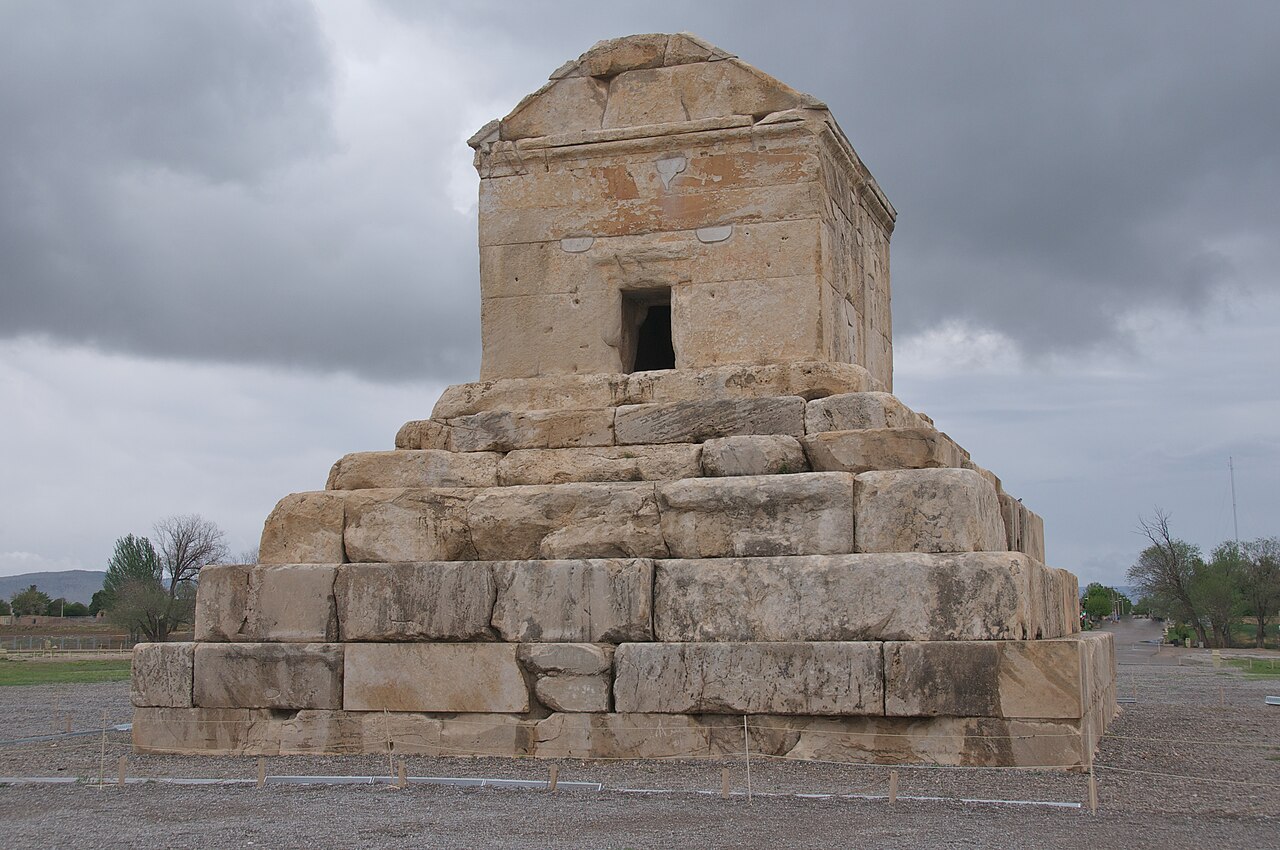
The tomb of Cyrus the Great at Pasargadae is a small stone house on six stepped tiers, about 11 metres high, built around 530 BCE for the founder of the Persian Empire. It has survived 2,500 years largely because its identity was forgotten: robbed in Alexander’s time and restored on his orders, it was later venerated as the shrine of the mother of Solomon, مشهد مادر سلیمان (Mashhad-e Mâdar-e Soleymân), and only identified again as Cyrus’s tomb in the nineteenth century.
| Built | c. 530 BCE, for Cyrus II (died 530 BCE) |
|---|---|
| Place | Pasargadae, Morghab plain, Fars province, about 1 km south-west of the palaces |
| Height | About 11 m including the lost roof stone |
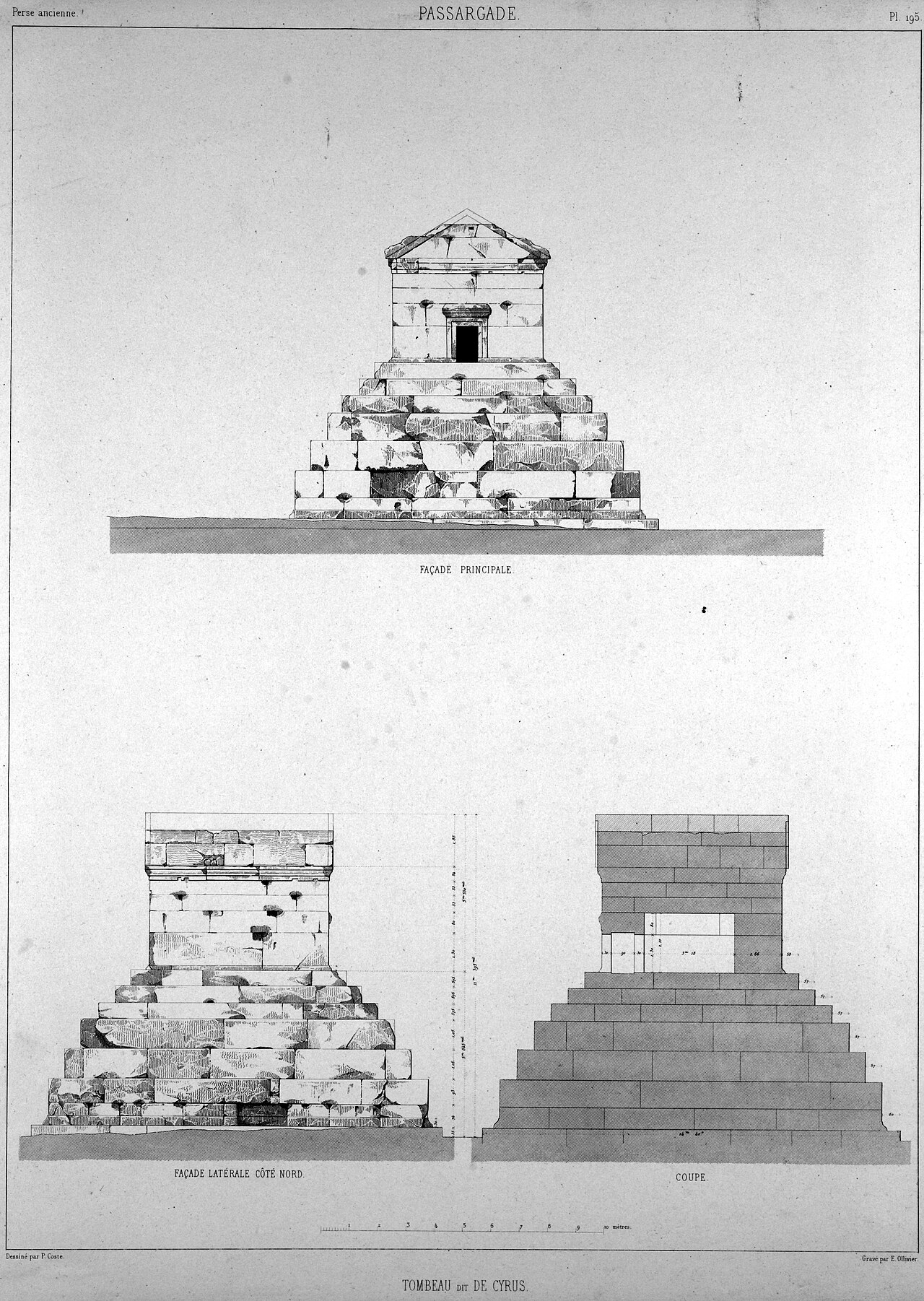
| Base | About 13.35 by 12.30 m; six receding tiers |
| Chamber | About 3.17 by 2.11 m inside, walls 1.5 m thick; doorway 0.78 m wide |
| Later name | Mashhad-e Mâdar-e Soleymân, “shrine of the mother of Solomon” |
| Status | Part of the UNESCO World Heritage Site of Pasargadae (2004) |
An unusual building
The tomb is unlike anything else in Iran. Its six steps are made of huge blocks of pale limestone. The three lower tiers are just over a metre high each, the three upper ones about half that, so the building seems to rise in two stages. On top sits a rectangular chamber with a pitched stone roof, entered through a low, narrow doorway on the north-west side. Inside the gable is a hollow space, perhaps to lighten the weight of the roof.
The stones are fitted without mortar. Joints were finished with smooth contact bands, a technique called anathyrosis, and the blocks were tied together with dovetail-shaped metal clamps. Both techniques came from Ionia and Lydia, which Cyrus had conquered around 547 BCE (see Cyrus conquers Lydia). Antigoni Zournatzi, writing in the Encyclopaedia Iranica, compares the chamber closely with the tomb of the Lydian king Alyattes at Sardis. The stepped base may recall Mesopotamian temple platforms, and the gabled house shape has been compared with buildings of the Zagros and Anatolia. The result is a combination of borrowed ideas into a new monument for a new empire.
The tomb was not set in an empty plain. Arrian says it stood in a royal park, with groves of trees, water channels and grass. Pasargadae as a whole, with its palaces and gardens, is described on Pasargadae: Cyrus’s capital and tomb.

What Alexander’s officers saw
Alexander came to Pasargadae early in 330 BCE, during his stay at Persepolis. One of his officers, Aristobulus, entered the tomb and later described it in a memoir that is lost but was used by Arrian (Anabasis 6.29) and Strabo (15.3.7). Inside, he said, were a golden coffin, a couch with feet of gold, rich textiles and tunics, swords, earrings and necklaces. Beside the tomb lived a family of Magi who guarded it, passing the duty from father to son. They received a sheep a day, an allowance of flour and wine, and a horse every month to sacrifice to Cyrus.
The same writers report an inscription. In Strabo’s version it ran roughly: “O man, I am Cyrus, who founded the empire of the Persians and was king of Asia. Do not begrudge me my monument.” No such epitaph has been found on the stones, and Zournatzi suggests Aristobulus, writing from memory, may have confused it with the short “I am Cyrus” inscriptions on the palaces. Another of Alexander’s men, Onesicritus, described the tomb as a tower of ten storeys, a sign of how unreliable these memories could be.
Robbed and restored
When Alexander returned from India in 324 BCE he found the tomb broken into. The robbers had taken almost everything, tried to cut open the coffin, and thrown out the body. Arrian says Alexander was deeply upset and ordered Aristobulus to restore the tomb: to put back what remained of the body, replace the lid, repair the damage, and wall up the doorway with stone and mud, sealing it with the royal seal. The Magi were tortured to find the culprits but confessed nothing. Plutarch says a Macedonian from Pella named Polymachus was executed for the crime. Curtius claims the Persian satrap Orxines was put to death on a false charge of the robbery, because he had offended Alexander’s favourite Bagoas.
The episode shows Alexander presenting himself as the respectful heir of Cyrus, whose reputation was high among Greeks thanks to Xenophon’s Cyropaedia. It also shows that within six years of the fall of the dynasty the guards of the founder’s tomb could no longer protect it.
The mother of Solomon
After the Arab conquest the memory of Cyrus faded from the local landscape. Muslim and Persian tradition linked many ancient ruins to the prophet-king Solomon, who was believed to command the jinn, and the tomb became the burial place of his mother. The twelfth-century geographer Ibn al-Balkhi is reported to have written that anyone who entered it would be struck blind.
In the early thirteenth century the Salghurid atabeg of Fars, Sa’d ibn Zangi, turned the site into a mosque. A mihrab, the niche showing the direction of Mecca, was carved into the south-west wall of the chamber, with an Arabic inscription, and a courtyard mosque was built around the tomb using columns taken from the Achaemenid palaces. European visitors from the fifteenth century onwards describe a small shrine with Arabic writing, visited above all by women. The British diplomat James Morier, who travelled in Persia in 1808 and 1809, was told that only women were allowed inside, and he was among the first Europeans to suggest that this was the tomb of Cyrus described by Arrian.

Excavation and restoration
Ernst Herzfeld began the first excavations at Pasargadae in 1928. Iranian archaeologists under Ali Sami worked there between 1949 and 1955, and David Stronach of the British Institute of Persian Studies excavated in 1961 to 1963. Before the celebration of 2,500 years of Iranian monarchy in 1971 the remains of the medieval mosque around the tomb were cleared away and the columns returned near their original places; the mihrab inside the chamber was kept. The tomb was the setting for the opening ceremony of those celebrations, at which Mohammad Reza Shah addressed Cyrus directly (see the 2,500-year celebration).
The stones have weathered badly, and many metal clamps were torn out for their value in past centuries. A long conservation programme ran from about 2002 to 2009, and further work began in 2024.
A modern place of gathering
Since the late twentieth century the tomb has become a place of pilgrimage of a new kind. Iranians come at Nowruz, and on 29 October (7 Aban), an unofficial “Cyrus Day” linked to his entry into Babylon. In October 2016 a large crowd gathered there; in several later years the authorities closed the roads to the site around that date. For practical information, see Visiting Pasargadae and the site’s article on Pasargad.
Persian words from this page
| آرامگاه کوروش | ârâmgâh-e Kurosh | tomb of Cyrus |
| پاسارگاد | Pâsârgâd | Pasargadae |
| مادر سلیمان | mâdar-e Soleymân | mother of Solomon |
| محراب | mehrâb | prayer niche |
| سنگ | sang | stone |
| پله | pelle | step |
| مرغاب | Morghâb | the plain of Pasargadae |
Sources and further reading
- Arrian, Anabasis of Alexander 6.29; Strabo, Geography 15.3.7; Plutarch, Life of Alexander 69
- Antigoni Zournatzi, “Cyrus v. The Tomb of Cyrus“, Encyclopaedia Iranica (1993)
- David Stronach, Pasargadae: A Report on the Excavations Conducted by the British Institute of Persian Studies from 1961 to 1963 (Oxford, 1978)
- James Morier, A Journey through Persia, Armenia, and Asia Minor, to Constantinople, in the Years 1808 and 1809 (1812)
- UNESCO World Heritage List, “Pasargadae“
Want to learn Persian? Get the free Starter Pack
Get the 14-page printable Starter Pack (all 32 letters, a 7-day reading plan, 100 core words and 20 survival phrases) and a short 5-email course. Free.
More in The Achaemenid Empire (550–330 BCE)
- Achaemenes, Teispes and the Early Persian Kings of Anshan
- Cyrus the Great: Birth, Legends and Rise to Power
- Cyrus Conquers Lydia: Croesus and the Battle of Thymbra
- The Persian Conquest of Ionia and Asia Minor
- Cyrus Takes Babylon (539 BCE)
- The Cyrus Cylinder
- Cyrus and the Return of the Jews
- The Death of Cyrus and the Massagetae
- Pasargadae: Cyrus’s Capital and Tomb
- The Tomb of Cyrus through History
- Cambyses II
- Cambyses Conquers Egypt: The Battle of Pelusium
- Bardiya and Gaumata: The Usurper Question
- Darius the Great Takes the Throne
- The Great Revolts of 522–521 BCE
- The Behistun Inscription
- The Persian Conquest of the Indus Valley
- Darius’s Scythian Campaign
- Darius’s Canal from the Nile to the Red Sea
- Darius’s Reforms: Satrapies, Taxes and Law
- The Royal Road and the Persian Postal System
- The Daric: Achaemenid Coinage and Economy
- The Ionian Revolt (499–493 BCE)
- The Greco-Persian Wars: An Overview
- Mardonius and the First Persian Expedition to Greece (492 BCE)
- The Battle of Marathon (490 BCE)
- The Death of Darius I and the Succession of Xerxes
- The Royal Tombs of Naqsh-e Rostam
- Xerxes I: King of Kings (486–465 BCE)
- Xerxes’ Invasion of Greece (480–479 BCE)
- The Battle of Thermopylae (480 BCE)
- The Battle of Artemisium (480 BCE)
- The Persian Capture of Athens (480–479 BCE)
- The Battle of Salamis (480 BCE)
- The Battle of Plataea and the End of the Invasion (479 BCE)
- The Palace of Darius at Susa
- Building Persepolis: How Darius and Xerxes Built Parsa
- The Persepolis Fortification and Treasury Tablets
- Herodotus and the Persians
- The Apadana Reliefs: Nations Bringing Gifts
- The Achaemenid Paradise Gardens
- The Persian Immortals and the Achaemenid Army
- The Achaemenid Navy
- Religion of the Achaemenid Kings
- Women of the Achaemenid Court
- Old Persian Language and Cuneiform
- Egypt under Persian Rule
- Babylon under Persian Rule
- Artaxerxes I
- The Peace of Callias
- Darius II and the Peloponnesian War
- Famous Satraps of the Persian Empire
- Artaxerxes II Mnemon
- Cyrus the Younger and the Battle of Cunaxa
- The King’s Peace (387 BCE)
- The Great Satraps’ Revolt
- Artaxerxes III and the Reconquest of Egypt
- Darius III, the Last Achaemenid King
- The Battle of the Granicus (334 BCE)
- The Battle of Issus (333 BCE)
- Alexander Takes Tyre, Gaza and Egypt (332 BCE)
- The Battle of Gaugamela (331 BCE)
- Ariobarzanes and the Battle of the Persian Gate
- The Burning of Persepolis (330 BCE)
- The Death of Darius III and Bessus
- The Legacy of the Achaemenid Empire