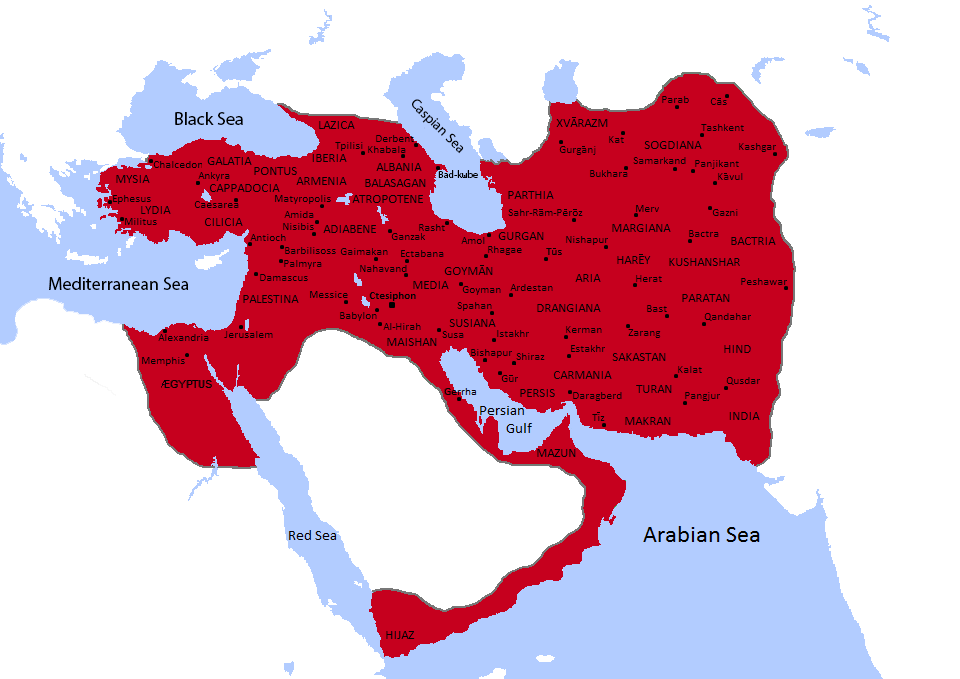
The Byzantine–Sasanian war of 602–628 was the last and greatest war between Rome and Persia. In its first twenty years the armies of Khosrow II conquered Byzantine Mesopotamia, Syria, Palestine and Egypt, took Jerusalem in 614 and reached the shores of the Bosporus, bringing the Sasanian Empire close to the borders of the Achaemenids. A Byzantine counterattack from 622 reversed everything, and both empires came out of the war exhausted, just before the rise of the Arab conquests.
| Dates | 602–628 CE (peace concluded 628–630) |
|---|---|
| Persian king | Khosrow II Parviz |
| Byzantine emperors | Phocas (602–610), Heraclius (610–641) |
| Persian generals | Shahrbaraz, Shahin, Rahzad and others |
| Persian conquests | Dara (c. 604), Edessa (609), Antioch (611), Damascus (613), Jerusalem (614), Egypt (618–621) |
| Result | Return to the pre-war frontier; both empires drained |
Revenge for Maurice
The war began as a quarrel over a murder. In November 602 the Byzantine emperor Maurice, who had helped Khosrow II recover his throne in 591, was overthrown and killed by an officer named Phocas. Khosrow declared that he would avenge his benefactor. He took up the cause of a young man presented as Maurice’s son Theodosius, who was said to have escaped the massacre, and promised to put him on the throne in Constantinople.
The cause was convenient. The peace of 591 had cost Persia much of Armenia and the fortress of Dara, and Khosrow, now secure at home, wanted them back. A Byzantine general in Edessa, Narses, also rebelled against Phocas and called on Persian help, which gave Khosrow an opening in Mesopotamia.

The war in Mesopotamia and Armenia, 603–610
The first years were a war of sieges. Khosrow himself led the army against Dara, which fell after a long siege, probably in 604 or 605. Over the next five years Persian forces took one Byzantine stronghold after another along the Euphrates and the Armenian frontier: Amida, Theodosiopolis, Edessa in 609. Phocas, busy with plots and revolts, could do little.
In 610 Heraclius, son of the governor of Africa, sailed to Constantinople and overthrew Phocas. Khosrow’s official reason for the war had gone, since Maurice was now avenged, but he did not stop. The new emperor’s peace offers were refused.
Syria, Jerusalem and the True Cross
From 610 the Persians crossed the Euphrates into Syria. Shahrbaraz, whose name means “boar of the empire”, took Antioch in 611 and defeated Heraclius himself outside the city in 613. Damascus fell the same year. Another army under Shahin drove deep into Asia Minor.
In the spring of 614 Shahrbaraz besieged Jerusalem. After about three weeks the walls were breached and the city was sacked. A monk of the monastery of Mar Saba, Antiochus Strategos, wrote a lament describing the massacre and the burning of churches; the death toll he gives, in the tens of thousands, cannot be checked and is probably exaggerated, but the sack was a shock across the Christian world. The Persians carried off the Patriarch Zacharias and the relic believed to be the True Cross to Ctesiphon. Some Jews of the region had supported the Persians, and for a short time a Jewish leadership was allowed authority in the city, before Persian policy changed in favour of the Christian majority.
In 615 Shahin reached Chalcedon, on the Asian shore facing Constantinople. A Byzantine embassy to Khosrow, offering to accept almost any terms, received no answer, and the envoys were held prisoner.
The conquest of Egypt
Egypt, the richest province of the eastern empire and the main source of Constantinople’s grain, fell between 618 and 621. Alexandria was taken in 619. For about ten years the Sasanians governed Egypt, Palestine and Syria. A large number of documents on papyrus written in Middle Persian survive from Egypt in these years, showing an occupation administration at work, collecting taxes and moving supplies. In church affairs the Persians generally favoured the Miaphysite Christians, who were the majority in Egypt and much of Syria and had been at odds with the imperial church.
At this moment, around 620, Khosrow ruled from the Caucasus to Egypt and from the Mediterranean to Central Asia. No Persian king had held so much territory since Darius III.
Turning point, 622–628
The Byzantine state did not collapse. Heraclius rebuilt his army with money borrowed from the Church, and in 622 he went on the offensive, not in Syria or Egypt but through Asia Minor and Armenia towards the heart of Iran. In 626 a joint attack on Constantinople by the Avars and Slavs in Europe, with Shahrbaraz’s army watching from the Asian shore, failed. In 627, with Turkish allies, Heraclius invaded Mesopotamia and won the battle of Nineveh. In February 628 Khosrow was overthrown by his son. These campaigns are told on Heraclius strikes back and the siege of Constantinople (626).
What the war cost
The peace made after 628 restored the old frontier. Shahrbaraz, who still held Egypt and Syria with his army, negotiated their evacuation with Heraclius, and the True Cross was returned to Jerusalem in 630. Twenty-six years of war had changed no borders.
It had changed much else. Cities in Syria, Anatolia and Mesopotamia had been sacked or emptied, armies destroyed, treasuries spent. In Iran the defeat discredited the king, set the great families against each other and led to four years of civil war. Plague returned in 627–628. When Arab armies appeared on the Euphrates in the 630s, they met two empires that had just spent a generation destroying each other’s strength. The long-term link is discussed in why the Sasanian Empire fell.
How the war is known
Almost all detailed sources are Christian: the Armenian history attributed to Sebeos, written within a generation, the Chronicon Paschale from Constantinople, the much later Byzantine chronicle of Theophanes, Syriac chronicles, and poems written for Heraclius by George of Pisidia. Persian views survive only in later Arabic and Persian histories, which say little about the western front and much about the court. Historians such as James Howard-Johnston have rebuilt the chronology from these scattered sources, but many dates, especially before 610, remain uncertain by a year or two.
- 602 Phocas murders Maurice; Khosrow II declares war
- c. 604 Fall of Dara after a long siege
- 609 Persians take Edessa
- 610 Heraclius becomes emperor
- 611 Shahrbaraz takes Antioch
- 613 Heraclius defeated near Antioch; fall of Damascus
- 614 Sack of Jerusalem; True Cross taken to Ctesiphon
- 615 Shahin at Chalcedon
- 619 Fall of Alexandria
- 622 Heraclius begins his counteroffensive
- 626 Siege of Constantinople fails
- 627 Battle of Nineveh
- 628 Khosrow II overthrown; peace
- 630 True Cross restored to Jerusalem
Persian words from this page
| شهربراز | Shahrbarâz | Shahrbaraz, “boar of the empire” |
| شاهین | Shâhin | Shahin; also “falcon” |
| روم | Rum | Rome, Byzantium |
| اورشلیم | Urshalim | Jerusalem |
| مصر | Mesr | Egypt |
| جنگ | jang | war |
Sources and further reading
- The Armenian History attributed to Sebeos, trans. R. W. Thomson, with commentary by James Howard-Johnston (Liverpool University Press, 1999).
- Chronicon Paschale 284–628 AD, trans. Michael and Mary Whitby (Liverpool University Press, 1989).
- Geoffrey Greatrex and Samuel N. C. Lieu, The Roman Eastern Frontier and the Persian Wars, Part II: AD 363–630 (Routledge, 2002).
- James Howard-Johnston, The Last Great War of Antiquity (Oxford University Press, 2021).
- Walter E. Kaegi, Heraclius, Emperor of Byzantium (Cambridge University Press, 2003).
Want to learn Persian? Get the free Starter Pack
Get the 14-page printable Starter Pack (all 32 letters, a 7-day reading plan, 100 core words and 20 survival phrases) and a short 5-email course. Free.
More in The Sasanian Empire (224–651 CE)
- The Origins of the Sasanian Family
- Ardashir I, Founder of the Sasanian Empire
- Firuzabad: Ardashir’s Round City
- Shapur I, King of Kings of Iran and Non-Iran
- Bishapur: Shapur’s City
- The Battle of Edessa and the Capture of Valerian
- The Ka’ba-ye Zartosht Inscription of Shapur I
- Mani and Manichaeism
- Hormizd I and Bahram I
- Kartir and the Zoroastrian Church
- Bahram II
- Narseh and the Peace of Nisibis
- Shapur II the Great
- Julian’s Invasion of Persia (363)
- Christians in the Sasanian Empire
- Shapur III and the Partition of Armenia
- Yazdegerd I
- Bahram V Gur
- Yazdegerd II
- The Battle of Avarayr (451)
- The Hephthalites and Iran’s Eastern Frontier
- Peroz I and the Hephthalite Disaster
- Kavad I
- Zamasp and Kavad’s Return
- Mazdak and the Mazdakite Movement
- Khosrow I Anushirvan the Just
- The Sasanian–Byzantine Wars of the 6th Century
- The Battle of Dara (530)
- Khosrow I Sacks Antioch (540)
- The Lazic War (541–562)
- The Reforms of Khosrow I
- The Academy of Gondishapur: History and Legend
- Borzuya, Chess and Kalila wa Dimna
- Taq Kasra: The Arch of Ctesiphon
- The Sasanian Conquest of Yemen
- The Sasanians and the Western Turks
- Hormizd IV
- Bahram Chobin’s Rebellion
- Khosrow II Parviz
- The Last Great War: Byzantium and Persia, 602–628
- The Siege of Constantinople (626)
- Heraclius Strikes Back
- Shirin: Queen and Legend
- Shahrbaraz, the General Who Became King
- Civil War and the Queens Boran and Azarmidokht
- Yazdegerd III, the Last Sasanian King
- The Sasanian Army
- Sasanian Society and the Class System
- Zoroastrianism under the Sasanians
- Sasanian Art: Silver, Reliefs and Silk
- The Sasanian Reliefs of Naqsh-e Rostam
- Taq-e Bostan
- Sasanian Cities, Palaces and Bridges
- Middle Persian (Pahlavi) Language and Literature
- Sasanian Coins and Silverwork
- Women in the Sasanian Empire
- Polo, Hunting and Games at the Sasanian Court
- The Sasanian Legacy