The Shahnameh, Ferdowsi’s epic finished in 1010, tells the history of Iran as a single line of about fifty reigns, from the first king, Kayumars, to the last Sasanian, Yazdegerd III. Its first half, the Pishdadian and Kayanian dynasties, is myth and legend drawn from the Avesta and Iranian oral tradition; its last third, the Sasanians, is largely real history. In between, the Achaemenids almost vanish and the Parthians shrink to a few lines.
This page compares the epic’s kings with what historians know. For the poet and how the book was written, see Ferdowsi and the Shahnameh; for the stories themselves, our article on the Shahnameh.
Three ages in one book
Scholars usually divide the Shahnameh into three parts. The mythical section runs from Kayumars to Fereydun and explains how civilisation began: fire, iron, clothing, the social classes, Nowruz. The heroic section, the longest and most loved, covers the wars between Iran and Turan and the deeds of Rostam, ending with his death. The historical section begins with Alexander and runs through the Sasanians to the Arab conquest. Ferdowsi did not invent this scheme. He took it from Sasanian court chronicles, the Khwaday-namag or “Book of Lords”, through a Persian prose version made in Tus in 957. These chronicles had already shaped the past to suit the Sasanian dynasty.
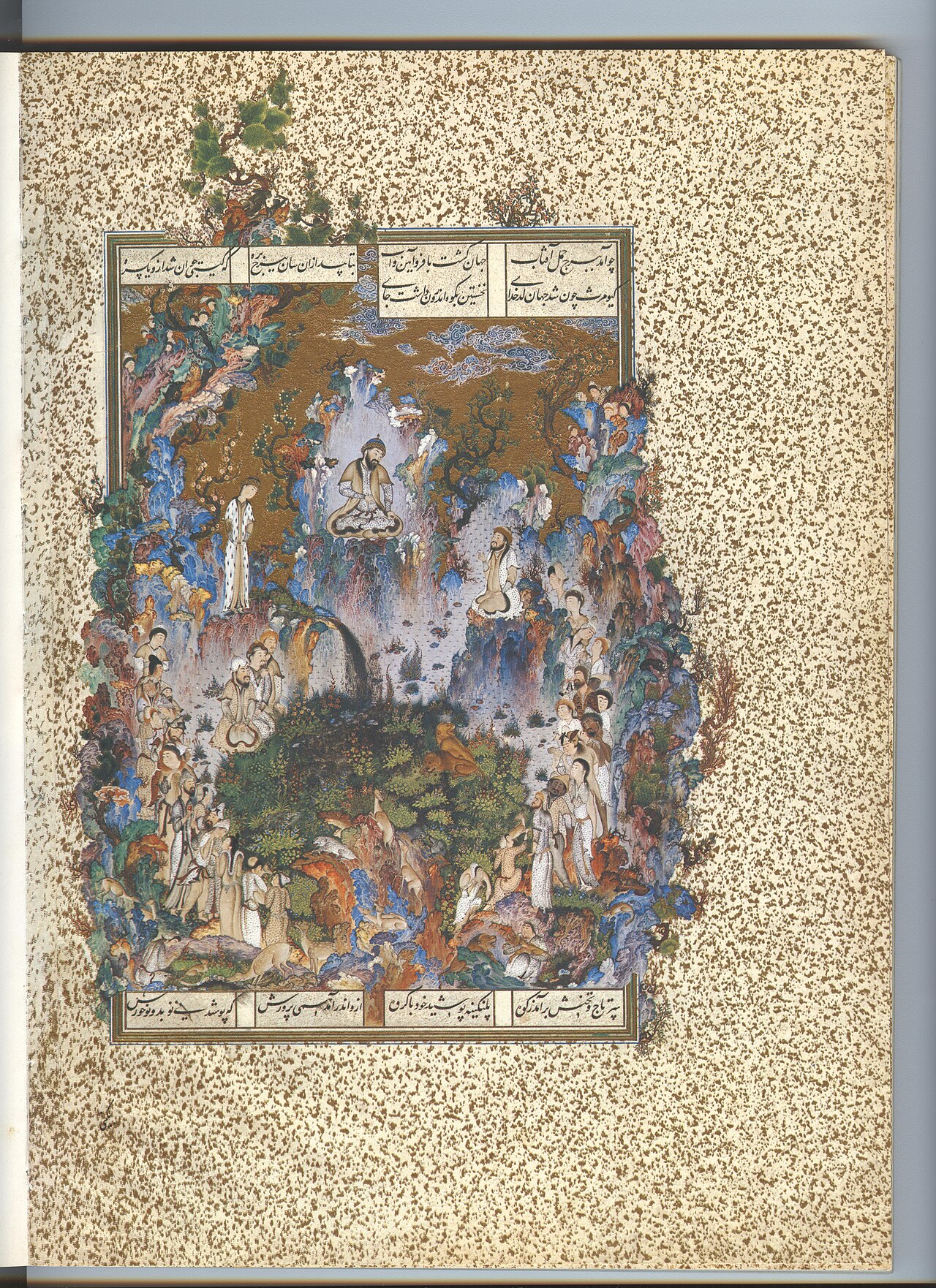

The Pishdadians: the first kings of the world
The name Pishdadian پیشدادیان comes from the Avestan title paradhata, given to the early king Haoshyangha (Hushang), and is usually explained as “the first to give the law”. Every Pishdadian has an older life in Zoroastrian or Indo-Iranian myth:
- Kayumars, the first king, is Gaya Maretan, the first man of Zoroastrian cosmology. The epic turns a primordial human into a king dressed in leopard skins.
- Hushang discovers fire by striking a stone, the origin story of the Sadeh festival.
- Jamshid is Avestan Yima, a close relative of the Indian Yama. He rules for centuries, invents crafts and founds Nowruz, then falls through pride. See Nowruz through history.
- Zahhak, the tyrant with snakes growing from his shoulders, is Azhi Dahaka, the three-headed dragon of the Avesta, turned into an Arab usurper.
- Fereydun, who defeats Zahhak with the help of Kaveh the blacksmith, is Avestan Thraetaona. He divides the world among his sons Salm, Tur and Iraj, and the murder of Iraj by his brothers starts the long feud of Iran and Turan.
None of these figures is historical. What the tales preserve is a memory of shared Indo-Iranian myth, many centuries older than any Iranian empire.
The Kayanians: an eastern Iranian memory
The Kayanian kings take their title from the Avestan kavi, a word used for princes in the Zoroastrian hymns. Kay Kavus, Kay Khosrow and Goshtasp correspond to Kavi Usan, Kavi Haosravah and Kavi Vishtaspa of the Avesta. Vishtaspa is the patron of Zoroaster, and in the Shahnameh Goshtasp accepts the new faith, a passage Ferdowsi took from the earlier poet Daqiqi.
Whether a real Kayanian dynasty lies behind these names is an old debate. Arthur Christensen argued that they reflect a ruling family of eastern Iran before the Achaemenids, and some still see a distant historical core. Most historians treat them as legend: the geography of the Kayanian stories points to the east, to Sistan, Balkh and Central Asia, not to Persis and Media where the historical empires arose. The name Vishtaspa was also borne by the father of Darius I, but no evidence links the two. See Zoroaster and the Avesta.
Where are the Medes and Achaemenids?
The most striking gap is the Persian Empire itself. Cyrus, Darius I and Xerxes, the best-known Iranians in world history, are absent by name. The Medes are absent altogether. Faint traces remain at the end of the Kayanian line:
- Bahman, also called Ardashir and nicknamed derazdast, “long-handed”, recalls Artaxerxes I, whom the Greeks called Makrocheir, “long hand” (see Artaxerxes I).
- Homay, Bahman’s daughter and successor, rules as queen.
- Darab and his son Dara carry the name Darius. Dara is defeated and killed in the reign of Iskandar, as the historical Darius III fell after his defeat by Alexander.
The Sasanians, who wrote the official history, knew little of the Achaemenids beyond names and ruins, and their chronicles had no use for a dynasty that did not lead to them. When Persians of later centuries saw Persepolis, they called it the throne of Jamshid, Takht-e Jamshid, because the epic gave them no other builder.
Iskandar: the conqueror made Iranian
The Shahnameh makes Alexander, Iskandar, a half-brother of Dara: the son of Darab and a daughter of Philip of Macedon, sent home before his birth. This turns the conquest into a family succession, and Iskandar becomes a legitimate Iranian king who seeks wisdom and the water of life. Zoroastrian texts, by contrast, call him “the accursed” for burning the sacred books. The two images, hero and destroyer, sit side by side in Persian memory. See Alexander in Iran.
The Parthians in a few lines
The Arsacids ruled Iran for nearly five centuries (247 BCE–224 CE), longer than any other dynasty. In the Shahnameh they fill a page. Ferdowsi says he knew little more than their names and gives them a total of about two hundred years. The reason lies in his sources: the Sasanians had overthrown the Parthians and had every reason to shorten their memory, folding them into a period of “petty kings”. Some Parthian material did survive by another route. Heroic families of the epic, such as the house of Gudarz, and the love story Vis and Ramin preserve a Parthian world. See the fall of the Parthians and the Parthian legacy.
The Sasanians: legend gives way to history
From Ardashir I onward, the Shahnameh’s king list matches what coins, inscriptions and the histories of Tabari and Byzantine writers record. The stories are still shaped for drama, but the frame is real:
- Bahram Gur the hunter-king, his years among the Arabs of Hira, and his love of music and the chase.
- Khosrow Anushirvan, his minister Bozorgmehr, and the arrival of chess from India.
- The rebel general Bahram Chobin and the long reign of Khosrow Parviz and Shirin.
- The death of Yazdegerd III, murdered near Merv in 651 by a miller, a story told in much the same way by Tabari.
Where the epic and the historians differ, the epic is usually telling the story the Sasanian court wanted told. Its value as a source for this period is real but needs to be checked against coins, inscriptions and outside writers.
Why the legendary history mattered
Until the 19th century, when Europeans deciphered cuneiform and read the Behistun inscription, the Shahnameh was the history of ancient Iran for Persian speakers. Court poets from the Ghaznavids to the Qajars praised their patrons as a new Jamshid or Kay Khosrow, and manuscripts of the epic were among the most lavish royal commissions. Reza Shah’s government in the 1930s promoted both: the restored Achaemenid past known from archaeology, and Ferdowsi’s millennium, celebrated in 1934 with a new tomb at Tus. Modern Iranians carry both histories, one from the epic and one from the textbooks.
Persian words from this page
| شاهنامه | Shâhnâme | Book of Kings |
| پیشدادیان | Pishdâdiyân | Pishdadians |
| کیانیان | Kiyâniyân | Kayanians |
| جمشید | Jamshid | Jamshid |
| ضحاک | Zahhâk | Zahhak |
| فریدون | Fereydun | Fereydun |
| اسکندر | Eskandar | Alexander |
| رستم | Rostam | Rostam |
For Ferdowsi’s own lines in Persian, see our collection of Ferdowsi quotes.
Sources and further reading
- Ferdowsi, Shahnameh, ed. Djalal Khaleghi-Motlagh; English translation by Dick Davis (2006).
- Ehsan Yarshater, “Iranian National History”, in The Cambridge History of Iran, vol. 3(1) (1983).
- Arthur Christensen, Les Kayanides (1931).
- Encyclopaedia Iranica, articles “Kayāniān” and “Pīšdādīān”.
- Tabari, History of Prophets and Kings, vol. 5, The Sasanids, the Byzantines, the Lakhmids and Yemen, trans. C. E. Bosworth (1999).
Want to learn Persian? Get the free Starter Pack
Get the 14-page printable Starter Pack (all 32 letters, a 7-day reading plan, 100 core words and 20 survival phrases) and a short 5-email course. Free.
More in Themes Across Iranian History (3000 BCE–today)
- A History of the Persian Language
- Zoroastrianism through the Ages
- Shi’a Islam in Iranian History
- The Jews of Iran
- The Armenians of Iran
- Christians of Iran
- The Baha’i Faith in Iran
- The Kurds in Iranian History
- Azerbaijanis in Iranian History
- The History of the Iranian Calendar
- Nowruz through History
- The Persian Garden (Pardis) through History
- Qanats: Iran’s Ancient Water Tunnels
- A History of Persian Carpets
- A History of Persian Architecture
- A History of Persian Painting
- A History of Persian Music
- Science in Iranian History
- Women in Iranian History
- Iran and the Silk Road
- Iran and China through History
- Iran and India through History
- Iran and Greece: Perceptions and Exchanges
- Persia and Rome: Seven Centuries of Rivalry
- Iran and the Ottoman Empire
- Iran and Russia through History
- Iran and Britain through History
- Iran and the United States
- How Iran’s Borders Changed
- The Capitals of Iran through History
- Coins of Iran through History: From the Daric to the Rial
- Flags and Symbols of Iran through History
- Myth and History in the Shahnameh: The Epic’s Kings and the Real Past
- Timeline of Iranian History: Key Dates from Elam to Today
- A History of Persian Cuisine: From Royal Banquets to Chelow Kabab
- A History of Persian Poetry: From Rudaki to Forough
- Wine in Iranian History: From Hajji Firuz to Hafez and Prohibition
- Sports in Iranian History: Polo, the Zurkhaneh and Wrestling
- List of Iranian Dynasties and Rulers