Middle Persian, often called Pahlavi, was the official language of the Sasanian Empire (224–651 CE) and the stage of Persian between the Old Persian of the Achaemenid kings and the New Persian spoken in Iran today. It was written in a difficult script derived from Aramaic, and its literature, most of it preserved by Zoroastrian priests, includes religious books, wisdom texts, romances and the lost royal chronicle that became the source of Ferdowsi’s Shahnameh.
| Language family | South-western Iranian, Indo-European |
|---|---|
| Own name | Parsig, “Persian” |
| Period of use | c. 3rd century BCE to the 9th–10th centuries CE (later among Zoroastrians) |
| Scripts | Inscriptional Pahlavi, Book Pahlavi, Psalter Pahlavi, Manichaean script |
| Main texts | Denkard, Bundahishn, Arda Wiraz Namag, Karnamag-i Ardashir, Madayan-i Hazar Datistan |
| Descendant | New Persian (Farsi, Dari, Tajik) |
Persian between two ages
Every learner of Persian is studying the third stage of a language with a recorded history of 2,500 years. Old Persian, the language of Darius’s inscriptions, had a rich system of noun cases and verb endings. By the time the Sasanians came to power, the spoken language of Fars had shed most of those endings and looked much more like the Persian of today. Words such as pidar (father), madar (mother) and brad (brother) are already close to modern پدر, مادر and برادر.
The Sasanians came from Fars, and their dialect became the language of the court and the empire. Early kings also used Parthian, the language of the dynasty they had overthrown: Shapur I’s great inscription on the Ka’ba-ye Zartosht is in Middle Persian, Parthian and Greek, and Narseh’s Paikuli inscription of the 290s is in Middle Persian and Parthian. After that, Middle Persian stood alone.
Why it is called Pahlavi
“Pahlavi” originally meant “Parthian”, from the name of the Parthian homeland, Parthava. Over time it came to mean the written language of pre-Islamic Iran in general, and Zoroastrian writers used it for their own Middle Persian books. Today “Pahlavi” usually refers to the script and to Zoroastrian Middle Persian literature, while scholars use “Middle Persian” for the language as a whole. The 20th-century Pahlavi dynasty took the name to stress its link with ancient Iran.
A script of puzzles
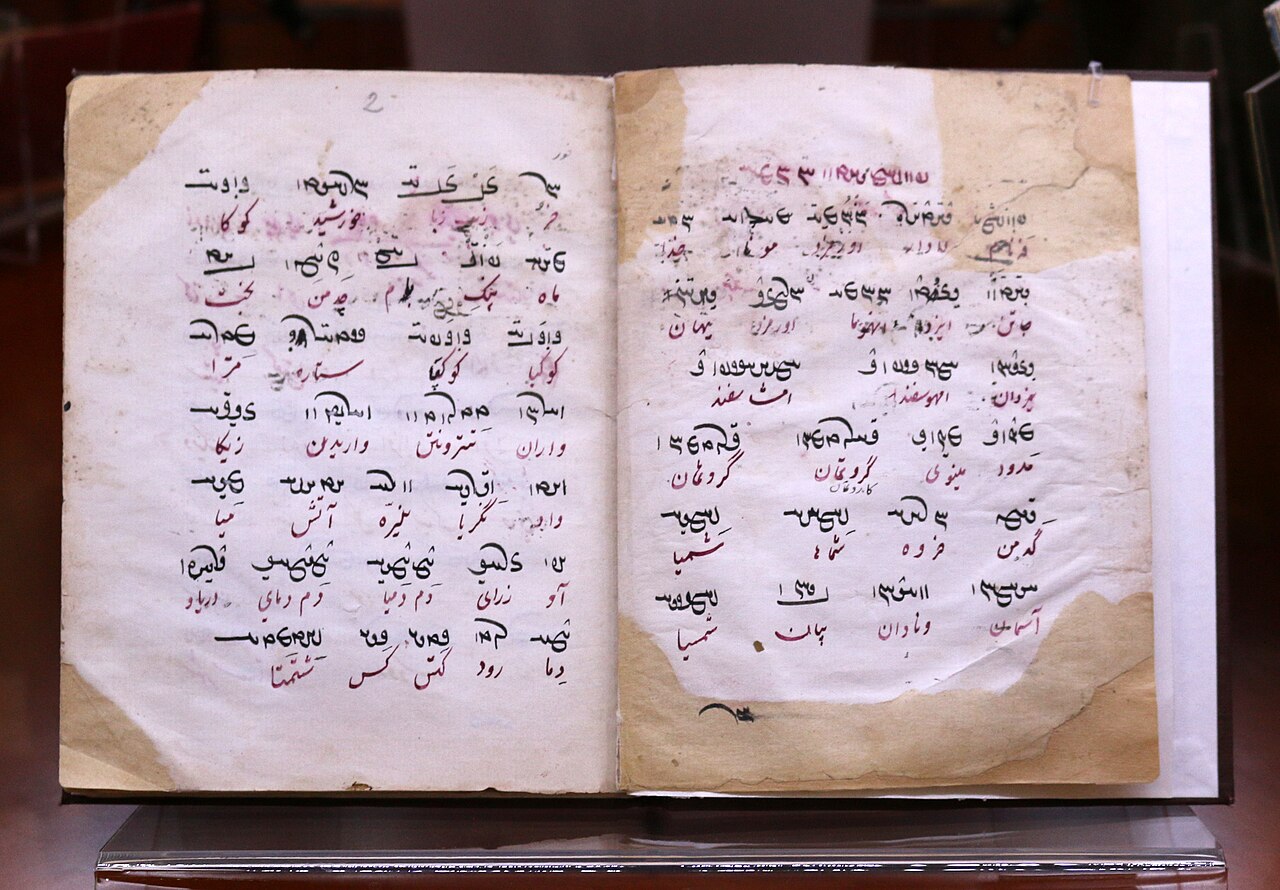
Middle Persian was written in an alphabet descended from the Aramaic script of the Achaemenid chancery. It is written from right to left, like modern Persian, and records mainly consonants. Two features make it hard to read.
Letters that merged
In the cursive Book Pahlavi used for most manuscripts, many letters came to look the same. A single sign can stand for several sounds, and some letters join in ways that create further ambiguity. A reader has to know the language to read the script.
Aramaic words read as Persian
Scribes also wrote many common words with their old Aramaic spelling, while reading them aloud in Persian. These “heterograms” or ideograms include MLKA, written in Aramaic letters but read shah, “king”, and LHMA, read nan, “bread”. The royal title “king of kings” was written MLKAn MLKA and pronounced shahan shah. It is rather like writing “e.g.” and saying “for example”.
Other scripts
Inscriptions on rock and coins used a clearer monumental form, Inscriptional Pahlavi. Christians wrote the Psalms in another variety, Psalter Pahlavi, known from a manuscript found at Turfan in Central Asia. Manichaeans wrote Middle Persian in their own clear script, and their texts from Turfan are important for reconstructing the pronunciation. Zoroastrian priests, unhappy with the ambiguity of Pahlavi for sacred words, created the Avestan alphabet, probably in the 5th or 6th century, with separate signs for every vowel, so that the Avesta could be written down exactly (see Zoroastrianism under the Sasanians).

The literature that survives
Much Sasanian literature was oral, and much that was written down has been lost. What survives was mostly copied by Zoroastrian communities in Iran and India, and much of it was compiled or edited in the 9th and 10th centuries, after the Arab conquest, on the basis of older material.
Religious books
The Denkard (“Acts of the Religion”) is a huge encyclopaedia of Zoroastrian learning, law and tradition. The Bundahishn (“Primal Creation”) tells of the creation of the world, the struggle between Ohrmazd and Ahriman, and the end of time. The Arda Wiraz Namag describes a righteous priest’s visionary journey through heaven and hell, with vivid punishments for sinners. There are also translations and commentaries of the Avesta, known as Zand.
Wisdom, romance and debate
Wisdom literature (andarz) gives advice attributed to kings and sages. The Karnamag-i Ardashir-i Pabagan, “Book of the Deeds of Ardashir son of Papak”, is a romance of the founder’s rise, close to the version later told in the Shahnameh. The Ayadgar-i Zareran is an epic about a hero of the Kayanid wars, and the Draxt-i Asurig is a verse debate between a date palm and a goat; both go back to Parthian originals. Khusraw ud Redag, “Khosrow and the Page”, has a young man answer the king’s questions about the best food, music, perfume and women: a window into court luxury.
Law and geography
The Madayan-i Hazar Datistan, “Book of a Thousand Judgements”, compiled in the early 7th century, records legal cases on property, marriage and inheritance. The Shahrestaniha-i Eran lists the cities of Iran and their legendary founders.
The lost Book of Lords
The most influential Middle Persian work does not survive. The Khwaday-namag, “Book of Lords”, was a royal history of Iran from the first mythical kings to the Sasanians, compiled at the late Sasanian court. In the 8th century Ibn al-Muqaffa translated it into Arabic, and other versions circulated. These versions fed the Arabic histories of al-Tabari and others, and a New Persian prose Shahnameh compiled at Tus in 957 for Abu Mansur, which in turn was a main source of Ferdowsi’s Shahnameh. Other Pahlavi books lived on in Arabic, including the animal fables of Kalila wa Dimna and the story collection Hazar Afsan, “A Thousand Tales”, an ancestor of the Thousand and One Nights.
After the Sasanians
Middle Persian did not vanish with the empire. The tax offices of the eastern caliphate kept their records in Pahlavi until the end of the 7th century, when the Umayyad governor al-Hajjaj ordered a switch to Arabic. Zoroastrian priests went on writing Pahlavi for centuries. Meanwhile the spoken language developed into New Persian, written from the 9th century in the Arabic alphabet, with many Arabic loanwords but a grammar and core vocabulary inherited from Middle Persian. That transition is told on the page on the birth of New Persian.
Persian words from this page
| پهلوی | Pahlavi | Pahlavi |
| پارسی | Pârsi | Persian (older name) |
| خداینامه | Khodâynâme | Book of Lords |
| کارنامه | kârnâme | book of deeds; today a school report |
| دینکرد | Dinkard | Denkard |
| شاهنشاه | shâhanshâh | king of kings |
| نان | nân | bread |
Sources and further reading
- D. N. MacKenzie, A Concise Pahlavi Dictionary (1971)
- Encyclopaedia Iranica, entries on the Middle Persian language and Pahlavi literature (iranicaonline.org)
- Ahmad Tafazzoli, Tarikh-e adabiyat-e Iran pish az Eslam (History of pre-Islamic Iranian literature, 1997)
- Prods Oktor Skjærvø, “Middle West Iranian”, in G. Windfuhr (ed.), The Iranian Languages (2009)
- Touraj Daryaee, Sasanian Persia (2009), chapter on language and literature
Want to learn Persian? Get the free Starter Pack
Get the 14-page printable Starter Pack (all 32 letters, a 7-day reading plan, 100 core words and 20 survival phrases) and a short 5-email course. Free.
More in The Sasanian Empire (224–651 CE)
- The Origins of the Sasanian Family
- Ardashir I, Founder of the Sasanian Empire
- Firuzabad: Ardashir’s Round City
- Shapur I, King of Kings of Iran and Non-Iran
- Bishapur: Shapur’s City
- The Battle of Edessa and the Capture of Valerian
- The Ka’ba-ye Zartosht Inscription of Shapur I
- Mani and Manichaeism
- Hormizd I and Bahram I
- Kartir and the Zoroastrian Church
- Bahram II
- Narseh and the Peace of Nisibis
- Shapur II the Great
- Julian’s Invasion of Persia (363)
- Christians in the Sasanian Empire
- Shapur III and the Partition of Armenia
- Yazdegerd I
- Bahram V Gur
- Yazdegerd II
- The Battle of Avarayr (451)
- The Hephthalites and Iran’s Eastern Frontier
- Peroz I and the Hephthalite Disaster
- Kavad I
- Zamasp and Kavad’s Return
- Mazdak and the Mazdakite Movement
- Khosrow I Anushirvan the Just
- The Sasanian–Byzantine Wars of the 6th Century
- The Battle of Dara (530)
- Khosrow I Sacks Antioch (540)
- The Lazic War (541–562)
- The Reforms of Khosrow I
- The Academy of Gondishapur: History and Legend
- Borzuya, Chess and Kalila wa Dimna
- Taq Kasra: The Arch of Ctesiphon
- The Sasanian Conquest of Yemen
- The Sasanians and the Western Turks
- Hormizd IV
- Bahram Chobin’s Rebellion
- Khosrow II Parviz
- The Last Great War: Byzantium and Persia, 602–628
- The Siege of Constantinople (626)
- Heraclius Strikes Back
- Shirin: Queen and Legend
- Shahrbaraz, the General Who Became King
- Civil War and the Queens Boran and Azarmidokht
- Yazdegerd III, the Last Sasanian King
- The Sasanian Army
- Sasanian Society and the Class System
- Zoroastrianism under the Sasanians
- Sasanian Art: Silver, Reliefs and Silk
- The Sasanian Reliefs of Naqsh-e Rostam
- Taq-e Bostan
- Sasanian Cities, Palaces and Bridges
- Middle Persian (Pahlavi) Language and Literature
- Sasanian Coins and Silverwork
- Women in the Sasanian Empire
- Polo, Hunting and Games at the Sasanian Court
- The Sasanian Legacy