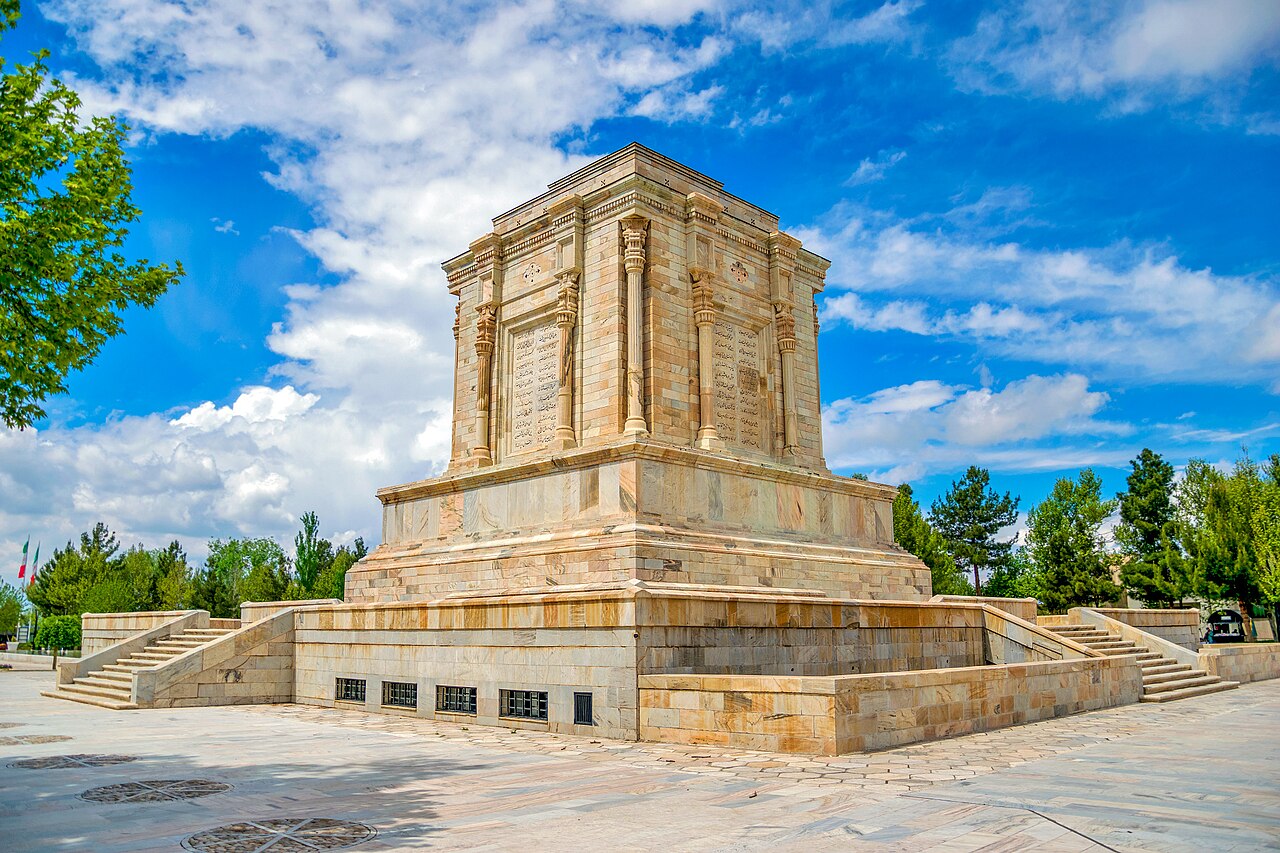
The Tomb of Ferdowsi (آرامگاه فردوسی, Ârâmgâh-e Ferdowsi) stands in a garden at Tus, about 25 km north-west of Mashhad, over the grave of the poet who wrote the Shahnameh. The white stone monument was first opened in 1934 for the thousandth anniversary of the poet’s birth and rebuilt in its present form in the 1960s. Its design deliberately echoes the tomb of Cyrus the Great, which says as much about 20th-century Iran as about the poet himself.
| Who is buried here | Abu’l-Qasem Ferdowsi (c. 940 – c. 1020), author of the Shahnameh |
|---|---|
| Location | Tus, Razavi Khorasan, about 25 km north-west of Mashhad |
| First monument | Opened 1934, designed by Karim Taherzadeh Behzad |
| Present building | Rebuilt by Houshang Seyhoun, completed 1968 |
| Complex | Garden of about 6 ha with a museum, library and the graves of two modern artists |
For the poet’s life and his epic, read Ferdowsi and the Shahnameh and our post on the Shahnameh. Here we look at the tomb, why it was built the way it was, and what to see.

A grave in a garden
Ferdowsi died in Tus around 1020. According to an early account preserved by Nezami Aruzi, a local preacher refused to allow him burial in the Muslim cemetery, so he was buried in his own garden. For centuries the grave was marked by little more than a small structure, and travellers who looked for it in the 19th and early 20th centuries found a modest, half-ruined platform.
A national monument, 1934
In the 1920s a group of reform-minded statesmen and scholars founded the Society for National Heritage (انجمن آثار ملی, Anjoman-e Âsâr-e Melli). They saw Ferdowsi, who had told the story of Iran’s kings in Persian with few Arabic words, as a founder of national identity. Money was raised from parliament and from donors, including Parsi Zoroastrians in India, and a design competition was held. Entries came from figures such as the archaeologist Ernst Herzfeld and the French architect André Godard, but the chosen design was by the Iranian architect Karim Taherzadeh Behzad.
The tomb was opened in 1934, during a millenary celebration attended by orientalists from Europe, the Soviet Union and India, under the eyes of Reza Shah. The style was chosen with intent: a stepped stone base and a cube-like upper storey that recall the tomb of Cyrus at Pasargadae, with columns and capitals borrowed from Persepolis and the winged Faravahar symbol on its faces. It was a statement that modern Iran traced its line back to the Achaemenids, through Ferdowsi.
Rebuilding in the 1960s
The 1934 building was not structurally sound and began to settle. In the 1960s it was taken down and rebuilt by the architect Houshang Seyhoun, who kept Taherzadeh Behzad’s basic design with changes to its proportions and decoration. The new tomb was completed in 1968. Seyhoun, who also designed the tombs of Omar Khayyam and Avicenna, gave Iran a whole generation of poets’ monuments.
After the 1979 revolution the tomb’s royal associations made it a target of criticism, but it survived, and today it is one of the most visited cultural sites in Khorasan.
What to see
The monument
Walk around the white stone tomb first. Verses from the Shahnameh are carved in Nastaliq script on its sides, including well-known lines in which the poet says that his work has made Persian live again. The Faravahar figure on the upper faces is the same symbol you see on Achaemenid reliefs.
The burial chamber
Steps lead down into a chamber under the monument where the grave lies. Its walls are lined with stone reliefs of scenes from the epic, carved in the 1960s by the sculptor Fereydoun Sadeghi: Rostam fighting the White Demon, the tragic duel of Rostam and Sohrab, and other episodes that Iranian visitors know from childhood.
The garden and statue
In front of the tomb, a long pool and a formal garden in the chahârbâgh pattern lead to a white statue of Ferdowsi by Abolhassan Sadighi. Families picnic on the lawns, and on special days storytellers and naqqâl performers recite episodes from the epic.
Museum, library and other graves
A small museum near the entrance shows finds from old Tus and material on the poet. The poet Mehdi Akhavan-Sales (died 1990) and the singer Mohammad-Reza Shajarian (died 2020) are also buried in the complex, and many visitors come to their graves too.
Old Tus and the Haruniyeh
Around the garden lie the remains of the medieval city of Tus, which was sacked several times and abandoned in favour of Mashhad. About 800 m away stands the Haruniyeh, a large brick dome of uncertain date and use, traditionally linked to Harun al-Rashid but more likely a Mongol-period building.
Practical notes
- Getting there: most people come from Mashhad by taxi or on a half-day tour, often combined with a visit to the Imam Reza shrine or a day trip to Neyshabur.
- When: spring and autumn are most pleasant. 15 May (25 Ordibehesht) is marked in Iran as Ferdowsi Day, and the site is busy then.
- Tickets and hours: check current official information; foreign visitors may pay a different rate.
- Safety: follow your own government’s travel advice for Iran.
For the wider region see our guide to Mashhad.
Persian words from this page
| آرامگاه | ârâmgâh | tomb, mausoleum |
| شاهنامه | Shâhnâmeh | Book of Kings |
| توس | Tus | Ferdowsi’s home town |
| رستم | Rostam | hero of the Shahnameh |
| نقال | naqqâl | storyteller who performs the epic |
| فروهر | Faravahar | winged symbol of ancient Iran |
Sources and further reading
- Encyclopaedia Iranica, “FERDOWSI, ABU’L-QĀSEM i. Life“.
- Nezami Aruzi, Chahar Maqala (Four Discourses), the earliest account of Ferdowsi’s burial.
- Talinn Grigor, Building Iran: Modernism, Architecture, and National Heritage under the Pahlavi Monarchs (Periscope, 2009), on the Society for National Heritage and the poets’ tombs.
- Afshin Marashi, Nationalizing Iran: Culture, Power, and the State, 1870–1940 (University of Washington Press, 2008), on the 1934 Ferdowsi millenary.
Want to learn Persian? Get the free Starter Pack
Get the 14-page printable Starter Pack (all 32 letters, a 7-day reading plan, 100 core words and 20 survival phrases) and a short 5-email course. Free.
More in Top Places to Visit in Iran
- Naqsh-e Jahan Square
- Shah (Imam) Mosque, Isfahan
- Sheikh Lotfollah Mosque
- Ali Qapu Palace
- Jameh Mosque of Isfahan
- Si-o-se Pol and Khaju Bridge
- Vank Cathedral
- Hasht Behesht Palace
- Naqsh-e Rostam
- Eram Garden, Shiraz
- Nasir al-Molk (Pink) Mosque
- Tomb of Hafez (Hafezieh)
- Tomb of Saadi (Saadieh)
- Shah Cheragh Shrine
- Arg of Karim Khan
- Fin Garden, Kashan
- Historic Houses of Kashan
- Jameh Mosque of Yazd
- Yazd Fire Temple and Towers of Silence
- Dowlatabad Garden and Windcatcher
- Amir Chakhmaq Complex
- Golestan Palace
- National Museum of Iran
- Treasury of National Jewels
- Tehran Grand Bazaar
- Milad Tower
- Imam Reza Shrine, Mashhad
- Tomb of Ferdowsi, Tus
- Tomb of Omar Khayyam, Neyshabur
- Tomb of Avicenna, Hamadan
- Ganjnameh Inscriptions, Hamadan
- Behistun (Bisotun): Visiting the Site
- Taq-e Bostan: Visiting the Site
- Tabriz Historic Bazaar
- Takht-e Soleyman
- Armenian Monastic Ensembles of Iran
- Sheikh Safi al-Din Shrine, Ardabil
- Dome of Soltaniyeh
- Alamut Castle
- Falak-ol-Aflak Castle
- Shushtar Historical Hydraulic System
- Chogha Zanbil: Visiting the Ziggurat
- Susa Archaeological Site
- Arg-e Bam
- Ganjali Khan Complex, Kerman
- Shazdeh Garden, Mahan
- Rayen Castle
- Dasht-e Lut (Lut Desert)
- Maranjab Desert and Caravanserai
- Varzaneh Desert
- Mount Damavand
- Hyrcanian Forests
- Lake Urmia
- Badab-e Surt Springs
- Ali Sadr Cave
- The Kaluts of Shahdad
- Qeshm Geopark
- Hormuz Island Colours
- Visiting Persepolis: A Day Trip from Shiraz
- Visiting Pasargadae
- Persian Caravanserais
- The Qanat of Gonabad
- Meymand Village
- Sasanian Sites of Fars: Firuzabad, Bishapur and Sarvestan
- Gonbad-e Qabus: Visiting the Tower
- Zayandeh Rud and Isfahan’s Bridges
- Tochal and Darband: Hiking Above Tehran
- Mount Sabalan
- Skiing in Iran: Dizin and Shemshak
- Golestan National Park