Qazvin is the capital of Qazvin province, a city of about 400,000 people at the foot of the Alborz mountains 150 km north-west of Tehran. It was the capital of Safavid Iran for about forty years in the sixteenth century, before Shah Abbas I moved the court to Isfahan, and it is the gateway to the Alamut valley, where the Nizari Ismailis held their mountain castles.
| Persian name | قزوین (Ghazvin) |
|---|---|
| Province | Qazvin (capital) |
| Population | 402,748 (city, 2016 census, Statistical Centre of Iran) |
| Elevation | About 1,300 m |
| Safavid capital | From the 1550s under Tahmasp I until Abbas I moved to Isfahan (1590s) |
| Languages heard | Persian, Azerbaijani Turkish, Tati in some villages |
| Distance | About 150 km north-west of Tehran; about 170 km south of Rasht |
A frontier post against the Daylamites
Qazvin grew up where the road from the plateau to Azerbaijan meets the road over the Alborz to the Caspian. Persian and Arab tradition credits the Sasanian king Shapur II with founding a fortified town here to watch the warlike Daylamites of the mountains. After the Arab conquest it remained a frontier garrison, and in the Abbasid period Harun al-Rashid is said to have built its walls and a mosque.
The city prospered under the Seljuks. Its Friday Mosque keeps a large domed prayer hall with fine brick and stucco inscriptions from the early twelfth century. The Mongols sacked Qazvin in 1220, but it recovered. Its best-known medieval son is Hamdallah Mustawfi, the fourteenth-century historian and geographer, whose tomb, with its turquoise conical dome, stands in the city. The satirical poet Obeyd Zakani also came from Qazvin.

Capital of the Safavids
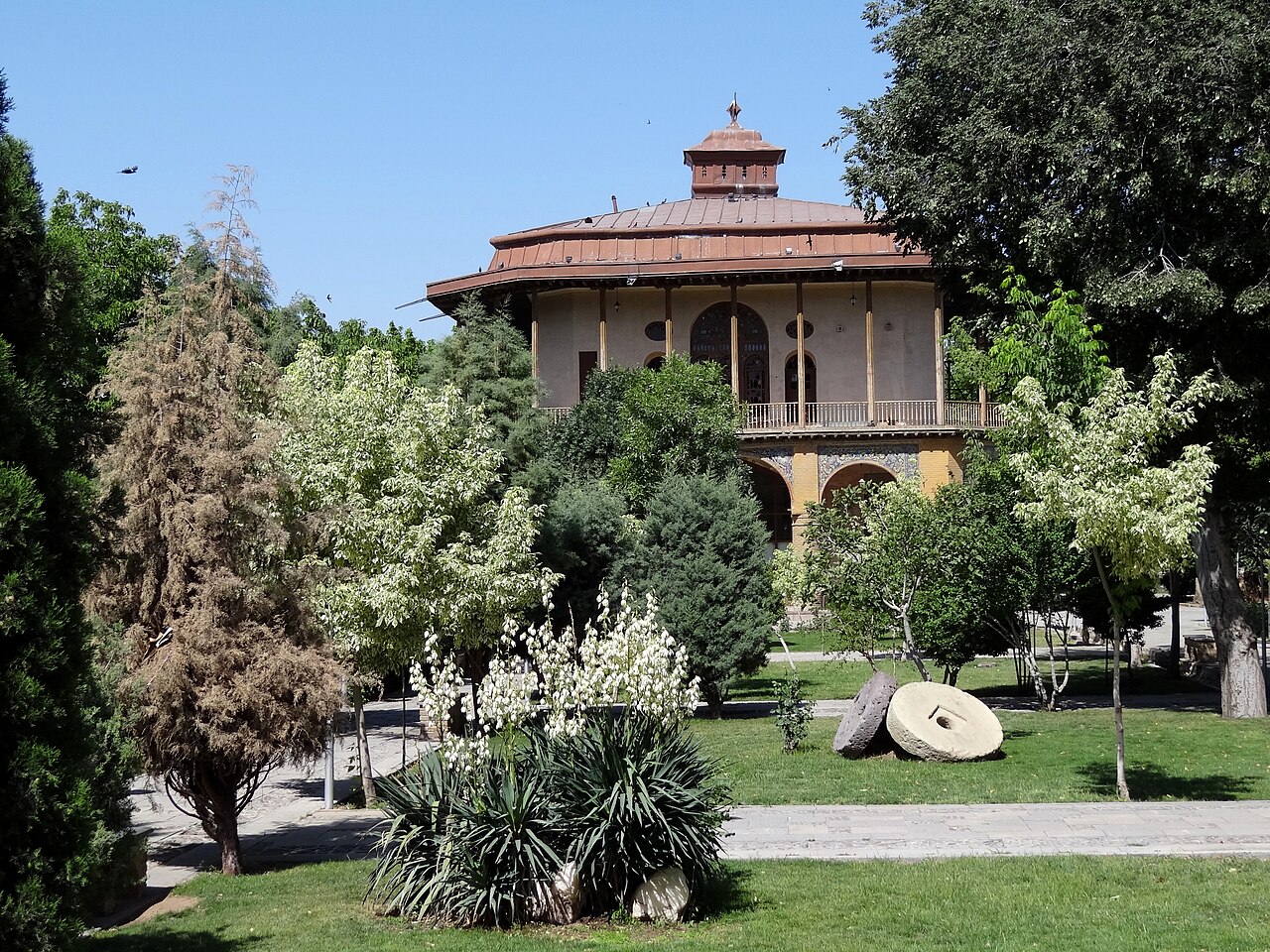
Tabriz, the first Safavid capital, was exposed to Ottoman invasion, and in the mid-sixteenth century Shah Tahmasp I moved his court to Qazvin. Dates given by historians range from 1548 to 1555. He laid out a new royal quarter with gardens, palaces, a great square and the Ali Qapu (“Lofty Gate”). Qazvin remained the capital under Ismail II and Mohammad Khodabanda, and Abbas I ruled from it for the first years of his reign before moving to Isfahan in the 1590s. The history of these decades is on the page about Qazvin, the second Safavid capital.
What survives
- The Chehel Sotoun or Kolah Farangi, a two-storey pavilion from Tahmasp’s palace garden, now a museum of calligraphy. Qazvin produced some of Iran’s greatest calligraphers, including Mir Emad, a master of the nasta’liq script.
- The Ali Qapu gate of the palace precinct, later altered.
- The shrine of Shahzadeh Hossein, rebuilt and enlarged under the Safavids and Qajars.
Caravanserais, cisterns and the bazaar
Qazvin was a trading city on the road between Tehran, Tabriz and Rasht, and much of its fabric dates from the Qajar period. The Sa’d al-Saltaneh caravanserai, a late Qajar complex of courtyards, domed halls and shops, is one of the largest urban caravanserais in Iran and has been restored as a centre for cafés, craft shops and galleries. Around it runs the old bazaar.
The city is also known for its آبانبار (âb-anbâr), domed underground cisterns that stored water from qanats. Several survive, with long staircases down to the water level. Qazvin was also the place where the 1921 coup began: in February that year Reza Khan led Cossack Brigade troops from their camp near Qazvin to Tehran, the first step towards the Pahlavi state.
The jokes about Qazvinis
In Persian humour, people from Qazvin are the butt of a whole tradition of jokes. The theme is old: Rumi’s Masnavi, written in the thirteenth century, has the story of a Qazvini who goes to have a lion tattooed on his shoulder and cannot bear the pain of the needle. Our Masnavi story of the man of Qazvin and the lion tattoo tells it in Persian with a translation.
Alamut and the castles of the Assassins
North-east of Qazvin, beyond the first ranges of the Alborz, lies the Alamut valley. In 1090 Hassan-i Sabbah seized the castle of Alamut there and made it the headquarters of the Nizari Ismaili state, which held a network of castles until the Mongols took Alamut in 1256. The remains of Alamut castle stand on a rock above the village of Gazor Khan, and the larger fortress of Lambesar (Lamiasar) is further west. The valley is a day trip from Qazvin or an overnight stay. See visiting Alamut Castle, Hassan-i Sabbah and the fortress of Alamut, and the Nizari Ismailis and the “Assassins” legend.
Food and sweets
Qazvin’s sweet is baghlava (باقلوا), lozenges of almond and pistachio paste between thin layers of pastry, perfumed with rosewater and cardamom, quite different from Turkish baklava. Its signature dish is gheymeh nesar, a rice dish layered with slivers of lamb, barberries, almonds, pistachios and orange peel, served at weddings and on religious occasions.
Getting there
Qazvin is about two hours from Tehran by motorway and on the railway lines to Tabriz and Rasht, so it is an easy first stop on a route north or west. The Alamut valley is reached by a mountain road; check road conditions in winter. For opening hours, transport and safety advice, check current official information and your own government’s travel advice. Nearby on the same route are Zanjan and Rasht.
Persian words from this page
| قزوین | Ghazvin | Qazvin |
| الموت | Alamut | Alamut |
| چهلستون | Chehel Sotun | “forty columns” |
| عالیقاپو | Âli Ghâpu | “lofty gate” |
| کاروانسرا | kârvânsarâ | caravanserai |
| آبانبار | âb-anbâr | water cistern |
| خوشنویسی | khoshnevisi | calligraphy |
| باقلوا | bâghlavâ | Qazvin’s almond pastry |
Sources and further reading
- Encyclopaedia Iranica, “Qazvin”.
- Hamdallah Mustawfi, Nuzhat al-Qulub (1340), translated by G. Le Strange as The Geographical Part of the Nuzhat-al-Qulub, 1919.
- Andrew J. Newman, Safavid Iran: Rebirth of a Persian Empire, I.B. Tauris, 2006.
- Farhad Daftary, The Isma’ilis: Their History and Doctrines, 2nd edition, Cambridge University Press, 2007.
- Statistical Centre of Iran, General Population and Housing Census 2016 (1395).
Want to learn Persian? Get the free Starter Pack
Get the 14-page printable Starter Pack (all 32 letters, a 7-day reading plan, 100 core words and 20 survival phrases) and a short 5-email course. Free.
More in Cities of Iran
- Tehran: Iran’s Capital
- Mashhad
- Isfahan
- Shiraz
- Tabriz
- Yazd
- Kashan
- Kerman
- Hamadan
- Qom
- Ahvaz
- Rasht
- Kermanshah
- Urmia
- Ardabil
- Zanjan
- Qazvin
- Sanandaj
- Khorramabad
- Bandar Abbas
- Bushehr
- Zahedan
- Birjand
- Gorgan
- Sari
- Semnan
- Arak
- Ilam
- Yasuj
- Shahr-e Kord
- Bojnurd
- Karaj
- Abadan and Khorramshahr
- Kish Island
- Qeshm Island
- Hormuz Island
- Masuleh
- Abyaneh
- Kandovan
- Bam
- Neyshabur (Nishapur)
- Shush (Susa) Today