The Nizari Ismailis were a branch of Shi’i Islam who, from 1090 to 1256, ruled a state of mountain castles in Iran and Syria from their headquarters at Alamut. Because they used targeted killings of enemy leaders against much larger Seljuk and Crusader armies, their opponents and later European writers called them the “Assassins” and surrounded them with tales of drugged killers and a secret paradise, stories historians now regard as myths. The Nizaris themselves survived and are today a worldwide Muslim community led by the Aga Khan.
| Period of the state | 1090–1256 in Iran; Syrian castles until the 1270s |
|---|---|
| Centres | Alamut and Lamasar (Rudbar), Girdkuh, Quhistan; Masyaf and other castles in Syria |
| Name | From Nizar (d. 1095), the Fatimid heir whose line they followed |
| Name used by enemies | Hashishi, Batini, Malahida (“heretics”); in Europe “Assassins” |
| Today | A worldwide community; imam since 2025: Aga Khan V |
| Persian name | اسماعیلیان نزاری (Esmâ’iliyân-e Nezâri) |
Who the Nizaris were
The Ismailis are Shi’is who trace the line of imams through Isma’il, a son of the sixth imam Ja’far al-Sadiq. By the eleventh century their main state was the Fatimid caliphate in Egypt. When the succession in Cairo split in 1094, the Ismailis of Iran, led by Hassan-i Sabbah, followed the elder heir Nizar and broke with Cairo. Their founding and the taking of Alamut are told on the page on Hassan-i Sabbah and the fortress of Alamut.
Rulers of Alamut after Hasan
- 1124–1138 Kiya Buzurg-Ummid, Hasan’s chosen successor, consolidates the state
- 1138–1162 His son Muhammad rules a stable, mostly defensive state
- 1162–1166 Hasan II proclaims the qiyama, the “Resurrection”, at Alamut in August 1164
- 1166–1210 Nur al-Din Muhammad continues the teaching of the qiyama
- 1210–1221 Jalal al-Din Hasan III orders his followers to observe Sunni law and is recognised by the caliph al-Nasir
- 1221–1255 Ala al-Din Muhammad rules as the Mongols advance
- 1255–1256 Rukn al-Din Khurshah surrenders to Hulagu
The qiyama of 1164 is the most debated episode. Hasan II declared to his followers that the age of the Resurrection had come, in which the inner truth of religion replaced the outward rules of the law. Later Nizari teaching held that the lords of Alamut from Hasan II onward were themselves imams of Nizar’s line. Hostile Sunni writers presented the qiyama as an orgy of law-breaking; modern historians read it as a spiritual doctrine, though it isolated the community further. Hasan III’s turn towards Sunni practice in 1210 was the opposite move, and it brought the Nizaris a period of acceptance just before the Mongol invasions.

The Syrian castles and the “Old Man of the Mountain”
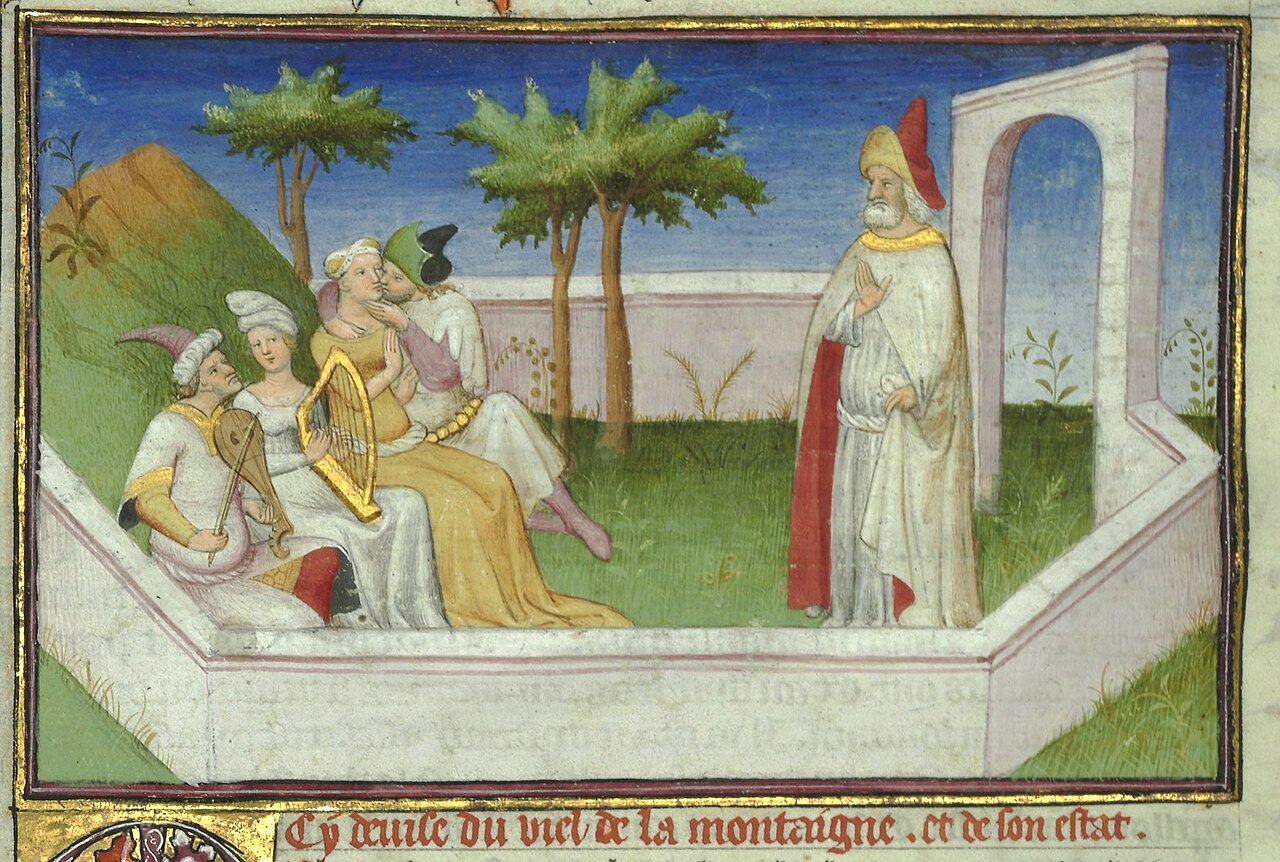
Missionaries from Alamut also built up a community in Syria, which held a cluster of castles in the Jabal Bahra mountains, with Masyaf as its main stronghold. Its most famous leader was Rashid al-Din Sinan (died 1193), who ran Syrian affairs with wide independence from Alamut. Surrounded by Crusader states, the Zengids and later Saladin, Sinan used diplomacy and threats with great skill. The Crusaders called him the Old Man of the Mountain, a translation of the Arabic title shaykh al-jabal, and it is mainly from this Syrian encounter that the European legend grew.
Political killing as a tactic
The Nizaris were a few castles and districts against empires. Their answer was to kill selected enemy leaders, usually with a dagger and usually in public, in a mosque or at court, which meant the killer had little hope of escape. The men who did it were called fida’is (فدائی), “those who offer their lives”.
The victims named in the sources include Nizam al-Mulk (1092), several Seljuk commanders and officials, the Fatimid caliph al-Amir (1130), the Abbasid caliphs al-Mustarshid (1135) and al-Rashid (1138), and Conrad of Montferrat, the would-be king of Jerusalem, in Tyre in 1192. Saladin escaped two attempts in the 1170s.
Three points help to put this in proportion. First, the sources are almost all hostile, and they tended to blame the Nizaris for any unexplained murder, sometimes to cover the work of others. Second, political murder was common in the period; sultans, viziers and Crusader barons had rivals killed too, and the Nizaris were themselves the victims of massacres in Isfahan, Aleppo and Damascus. Third, most of the state’s energy went into ordinary things: farming the valleys, defending castles, negotiating with neighbours, keeping libraries and writing theology.
How the legend was made
The word “assassin” comes from hashishi. The earliest known use against the Nizaris is in a Fatimid polemic of the 1120s, and Syrian writers used it as an insult, meaning something like “riff-raff”. No Nizari text uses it, and no reliable source shows that they took hashish. Crusader writers picked up the word as assassini or heyssessini, and by the thirteenth century it had entered European languages as a word for any hired killer.
The stories grew in the retelling. Chroniclers such as William of Tyre and Arnold of Lübeck wrote of blind obedience, and a famous tale, set in Syria, has the Old Man ordering devotees to leap to their deaths from a tower to impress a visiting count. Marco Polo, who passed through Iran in the 1270s after Alamut had fallen, gave the fullest version: a hidden garden of paradise in which the Old Man drugged young men, let them taste its pleasures, and promised them a return if they killed for him. Polo was repeating local hearsay about a state that no longer existed.
In the nineteenth century the orientalists Silvestre de Sacy (1809) and Joseph von Hammer-Purgstall (1818) gave the legends scholarly authority, the second explicitly comparing the Nizaris to secret societies of his own day. From there they passed into novels, such as Vladimir Bartol’s Alamut (1938), and video games. Modern research, led by Marshall Hodgson, Bernard Lewis and Farhad Daftary, who has written a full study of these “Assassin legends”, has separated them from the evidence of Nizari and neutral sources.
After Alamut: a living community
The Mongols took Alamut in 1256 and killed many Nizaris, and the Syrian castles fell to the Mamluk sultan Baybars by the early 1270s. The community survived in Iran, often hidden under Sufi forms, as well as in Syria, Central Asia and India. In the nineteenth century the Qajar shah Fath Ali Shah gave the Nizari imam the title Aga Khan, and the first Aga Khan moved to India in the 1840s. Today Nizari Ismailis live in many countries, including Pakistan, India, Afghanistan, Tajikistan, Syria, East Africa, Europe and North America. Their imam since February 2025 is Rahim al-Hussaini, Aga Khan V, who succeeded his father, Aga Khan IV. The end of the Iranian state is told on the page on the fall of Alamut, and the castle itself on the page on Alamut Castle.
Persian words from this page
| نزاری | Nezâri | Nizari |
| اسماعیلی | Esmâ’ili | Ismaili |
| فدائی | fedâ’i | devotee, one who sacrifices himself |
| حشیشی | hashishi | “hashish-user”, an insult |
| قیامت | qiyâmat | resurrection |
| امام | emâm | imam |
Sources and further reading
- Farhad Daftary, The Assassin Legends: Myths of the Isma’ilis (London, 1994).
- Farhad Daftary, The Isma’ilis: Their History and Doctrines, 2nd ed. (Cambridge, 2007).
- Bernard Lewis, The Assassins: A Radical Sect in Islam (London, 1967).
- Marshall G. S. Hodgson, The Order of Assassins (The Hague, 1955).
- Marco Polo, The Description of the World, the chapter on the Old Man of the Mountain.
Want to learn Persian? Get the free Starter Pack
Get the 14-page printable Starter Pack (all 32 letters, a 7-day reading plan, 100 core words and 20 survival phrases) and a short 5-email course. Free.
More in Ghaznavids, Seljuks and Khwarazmshahs (977–1231)
- The Ghaznavid Empire
- Mahmud of Ghazni
- The Rise of the Seljuks
- The Battle of Dandanaqan (1040)
- Tughril Beg Enters Baghdad
- Alp Arslan
- Seljuk Architecture: Tomb Towers and Caravanserais
- The Battle of Manzikert (1071)
- Malik Shah I
- The Seljuks of Kerman
- Nizam al-Mulk and the Siyasatnama
- The Seljuk Domes of Isfahan’s Jameh Mosque
- Omar Khayyam: Poet and Scientist
- Al-Ghazali
- Sana’i of Ghazni
- Hassan-i Sabbah and the Fortress of Alamut
- The Nizari Ismailis and the “Assassins” Legend
- Sultan Sanjar and the Qara Khitai
- The Battle of Qatwan (1141)
- Anvari and Seljuk Court Poetry
- Seljuk Decline and the Atabegs
- The Ghurids
- Attar of Nishapur
- Nizami Ganjavi
- The Khwarazmian Empire
- Ala al-Din Muhammad II
- The Otrar Incident (1218): How Khwarazm Provoked Genghis Khan
- Jalal al-Din Mingburnu