After the death of Malik Shah in 1092 the Great Seljuk empire split into competing branches, and in the twelfth century real power in western Iran passed to atabegs: Turkish commanders appointed as guardians of young Seljuk princes who made themselves hereditary rulers. The strongest were the Eldiguzids of Azerbaijan, who controlled the last Seljuk sultans of Iraq until 1194, and the Salghurids of Fars, who ruled Shiraz from 1148 into the Mongol age.
| Period | c. 1118–1194 for the western Seljuk sultanate; atabeg dynasties into the late 13th century |
|---|---|
| Western Seljuk capital | Hamadan |
| Main atabeg dynasties | Eldiguzids (Azerbaijan, Jibal), Salghurids (Fars), Ahmadilis (Maragheh), Hazaraspids (Luristan), atabegs of Yazd; Zengids in Mosul and Syria |
| End of the sultanate | Toghrul III killed near Rey by the Khwarazmshah Tekish, 1194 |
| Persian word | اتابک (atâbak) |
A divided empire
The Seljuk state was a family business. Sons, brothers and nephews of the sultan received provinces, and each could hope for the throne. After Malik Shah died in 1092 his sons fought for more than a decade. When Muhammad Tapar died in 1118 the empire was settled in two parts: his brother Sanjar ruled the east from Merv as senior sultan, and Muhammad’s sons held a western sultanate of Iraq and western Iran, usually ruled from Hamadan. Branch lines also governed Kerman, covered on the page on the Seljuks of Kerman, and Anatolia, where the Seljuks of Rum built a separate state.
The western sultans Mahmud, Tughril II, Mas’ud and their successors faced a revived caliphate in Baghdad. The caliph al-Mustarshid raised his own army and was defeated and captured by Sultan Mas’ud in 1135; while still a prisoner he was murdered by Nizari fida’is. After Mas’ud died in 1152 the sultans became figures in the hands of their commanders.
What an atabeg was
The Turkish title atabeg means roughly “father-lord”. When a Seljuk prince was sent as a child to govern a province, a senior commander went with him as his guardian and tutor. The atabeg ran the province, commanded its troops and often married the prince’s widowed mother. It was a system designed to protect the dynasty, and it ended up dissolving it: by the middle of the twelfth century many atabegs passed their provinces to their own sons, keeping a Seljuk prince only as a source of legitimacy, or not at all.
The Eldiguzids: guardians who ruled
The most powerful atabeg family began with Shams al-Din Eldiguz, a Kipchak Turk who had been a slave of the vizier and rose in the service of Sultan Mas’ud. In 1136 he became atabeg to the infant prince Arslan Shah and married his mother, a widow of the late sultan Tughril II. Building on estates in Azerbaijan around Nakhchivan and Ganja, Eldiguz put Arslan Shah on the throne in 1160 and from then on ruled western Iran in his name, from Azerbaijan to Isfahan, fighting the kings of Georgia in the Caucasus.
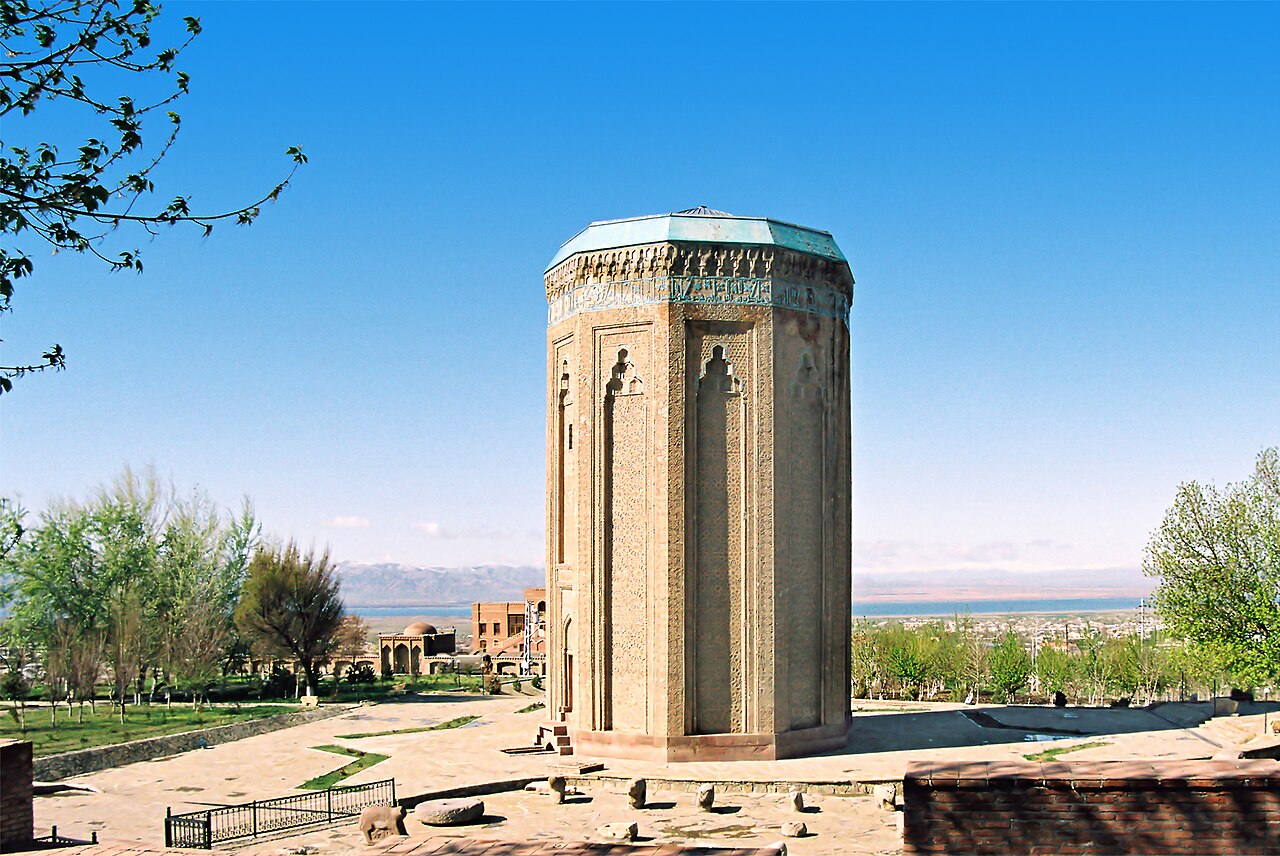

His sons continued the pattern. Muhammad Jahan Pahlavan (1175–1186) governed the Seljuk heartland while his brother Qizil Arslan held Azerbaijan. The Eldiguzid courts were patrons of Persian poetry: Nizami of Ganja dedicated Khosrow and Shirin to Jahan Pahlavan and Qizil Arslan. The domed tomb tower that Jahan Pahlavan built in Nakhchivan in 1186 for his mother Momine Khatun, decorated with turquoise glazed brick, is the finest surviving monument of the dynasty. Nizami’s life is told on the page on Nizami Ganjavi.
Toghrul III, the last Seljuk of Iran
The last western sultan, Toghrul III, came to the throne in 1176 as a boy under Jahan Pahlavan’s guardianship. As an adult he tried to rule in his own right. Qizil Arslan imprisoned him and in 1191 tried to take the sultan’s title for himself, with the caliph’s encouragement, but was murdered in his bed the same year. Toghrul escaped, regained Hamadan and briefly ruled again.
His enemies now included the ambitious caliph al-Nasir, who wanted the sultanate gone, and the rising Khwarazmshah Tekish, whom al-Nasir invited west. In 1194 Toghrul met Tekish’s army near Rey and was killed in the battle. His head was sent to Baghdad. With him the Seljuk line in Iran ended, 157 years after Tughril Beg had taken Nishapur. The historian Ravandi, who had served at Toghrul’s court, finished his chronicle Rahat al-Sudur a few years later and dedicated it to the Seljuk sultan of Rum in Anatolia, the only branch of the family still on a throne. The Khwarazmian side of the story is on the page on the Khwarazmian Empire.
The Salghurids of Fars
In the south, Fars and its capital Shiraz had been given to atabegs since the early twelfth century. In 1148 a Turkmen chief named Sunqur, of the Salghur tribe, took control of the province, and his family ruled it for the next 130 years. They kept Fars largely out of the wars of the north, paying homage to whichever great power was strongest: the Seljuks, then the Khwarazmshahs, then the Mongols.
Under Sa’d ibn Zangi (ruled about 1198–1226) and his son Abu Bakr ibn Sa’d (1226–1260), Shiraz flourished. Abu Bakr submitted to the Mongols early, sending tribute and troops, and Shiraz was spared the destruction suffered by Khorasan. The poet Saadi, returning to Shiraz after years of travel, dedicated his Bustan to Abu Bakr and his Golestan in 1258 to the same court. The last ruler of the line, Abish Khatun, was married to a son of the Ilkhan Hulagu, and after her death in the 1280s Fars passed under direct Mongol rule. Saadi’s life is told on the page on Saadi of Shiraz, and the city on the page on Shiraz.
Other atabegs
Similar families held other regions. The Ahmadilis ruled Maragheh in Azerbaijan; one of them, Ala al-Din Korp Arslan, received Nizami’s Haft Paykar. Kurdish and Lur chiefs ruled Luristan as the Hazaraspid atabegs into the fourteenth century, and Yazd had its own atabeg line. Outside Iran, the atabeg Zengi of Mosul and his son Nur al-Din founded the Zengid state in Iraq and Syria that fought the Crusaders and prepared the way for Saladin.
Decline or transformation
Older histories describe the century after Malik Shah as simple decline. Historians today stress that the Seljuk system was always shared among family members and commanders, and that its fragmentation produced vigorous regional courts. Persian poetry, architecture and learning flourished at Ganja, Maragheh, Hamadan and Shiraz. What disappeared was a single power able to defend Iran as a whole, and that weakness mattered when first the Khwarazmshahs and then the Mongols arrived.
Persian words from this page
| اتابک | atâbak | atabeg, guardian of a prince |
| همدان | Hamedân | Hamadan |
| فارس | Fârs | Fars province |
| شیراز | Shirâz | Shiraz |
| سعدی | Sa’di | Saadi |
| سلطان | soltân | sultan |
Sources and further reading
- Muhammad ibn Ali Ravandi, Rahat al-Sudur wa Ayat al-Surur (c. 1202–1206), ed. Muhammad Iqbal (London, 1921).
- C. E. Bosworth, “The Political and Dynastic History of the Iranian World (A.D. 1000–1217)”, in The Cambridge History of Iran, vol. 5 (Cambridge, 1968).
- A. C. S. Peacock, The Great Seljuk Empire (Edinburgh, 2015).
- Encyclopaedia Iranica, “Atabakan-e Azarbayjan” and “Salghurids”.
- Ibn al-Athir, al-Kamil fi’l-Tarikh, trans. D. S. Richards, The Chronicle of Ibn al-Athir for the Crusading Period (Aldershot, 2006–2008).
Want to learn Persian? Get the free Starter Pack
Get the 14-page printable Starter Pack (all 32 letters, a 7-day reading plan, 100 core words and 20 survival phrases) and a short 5-email course. Free.
More in Ghaznavids, Seljuks and Khwarazmshahs (977–1231)
- The Ghaznavid Empire
- Mahmud of Ghazni
- The Rise of the Seljuks
- The Battle of Dandanaqan (1040)
- Tughril Beg Enters Baghdad
- Alp Arslan
- Seljuk Architecture: Tomb Towers and Caravanserais
- The Battle of Manzikert (1071)
- Malik Shah I
- The Seljuks of Kerman
- Nizam al-Mulk and the Siyasatnama
- The Seljuk Domes of Isfahan’s Jameh Mosque
- Omar Khayyam: Poet and Scientist
- Al-Ghazali
- Sana’i of Ghazni
- Hassan-i Sabbah and the Fortress of Alamut
- The Nizari Ismailis and the “Assassins” Legend
- Sultan Sanjar and the Qara Khitai
- The Battle of Qatwan (1141)
- Anvari and Seljuk Court Poetry
- Seljuk Decline and the Atabegs
- The Ghurids
- Attar of Nishapur
- Nizami Ganjavi
- The Khwarazmian Empire
- Ala al-Din Muhammad II
- The Otrar Incident (1218): How Khwarazm Provoked Genghis Khan
- Jalal al-Din Mingburnu