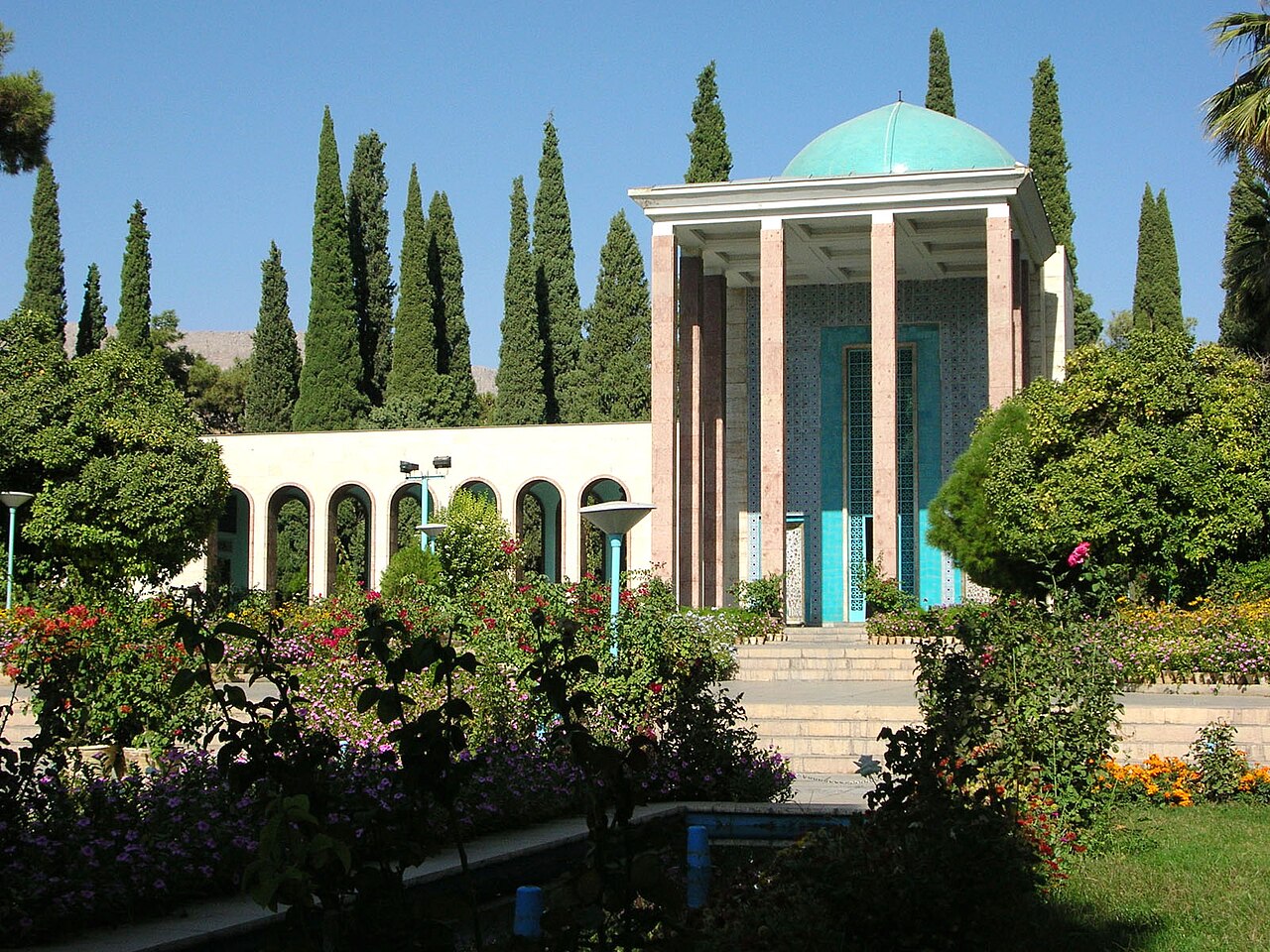
The Tomb of Saadi, known in Shiraz as the Saadieh (سعدیه), is the garden mausoleum of the 13th-century poet Saadi, author of the Golestan and the Bustan. It stands on the spot where he spent his last years and was buried, around 1291–1292, in the north-east of the city. The present building, a colonnaded hall with a turquoise-tiled dome, dates from 1950–1952.
| Persian name | Ârâmgâh-e Sa’di, popularly Sa’diye |
|---|---|
| Poet | Mosleh al-Din Saadi of Shiraz, c. 1210–1291/92 |
| Location | North-eastern Shiraz, at the foot of the hills near the Delgosha garden |
| Buildings | Present mausoleum designed by Mohsen Foroughi, built 1950–1952 |
| Saadi Day | 1 Ordibehesht (around 21 April) |

A grave in a Sufi lodge
Saadi left Shiraz as a young man and spent decades away, studying in Baghdad and travelling, by his own account, across the Arab lands. He came back in the 1250s, wrote the Bustan (1257) and the Golestan (1258), and lived on into old age. In his last years he is said to have lived in a khânegâh, a Sufi lodge, outside the city walls, on the site where the tomb now stands. When he died he was buried there.
That choice of site still shapes a visit. Hafez lies in a cemetery garden close to the old centre, and the Hafezieh feels like a public park. The Saadieh is further out, under the bare hills on the road to the north-east, and the garden is smaller, greener and usually quieter. Our page on the Tomb of Hafez covers the other great poet’s grave, and many visitors see both on the same day.
Four buildings in seven centuries
The first monument over the grave is attributed to Shams al-Din Juvayni, the chief minister of the Ilkhanid ruler Abaqa Khan, who admired Saadi and supported him. Nothing of it survives. By the 17th century the tomb was in poor condition, and the Italian traveller Pietro della Valle, who visited Shiraz in the 1620s, wrote about the graves of both poets.
In the 18th century Karim Khan Zand, who rebuilt Shiraz as his capital, gave Saadi a new tomb of brick and plaster on two floors, with a room on each side. Old photographs show a modest building. In the 20th century the Society for National Heritage, the body that also built the tombs of Ferdowsi in Tus and Avicenna in Hamadan, replaced it with the building visitors see today. The architect was Mohsen Foroughi, and work ran from 1950 to 1952.
Foroughi borrowed from older Persian forms without copying any one of them. A tall portico of slender stone columns, an idea taken from Safavid pavilions such as the Chehel Sotoun in Isfahan, fronts a square building. Inside, the tomb chamber is octagonal, and above it rises a dome covered in turquoise tiles.
What to look at
The tomb chamber
The cenotaph stands in the octagonal room under the dome. The walls are faced with stone and carry lines of Saadi’s verse in tile and carving. Iranian visitors often stand and read them aloud. Many know passages of the Golestan from school, where it has been a model of Persian prose for centuries.
The portico and garden
The colonnade looks over a long pool and beds of flowers, with cypresses and orange trees around the edges. In spring the garden is at its best, and the light in the late afternoon falls straight onto the columns. Around the garden are graves of other people who chose to be buried near the poet, a common custom at the tombs of Iranian saints and poets.
The fish pool
The detail most visitors remember is underground. Steps lead down from the garden to a small chamber where a spring-fed pool, the howz-e mâhi (حوض ماهی, “fish pool”), holds fish swimming in clear water. People drop coins into the water and make a wish. Local tradition says the water has healing powers. The pool is fed by an old water channel that runs under the site.
Saadi in everyday Persian
Saadi is the Persian poet whose lines most often turn up in conversation, as proverbs, without people knowing who wrote them. His verses on the unity of the human race, “Bani Adam”, are the best-known example. Our post on famous Saadi quotes explains those lines and dozens of others with the Persian text. For his life, travels and patrons, see our history page on Saadi of Shiraz.
The Iranian calendar marks Saadi Day on 1 Ordibehesht, around 21 April, and the garden fills with readings and visitors in the days around it.
Visiting
- The Saadieh is in the north-east of Shiraz, a short taxi ride from the centre and from the Hafezieh. It is not walking distance from the old bazaar for most people.
- Late afternoon and early evening are pleasant times to go, especially in spring and autumn. Summer middays are hot and the garden has little deep shade.
- Dress modestly, as at any tomb in Iran. The site is a place of respect but not a shrine, and there are no special rules beyond normal courtesy.
- Opening hours and ticket prices change, and foreign visitors may pay a different rate. Check current information locally before you go.
- Combine the visit with the rest of the city on our Shiraz page, and with the Qajar garden of Eram on the other side of town.
Persian words from this page
| سعدی | Sa’di | Saadi, the poet |
| سعدیه | Sa’diye | the Saadieh, his tomb garden |
| آرامگاه | ârâmgâh | tomb, resting place |
| گلستان | Golestân | “The Rose Garden”, his prose work |
| بوستان | Bustân | “The Orchard”, his book of verse |
| حوض ماهی | howz-e mâhi | fish pool |
| خانقاه | khânegâh | Sufi lodge |
Sources and further reading
- Encyclopaedia Iranica, “SAʿDI“.
- Encyclopaedia Iranica, “SHIRAZ i. History to 1940“.
- Cristelle Baskins, “Writing the Dead: Pietro della Valle and the Tombs of Shirazi Poets”, Muqarnas 34 (2017).
- Saadi, The Gulistan (Rose Garden) of Sa’di, trans. Wheeler M. Thackston (Ibex, 2008).
- ArchNet, “Sa’di Mausoleum” (building record).
Love Persian poetry? Learn to read it: free Starter Pack
Get the 14-page printable Starter Pack (all 32 letters, a 7-day reading plan, 100 core words and 20 survival phrases) and a short 5-email course. Free.
More in Top Places to Visit in Iran
- Naqsh-e Jahan Square
- Shah (Imam) Mosque, Isfahan
- Sheikh Lotfollah Mosque
- Ali Qapu Palace
- Jameh Mosque of Isfahan
- Si-o-se Pol and Khaju Bridge
- Vank Cathedral
- Hasht Behesht Palace
- Naqsh-e Rostam
- Eram Garden, Shiraz
- Nasir al-Molk (Pink) Mosque
- Tomb of Hafez (Hafezieh)
- Tomb of Saadi (Saadieh)
- Shah Cheragh Shrine
- Arg of Karim Khan
- Fin Garden, Kashan
- Historic Houses of Kashan
- Jameh Mosque of Yazd
- Yazd Fire Temple and Towers of Silence
- Dowlatabad Garden and Windcatcher
- Amir Chakhmaq Complex
- Golestan Palace
- National Museum of Iran
- Treasury of National Jewels
- Tehran Grand Bazaar
- Milad Tower
- Imam Reza Shrine, Mashhad
- Tomb of Ferdowsi, Tus
- Tomb of Omar Khayyam, Neyshabur
- Tomb of Avicenna, Hamadan
- Ganjnameh Inscriptions, Hamadan
- Behistun (Bisotun): Visiting the Site
- Taq-e Bostan: Visiting the Site
- Tabriz Historic Bazaar
- Takht-e Soleyman
- Armenian Monastic Ensembles of Iran
- Sheikh Safi al-Din Shrine, Ardabil
- Dome of Soltaniyeh
- Alamut Castle
- Falak-ol-Aflak Castle
- Shushtar Historical Hydraulic System
- Chogha Zanbil: Visiting the Ziggurat
- Susa Archaeological Site
- Arg-e Bam
- Ganjali Khan Complex, Kerman
- Shazdeh Garden, Mahan
- Rayen Castle
- Dasht-e Lut (Lut Desert)
- Maranjab Desert and Caravanserai
- Varzaneh Desert
- Mount Damavand
- Hyrcanian Forests
- Lake Urmia
- Badab-e Surt Springs
- Ali Sadr Cave
- The Kaluts of Shahdad
- Qeshm Geopark
- Hormuz Island Colours
- Visiting Persepolis: A Day Trip from Shiraz
- Visiting Pasargadae
- Persian Caravanserais
- The Qanat of Gonabad
- Meymand Village
- Sasanian Sites of Fars: Firuzabad, Bishapur and Sarvestan
- Gonbad-e Qabus: Visiting the Tower
- Zayandeh Rud and Isfahan’s Bridges
- Tochal and Darband: Hiking Above Tehran
- Mount Sabalan
- Skiing in Iran: Dizin and Shemshak
- Golestan National Park