Abu Hamid al-Ghazali (c. 1058–1111) was a Persian theologian and jurist from Tus who became the most influential Sunni thinker of the Seljuk age. Appointed by Nizam al-Mulk to the Nizamiyya college of Baghdad in 1091, he gave up the post four years later in a spiritual crisis, turned to Sufism, and wrote the Revival of the Religious Sciences, a work that shaped Islamic religious life for centuries.
| Full name | Abu Hamid Muhammad ibn Muhammad al-Ghazali al-Tusi; in medieval Latin “Algazel” |
|---|---|
| Born | c. 1058, Tabaran, the town of Tus, Khorasan |
| Died | 19 December 1111, Tus |
| School | Shafi’i in law, Ash’ari in theology; Sufi in his later life |
| Main works | The Incoherence of the Philosophers; Revival of the Religious Sciences; Deliverance from Error; The Alchemy of Happiness (in Persian) |
From Tus to the vizier’s camp
Al-Ghazali was born in Tabaran, one of the twin towns of Tus near modern Mashhad, the same district that produced Ferdowsi and Nizam al-Mulk. His father is said to have been a modest spinner of wool, and he and his younger brother Ahmad, later a famous Sufi preacher, were raised by a family friend after their father’s death. He studied in Tus and Gorgan and then at Nishapur under al-Juwayni, the leading Ash’ari theologian of the day, who taught at the Nizamiyya college there.
When al-Juwayni died in 1085, al-Ghazali joined the travelling court of Nizam al-Mulk, a circle of scholars, judges and officials that moved with the sultan’s army. There he made his name in public debates. In July 1091 the vizier appointed him to the most prestigious teaching post in the Islamic world, the chair at the Nizamiyya of Baghdad, where he is said to have lectured to hundreds of students. The colleges and their purpose are described on the page on Nizam al-Mulk and the Siyasatnama.

Against the philosophers and the Ismailis
In Baghdad al-Ghazali took on the two intellectual challenges that worried the Sunni establishment. The first was philosophy in the Greek tradition, as developed by al-Farabi and Avicenna. He first wrote a clear summary of their teachings, The Aims of the Philosophers, and then attacked them in The Incoherence of the Philosophers, completed around 1095. He argued that on twenty points their proofs failed, and that three of their doctrines, that the world has no beginning, that God does not know particular things, and that there is no bodily resurrection, went beyond error into unbelief.
The book did not end philosophy. Al-Ghazali himself used Aristotelian logic and defended it as a tool, and his own theology absorbed many philosophical ideas. The Andalusian philosopher Ibn Rushd (Averroes) answered him point by point in The Incoherence of the Incoherence later in the twelfth century.
The second challenge was political as well as religious: the Ismaili mission led in Iran by Hassan-i Sabbah, who had seized the castle of Alamut in 1090. At the request of the Abbasid caliph al-Mustazhir, al-Ghazali wrote a polemic against the Batinis, as their opponents called the Ismailis, attacking their doctrine that truth must be taught by an infallible imam. The movement he was writing against is described on the page on Hassan-i Sabbah and the fortress of Alamut.
The crisis of 1095
In 1095, at the height of his career, al-Ghazali stopped being able to teach. In his autobiography, Deliverance from Error, written years later, he says his tongue dried up so that he could not lecture, and that he came to see his ambition for fame as a danger to his soul. He concluded that the Sufis, who sought direct experience of God, had found what theology and philosophy could not give.
In November 1095 he left Baghdad, saying he was going on the pilgrimage, gave away his wealth except what his family needed, and spent the next years in retreat, in Damascus, Jerusalem and Hebron, then Mecca and Medina, before returning to Tus. Historians have asked whether politics played a part: his patron Nizam al-Mulk had been murdered in 1092, Malik Shah had died weeks later, and the Seljuk family was at war over the succession. The two explanations are not exclusive, and his own account remains the main source.
The Revival of the Religious Sciences
The great work of his retreat was the Ihya Ulum al-Din, the “Revival of the Religious Sciences”, in forty books. It takes the reader from the rules of worship and daily life, through the vices that ruin the soul, to the virtues that save it, such as repentance, patience, gratitude and love of God. Its aim is to put inner meaning back into religious law: prayer, fasting and trade done with the right intention, under the discipline of Sufi practice.
For Persian readers he made a shorter version in his own language, the Kimiya-yi Sa’adat (کیمیای سعادت), “The Alchemy of Happiness”. Its clear Persian prose has kept it in print in Iran ever since. He also wrote Persian letters and a book of advice for rulers, Nasihat al-Muluk, though the authorship of its second part is doubted.
Return to teaching and death
In 1106 Fakhr al-Mulk, a son of Nizam al-Mulk and vizier to Sanjar in Khorasan, persuaded him to teach again, at the Nizamiyya of Nishapur. Al-Ghazali agreed reluctantly, saying he hoped to teach a knowledge that turns people away from worldly rank rather than towards it. He met hostility from some scholars who accused his writings of philosophy and of extreme Sufi ideas. Within a few years he went back to Tus, where he lived among his disciples in a Sufi lodge and a small school he had built, and died there in December 1111.
How he has been judged
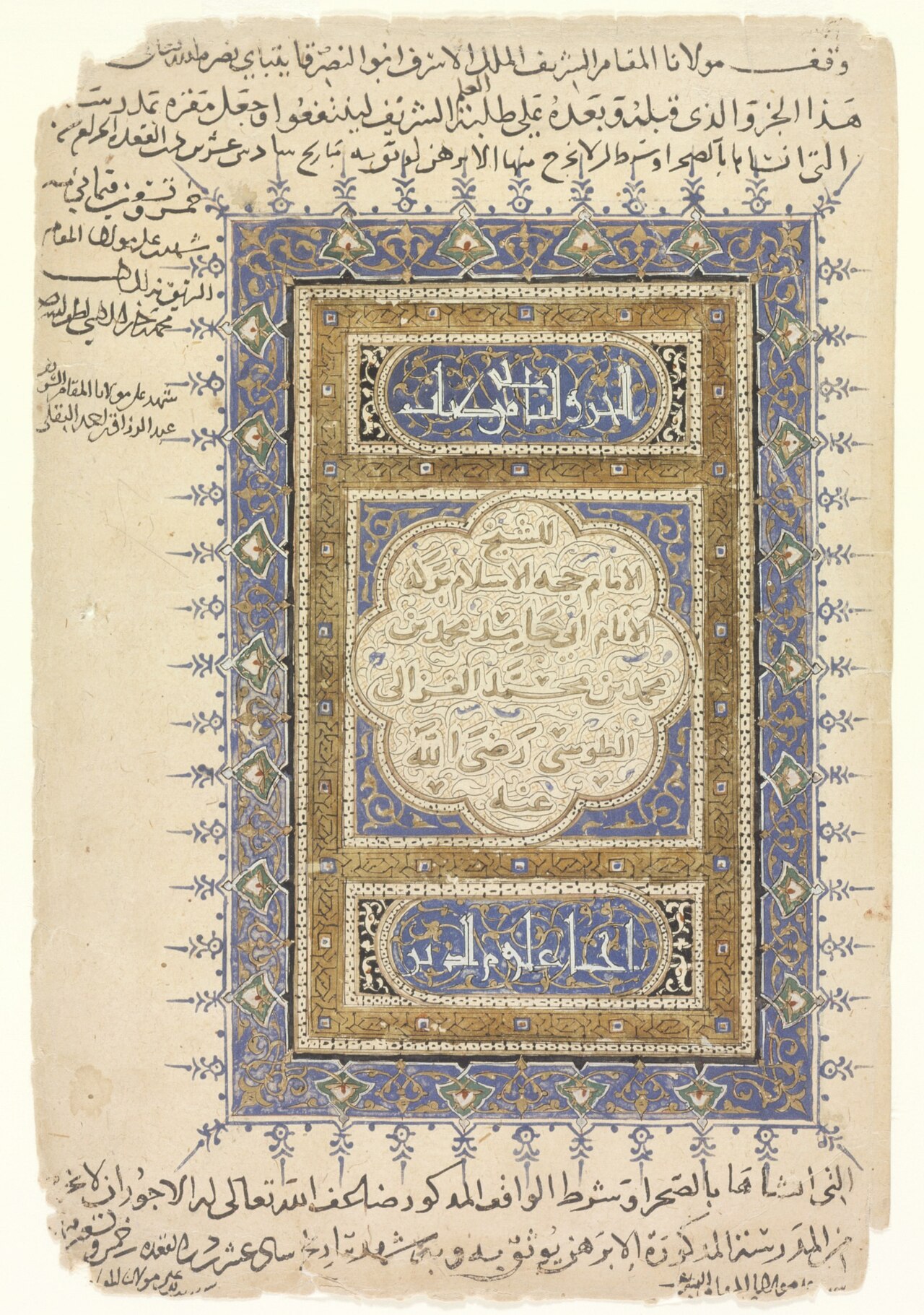
Later Sunni scholars called him Hujjat al-Islam, “the Proof of Islam”, and many saw him as the renewer promised at the turn of each Islamic century. His synthesis made Sufism respectable within Sunni law and theology, and the Revival became one of the most widely read books in the Muslim world after the Quran and the collections of hadith.
Older Western histories blamed him for the decline of science in Islam by turning people against philosophy. Most historians now reject that view: philosophy, logic and astronomy continued to flourish in Iran for centuries after him, and his critique helped drive philosophy into theology rather than out of it. In Europe, his summary of the philosophers was translated into Latin in the twelfth century, and medieval readers knew “Algazel” mainly as a philosopher, the opposite of his intention.
His near contemporary Omar Khayyam, also from Khorasan, was a scholar of a very different temperament; Sufi poets such as Attar of Nishapur later drew on the inner, mystical religion that al-Ghazali defended.
Persian words from this page
| غزالی | Ghazzâli | al-Ghazali |
| طوس | Tus | Tus, his home district |
| نظامیه | Nezâmiyye | the Nizamiyya colleges |
| کیمیای سعادت | Kimiyâ-ye sa’âdat | The Alchemy of Happiness |
| صوفی | sufi | Sufi, mystic |
| فلسفه | falsafe | philosophy |
Sources and further reading
- Al-Ghazali, al-Munqidh min al-Dalal (Deliverance from Error), trans. W. Montgomery Watt in The Faith and Practice of al-Ghazali (London, 1953).
- Al-Ghazali, The Incoherence of the Philosophers, trans. Michael E. Marmura (Provo, 2000).
- Frank Griffel, Al-Ghazali’s Philosophical Theology (Oxford, 2009).
- Kenneth Garden, The First Islamic Reviver: Abu Hamid al-Ghazali and His Revival of the Religious Sciences (Oxford, 2014).
- Encyclopaedia Iranica, “Ghazali” (biography and works).
Want to learn Persian? Get the free Starter Pack
Get the 14-page printable Starter Pack (all 32 letters, a 7-day reading plan, 100 core words and 20 survival phrases) and a short 5-email course. Free.
More in Ghaznavids, Seljuks and Khwarazmshahs (977–1231)
- The Ghaznavid Empire
- Mahmud of Ghazni
- The Rise of the Seljuks
- The Battle of Dandanaqan (1040)
- Tughril Beg Enters Baghdad
- Alp Arslan
- Seljuk Architecture: Tomb Towers and Caravanserais
- The Battle of Manzikert (1071)
- Malik Shah I
- The Seljuks of Kerman
- Nizam al-Mulk and the Siyasatnama
- The Seljuk Domes of Isfahan’s Jameh Mosque
- Omar Khayyam: Poet and Scientist
- Al-Ghazali
- Sana’i of Ghazni
- Hassan-i Sabbah and the Fortress of Alamut
- The Nizari Ismailis and the “Assassins” Legend
- Sultan Sanjar and the Qara Khitai
- The Battle of Qatwan (1141)
- Anvari and Seljuk Court Poetry
- Seljuk Decline and the Atabegs
- The Ghurids
- Attar of Nishapur
- Nizami Ganjavi
- The Khwarazmian Empire
- Ala al-Din Muhammad II
- The Otrar Incident (1218): How Khwarazm Provoked Genghis Khan
- Jalal al-Din Mingburnu