Alp Arslan (c. 1030–1072) was the second Seljuk sultan, ruling from 1063 to 1072. A nephew of Tughril, he spent his reign on campaign in the Caucasus, eastern Anatolia and Syria, taking the Armenian capital Ani in 1064 and capturing the Byzantine emperor at Manzikert in 1071, while his vizier Nizam al-Mulk built the administration that held the empire together.
| Full name | Muhammad ibn Dawud (Chaghri); Alp Arslan, “hero lion”, is a Turkish title |
|---|---|
| Born | c. 1030 (sources differ between 1029 and 1032) |
| Reign | 1063–1072 (ruler of Khorasan from c. 1059) |
| Vizier | Nizam al-Mulk |
| Main campaigns | Caucasus 1064 and 1068; Syria 1070–71; Manzikert 1071; Transoxiana 1072 |
| Died | Late 1072, stabbed by a prisoner; buried at Merv |
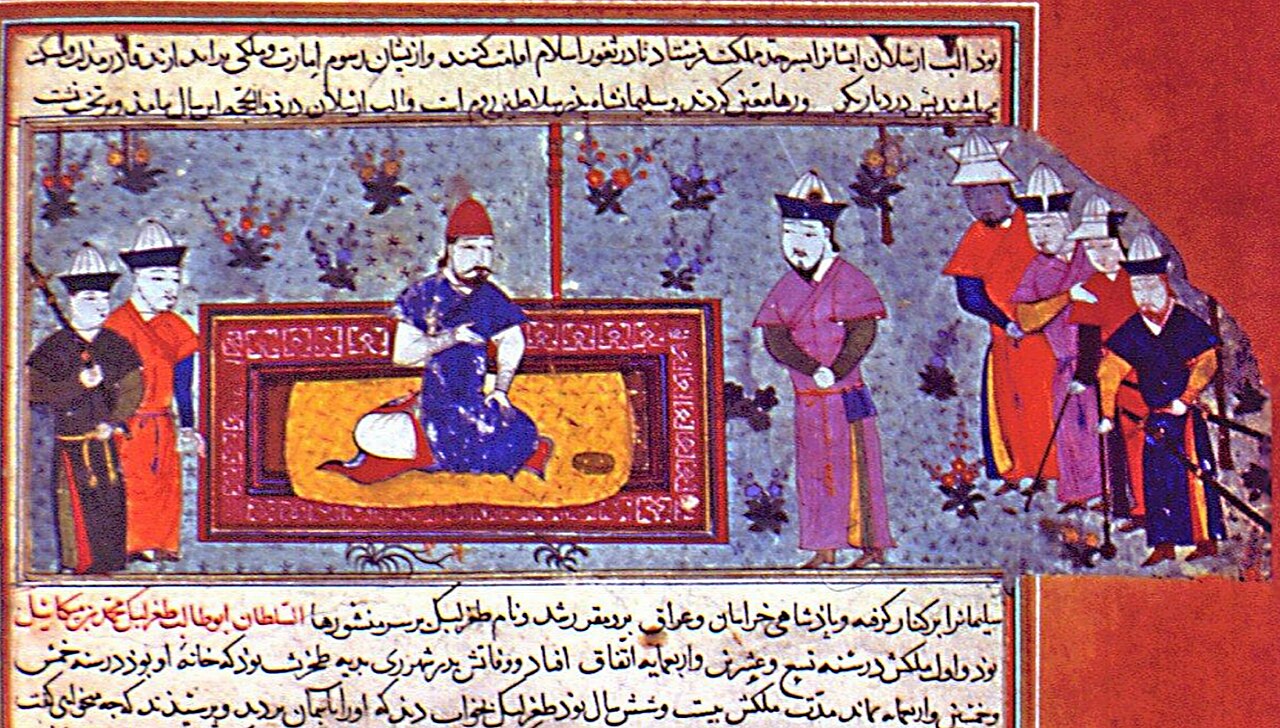

Son of Chaghri
Alp Arslan was the son of Chaghri, the brother who had held Khorasan for the Seljuks while Tughril conquered the west (see The Rise of the Seljuks). He grew up as a commander in the eastern wars against the Ghaznavids and, when his father died around 1059, took over Khorasan. His chief administrator there was a Persian official from Tus, Hasan ibn Ali, later known as Nizam al-Mulk.
Winning the throne
Tughril died childless in 1063, and his vizier al-Kunduri tried to make Alp Arslan’s young brother Sulayman sultan. Alp Arslan moved west with the army of Khorasan and was accepted in most of Iran. His most dangerous rival was a cousin, Qutalmish, son of Arslan Israil, who claimed the throne as the senior member of the family. Their armies met near Rey in 1064; Qutalmish was defeated and died in the rout. Al-Kunduri was arrested and executed, and Nizam al-Mulk became vizier of the whole empire.
Alp Arslan also had to deal with other relatives. His brother Qavurt, who ruled Kerman as a branch of the family (see The Seljuks of Kerman), rebelled and was forced back to obedience. Family revolts like this recurred at every succession.
The Caucasus: Ani and Georgia
For a sultan whose power rested on Turkmen tribes, war on the frontier was a necessity: it gave the tribesmen plunder and kept them away from the settled heart of Iran. Alp Arslan’s first great campaign, in 1064, went north-west into Armenia and Georgia. In August 1064, after a siege, he took Ani, the old capital of the Bagratid kings of Armenia, which had passed to Byzantium only twenty years before. Armenian and Arabic chroniclers describe a massacre and the destruction of churches; their figures for the dead are not reliable, but the fall of Ani was remembered as a disaster in Armenian history.
He returned in 1068 with a campaign into Georgia. The Georgian king Bagrat IV was forced to submit, and Tbilisi was handed to a Muslim vassal. The region was not occupied in any lasting way; the aim was submission, tribute and booty.
Syria and the road to Manzikert
Alp Arslan’s larger goal in the west seems to have been Fatimid Egypt, the centre of the rival Shi’a caliphate. In 1070 he crossed eastern Anatolia, taking the fortresses of Manzikert and Arjish north of Lake Van, and moved into northern Syria. In 1071 the ruler of Aleppo submitted to him and had the sermon read for the Abbasid caliph and the Seljuk sultan.
Then news came that the Byzantine emperor Romanos IV Diogenes was marching east with a large army. Alp Arslan turned north and met him at Manzikert on 26 August 1071. The emperor was defeated and captured, then released on terms after a week. The battle is described on its own page, The Battle of Manzikert. For Alp Arslan it was a frontier victory that secured his flank; there is little sign that he planned to conquer Anatolia himself.
A sultan on campaign
Alp Arslan spent most of his reign in the field. He apparently never visited Baghdad, leaving relations with the caliph to his officials, and left the government of the settled lands to Nizam al-Mulk, who ran the treasury, the chancery and appointments and founded the first of his Nizamiyya colleges in Baghdad in 1067 (see Nizam al-Mulk and the Siyasatnama). The division suited both: the sultan kept the loyalty of the Turkish soldiers, the vizier kept the revenue flowing.
Death on the Oxus
In 1072 Alp Arslan led an army across the Oxus against the Qarakhanids of Transoxiana. During the campaign a captured fortress commander, brought before him, drew a knife and stabbed him. The usual account says the sultan, proud of his archery, waved away his guards and missed his shot. He died a few days later, in late 1072, and was buried at Merv. His son Malik Shah, then about seventeen, succeeded him with Nizam al-Mulk at his side.
A famous line said to be inscribed on his tomb warns that those who saw Alp Arslan’s greatness raised to the heavens should come to Merv and see him under the earth. It is quoted in many later histories, but it belongs to literary tradition; the tomb itself does not survive.
- c. 1059 Succeeds his father Chaghri in Khorasan
- 1063 Death of Tughril
- 1064 Defeats Qutalmish near Rey; Nizam al-Mulk becomes vizier; Ani taken
- 1067 Nizamiyya college of Baghdad opens
- 1068 Georgian campaign
- 1070–71 Campaign into eastern Anatolia and Syria; Aleppo submits
- 26 Aug 1071 Victory at Manzikert
- 1072 Killed on campaign in Transoxiana
Persian words from this page
| آلپ ارسلان | Âlp Arslân | Alp Arslan |
| وزیر | vazir | vizier, minister |
| گرجستان | Gorjestân | Georgia |
| ارمنستان | Armanestân | Armenia |
| ملازگرد | Malâzgerd | Manzikert |
Sources and further reading
- Ibn al-Athir, The Annals of the Saljuq Turks, trans. D. S. Richards (London, 2002).
- A. C. S. Peacock, The Great Seljuk Empire (Edinburgh, 2015).
- Carole Hillenbrand, Turkish Myth and Muslim Symbol: The Battle of Manzikert (Edinburgh, 2007).
- Encyclopaedia Iranica, “Alp Arslan” (C. E. Bosworth).
- The Cambridge History of Iran, vol. 5 (1968).
Want to learn Persian? Get the free Starter Pack
Get the 14-page printable Starter Pack (all 32 letters, a 7-day reading plan, 100 core words and 20 survival phrases) and a short 5-email course. Free.
More in Ghaznavids, Seljuks and Khwarazmshahs (977–1231)
- The Ghaznavid Empire
- Mahmud of Ghazni
- The Rise of the Seljuks
- The Battle of Dandanaqan (1040)
- Tughril Beg Enters Baghdad
- Alp Arslan
- Seljuk Architecture: Tomb Towers and Caravanserais
- The Battle of Manzikert (1071)
- Malik Shah I
- The Seljuks of Kerman
- Nizam al-Mulk and the Siyasatnama
- The Seljuk Domes of Isfahan’s Jameh Mosque
- Omar Khayyam: Poet and Scientist
- Al-Ghazali
- Sana’i of Ghazni
- Hassan-i Sabbah and the Fortress of Alamut
- The Nizari Ismailis and the “Assassins” Legend
- Sultan Sanjar and the Qara Khitai
- The Battle of Qatwan (1141)
- Anvari and Seljuk Court Poetry
- Seljuk Decline and the Atabegs
- The Ghurids
- Attar of Nishapur
- Nizami Ganjavi
- The Khwarazmian Empire
- Ala al-Din Muhammad II
- The Otrar Incident (1218): How Khwarazm Provoked Genghis Khan
- Jalal al-Din Mingburnu