Anvari (Awhad al-Din Anvari, c. 1126 – c. 1189) was the most admired master of the Persian panegyric ode, the qasida, and the leading poet at the court of the Seljuk sultan Sanjar. His career, with those of Mu’izzi, Adib Sabir and Rashid al-Din Vatvat, shows how twelfth-century court poetry worked: a learned, highly formal art of praise, paid in gold and favour, that was also news, propaganda and political pleading.
| Poet | Awhad al-Din Ali (or Muhammad) Anvari, انوری |
|---|---|
| Born | Khavaran district near Abivard, Khorasan (now in Turkmenistan), early 12th century |
| Died | Balkh, c. 1189 (dates from 1168 to 1191 are given) |
| Patrons | Sultan Sanjar (d. 1157) and his successors in Khorasan |
| Forms | Qasida (ode), qit’a (occasional poem, often satirical), ghazal |
| Best-known poem | The ode later called “The Tears of Khorasan” |
How a court qasida works
A Persian qasida is a long poem, often 40 to 100 couplets or more, with a single rhyme running through it. The first couplet rhymes in both halves and announces the rhyme. A classic court qasida usually opens with a prelude, the tashbib or nasib: a description of spring, of dawn, of a beloved, of a ruined campsite, or a complaint about the poet’s own fortune. Then comes the turning point, the gorizgah, often a clever couplet that slides from the prelude to the patron. The main body is praise (madh) of the ruler’s justice, generosity, courage and lineage, and the poem closes with a prayer for his long life and victory.
These poems were performed at court on set occasions: Nowruz, the autumn festival of Mehregan, the two Eids, a victory, an accession, a recovery from illness. They told the court and visiting envoys what the ruler wished to be known for, and a good line could travel across the Persian-speaking world. In return poets received robes, horses, money and sometimes estates. Nizami Aruzi’s Chahar Maqala (c. 1156), written by a professional court writer of the period, treats the poet as one of the four servants a king cannot do without, next to the secretary, the astrologer and the physician, because only poetry makes a king’s name last.
Poets of the Seljuk courts
Mu’izzi was poet laureate (amir al-shu’ara) to Malik Shah, who gave him his pen name, and then to Sanjar. His smooth, musical odes made him the model court poet of his generation, and according to Nizami Aruzi his rise began with a quickly improvised verse on the sighting of a new moon, recited before Malik Shah. He died in the 1120s, and his story of the stray arrow is told on the page on Sultan Sanjar.
Adib Sabir served Sanjar in another way as well. According to Juvayni, the sultan sent him to the court of the rebellious Khwarazmshah Atsiz, where he warned Sanjar of a plot against his life. Atsiz discovered this and had him drowned in the Amu Darya, around 1147.
Rashid al-Din Vatvat was Atsiz’s chief secretary and poet, a scholar who wrote the Hada’iq al-sihr, a famous handbook of rhetorical figures. When Sanjar besieged Atsiz in the fortress of Hazarasp in 1147, so the story goes, Anvari in the sultan’s camp and a poet inside the walls, usually identified as Vatvat, exchanged insulting verses tied to arrows.
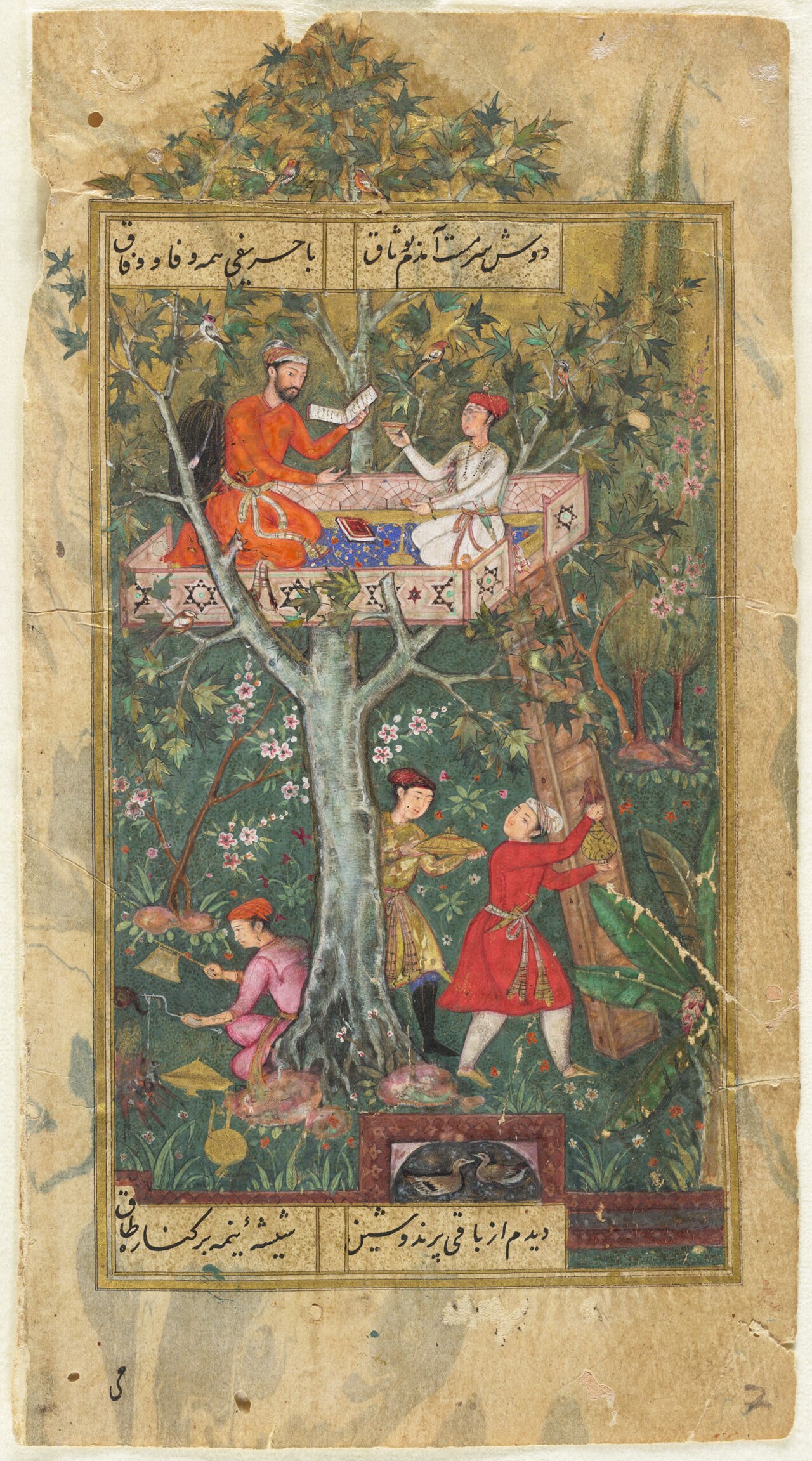

Anvari’s career
Anvari studied at Tus and was trained in the sciences of his day, astronomy and astrology, logic, mathematics and philosophy, as well as letters. Dawlatshah, a fifteenth-century biographer, tells that as a poor student he saw a splendidly dressed man ride by, learned that he was a court poet, and wrote a qasida that very night to present to Sanjar. Whether or not that is true, his odes won him the sultan’s favour and he followed the court on its campaigns.
His qasidas are admired for their argument and wit more than for their sound. He packs them with technical learning, legal and astronomical terms, and bold comparisons, and even medieval readers found some of them obscure; Dawlatshah said that his Divan needed a commentary. At the same time he had a gift for plain, conversational lines, and his short qit’a poems are full of sharp, often coarse satire, including satire of poets who beg for rewards.
The Tears of Khorasan
After the Oghuz nomads captured Sanjar in 1153 and sacked Merv, Nishapur and Tus, Anvari wrote an ode in the form of a petition from the people of Khorasan to the khan of Samarkand, begging him to come to their rescue. It describes scholars humiliated, mosques turned into stables and the good at the mercy of the wicked. The ode reached English readers in the 1780s as “The Tears of Khorasan”, and it remains the best-known poem about the catastrophe.
A failed prophecy
Anvari’s learning cost him dearly. He predicted that a rare conjunction of planets in 1185 or 1186 would bring a destructive storm. The day came and was so still that, it is said, a lamp could burn on a rooftop without flickering. His enemies mocked him, and he spent his last years in retirement at Balkh, where he died around 1189. Several of his poems complain bitterly of fate and say he had given up writing praise poetry, though it is hard to date when.
Reputation
For centuries Anvari was ranked among the greatest of all Persian poets. A well-known later verse names three “prophets” of poetry: Ferdowsi for the epic, Anvari for the ode and Saadi for the ghazal. Modern taste has preferred the lyric to the panegyric, and his fame has faded outside Iran, but his qasidas remain essential reading for anyone who wants to understand how Persian court culture spoke to power. The tradition he perfected was continued by Khaqani in Shirvan and by Zahir Faryabi, and the lyric side of his art fed into the ghazal of Saadi.
Persian words from this page
| قصیده | qaside | ode, qasida |
| مدح | madh | praise |
| ممدوح | mamduh | the person praised, the patron |
| تشبیب | tashbib | lyrical prelude of a qasida |
| صله | sele | reward given to a poet |
| قطعه | qet’e | short occasional poem |
| ملکالشعرا | malek osh-sho’arâ | poet laureate |
Read next: the mystical poetry of Anvari’s older contemporary Sana’i of Ghazni, and the defeat that first shook Sanjar’s court, the Battle of Qatwan.
Sources and further reading
- Nizami Aruzi Samarqandi, Chahar Maqala, translated by E. G. Browne as The Chahar Maqala (Four Discourses).
- Encyclopaedia Iranica, “Anwari”.
- Dawlatshah Samarqandi, Tadhkirat al-Shu’ara.
- J. Rypka, History of Iranian Literature (Reidel, 1968).
- Julie Scott Meisami, Medieval Persian Court Poetry (Princeton University Press, 1987).
- E. G. Browne, A Literary History of Persia, vol. 2.
Love Persian poetry? Learn to read it: free Starter Pack
Get the 14-page printable Starter Pack (all 32 letters, a 7-day reading plan, 100 core words and 20 survival phrases) and a short 5-email course. Free.
More in Ghaznavids, Seljuks and Khwarazmshahs (977–1231)
- The Ghaznavid Empire
- Mahmud of Ghazni
- The Rise of the Seljuks
- The Battle of Dandanaqan (1040)
- Tughril Beg Enters Baghdad
- Alp Arslan
- Seljuk Architecture: Tomb Towers and Caravanserais
- The Battle of Manzikert (1071)
- Malik Shah I
- The Seljuks of Kerman
- Nizam al-Mulk and the Siyasatnama
- The Seljuk Domes of Isfahan’s Jameh Mosque
- Omar Khayyam: Poet and Scientist
- Al-Ghazali
- Sana’i of Ghazni
- Hassan-i Sabbah and the Fortress of Alamut
- The Nizari Ismailis and the “Assassins” Legend
- Sultan Sanjar and the Qara Khitai
- The Battle of Qatwan (1141)
- Anvari and Seljuk Court Poetry
- Seljuk Decline and the Atabegs
- The Ghurids
- Attar of Nishapur
- Nizami Ganjavi
- The Khwarazmian Empire
- Ala al-Din Muhammad II
- The Otrar Incident (1218): How Khwarazm Provoked Genghis Khan
- Jalal al-Din Mingburnu