Omar Khayyam (1048–1131) was a mathematician and astronomer from Nishapur who solved cubic equations with geometry and led the team that produced the Jalali solar calendar for the Seljuk sultan Malik Shah in 1079. In his lifetime he was known as a scientist; his fame as a poet of quatrains (rubaiyat) grew after his death and exploded in the West after Edward FitzGerald’s English version of 1859, though how many of the poems are really his remains an open question.
| Full name | Ghiyath al-Din Abu’l-Fath Umar ibn Ibrahim al-Khayyami of Nishapur |
|---|---|
| Born | 18 May 1048, Nishapur, Khorasan (date worked out by modern scholars from his horoscope) |
| Died | 4 December 1131, Nishapur (other dates, such as 1123 or 1126, are found) |
| Patrons | Abu Tahir, chief judge of Samarkand; Sultan Malik Shah and the vizier Nizam al-Mulk |
| Known for | Treatise on algebra; the Jalali calendar; quatrains attributed to him |
| Persian name | عمر خیام (Omar Khayyâm) |
A scholar of Seljuk Khorasan
Khayyam was born in Nishapur, then one of the great cities of Khorasan, in the generation after the Seljuk Turks took the city in 1037. His name probably means “tent-maker’s son”, but nothing certain is known about his family. He studied the sciences of his day: mathematics, astronomy, medicine and the philosophy of Avicenna, whose ideas run through his own short philosophical treatises.
His career depended on patrons, like that of every scholar of the time. In about 1070 he was in Samarkand under the protection of Abu Tahir, the city’s chief judge, and there he wrote his best-known mathematical work. A few years later he was called to Isfahan, the capital of Malik Shah, where he spent close to two decades at the court. After the murder of Nizam al-Mulk and the death of Malik Shah in 1092 he lost his main protectors. He seems to have spent his later years mostly in Nishapur, with journeys to Merv and elsewhere.

The algebra of cubic equations
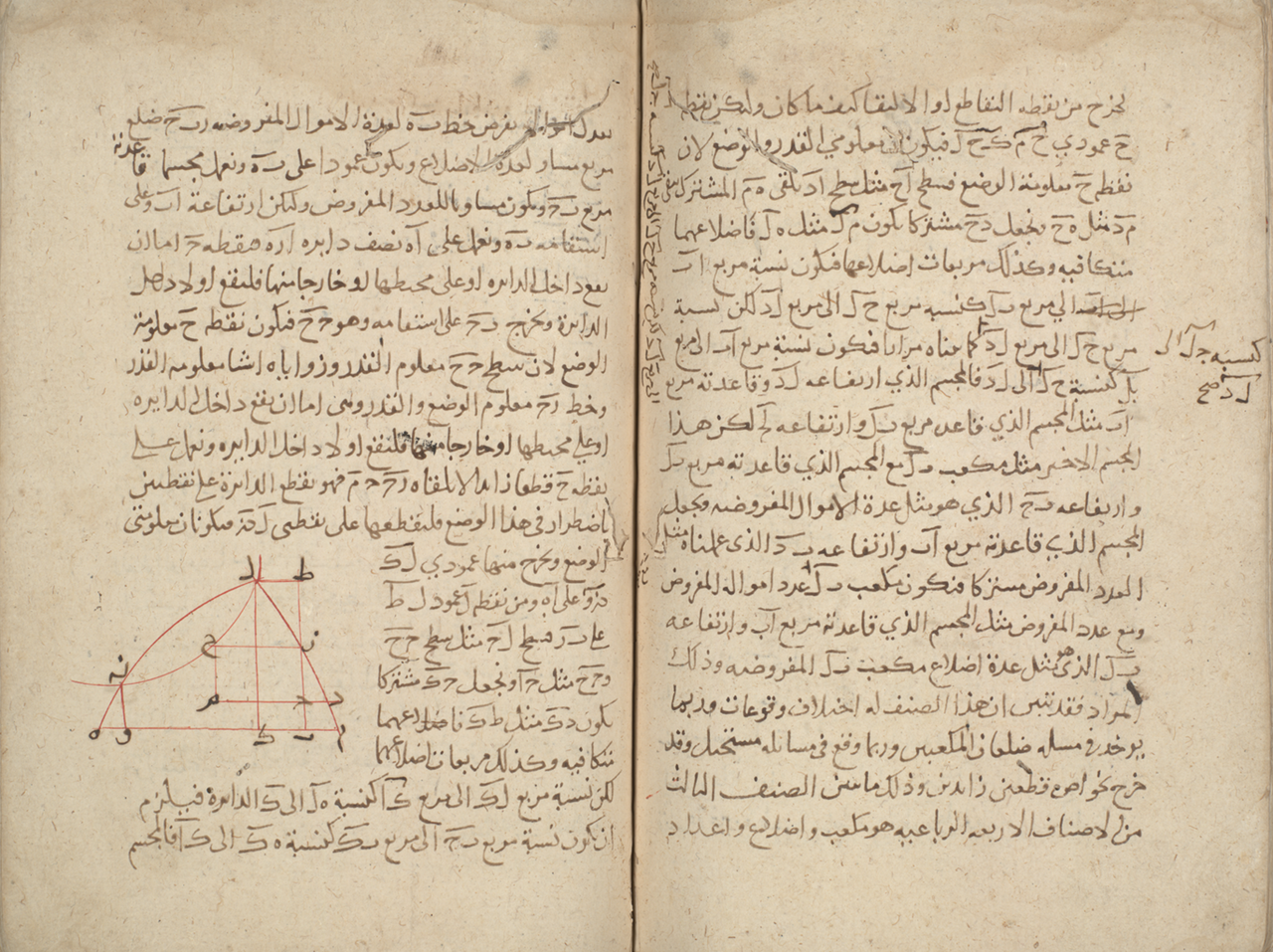
Khayyam’s Treatise on the Demonstration of Problems of Algebra is his most important scientific work. Earlier mathematicians writing in Arabic, from al-Khwarizmi onwards, had solved quadratic equations. Khayyam went further and set out a full classification of cubic equations: the types that can be reduced to simpler forms and those that cannot. For each of the hard cases he gave a geometric solution, finding the answer where two conic sections, such as a circle and a parabola or two hyperbolas, cross each other.
He knew the limits of his method. He wrote that he had not found a way to solve cubics by arithmetic alone and hoped that later scholars would. That general algebraic solution came only in sixteenth-century Italy. Khayyam also wrote a commentary on the difficult postulates of Euclid, including the parallel postulate, in which his reasoning about quadrilaterals anticipated arguments that European mathematicians made centuries later.
The Jalali calendar of 1079
The work that touched most people was the calendar. The Islamic lunar calendar drifts through the seasons, which made it useless for fixing the dates of harvests and tax collection, and the old Persian solar year had fallen out of step with the sun. Malik Shah, whose title was Jalal al-Dawla, ordered a reform, and Khayyam was one of the astronomers assembled for the task at an observatory, probably in Isfahan.
The new calendar, named Jalali after the sultan, began on 15 March 1079. Its year started at Nowruz, the spring equinox, and it kept in step with the sun by adding leap days on a cycle worked out from observation. It was one of the most accurate calendars made before modern times. It lies behind the solar calendar that Iran uses officially today, in which Nowruz still begins the year; the long story is told on the page on the history of the Iranian calendar.
The poet, and the problem of the rubaiyat
A rubai (رباعی) is a four-line poem, usually rhyming in the first, second and fourth lines. Persian poets had written them since Rudaki’s time. The quatrains linked to Khayyam are short reflections on the brevity of life, the silence of the dead, the limits of knowledge and the consolation of wine.
The difficulty is the evidence. No collection of Khayyam’s poems survives from his lifetime. The earliest writers to quote quatrains in his name, such as the theologian Fakhr al-Din Razi (died 1209) and the Sufi Najm al-Din Razi (writing in the 1220s), lived generations later, and Najm al-Din cited them to condemn him as a godless philosopher. Manuscript collections then grew steadily larger: the Bodleian manuscript of 1460 used by FitzGerald has 158 quatrains, and later collections hold hundreds more.
In 1897 the Russian scholar Valentin Zhukovsky showed that dozens of the quatrains credited to Khayyam were also credited to other poets. These “wandering quatrains” made it clear that the name had become a magnet for any skeptical or wine-loving verse. Scholars such as Arthur Christensen and the Iranian writer Ali Dashti tried to identify a core of genuine poems from the oldest sources; their lists range from a dozen or so to around a hundred. No method has won general agreement, and some scholars doubt that any single quatrain can be proven his.
One of the most quoted, which appears in many collections, begins:
این قافلهٔ عمر عجب میگذرد
دریاب دمی که با طرب میگذرد
“This caravan of life passes strangely fast; seize the moment that passes in joy.” Many more quatrains, in Persian with translations, are collected in our article on Omar Khayyam quotes and famous rubaiyat.
FitzGerald and the Western Khayyam
Edward FitzGerald, an English gentleman scholar, published The Rubaiyat of Omar Khayyam in 1859. It had 75 stanzas, sold almost nothing at first, and then became one of the most popular poems in English. FitzGerald worked from the Bodleian manuscript and a copy of one in Calcutta, but he translated freely: he combined quatrains, invented connections and arranged the poems into a single day of drinking and doubt. It is best read as an English poem inspired by Persian originals.
The Victorian craze made Khayyam a symbol of free thought and pleasure, with Omar Khayyam clubs in London and Boston. In Iran he has been read in other ways: as a mystic whose “wine” is divine love, as a rationalist skeptic, or as a national scientist. These readings say as much about the readers as about the eleventh-century astronomer.
Legend and memory
The oldest personal story about Khayyam comes from Nizami Aruzi, who met him in Balkh in about 1112. Khayyam told him that his grave would be in a place where the north wind would scatter blossoms over it. In 1135, Nizami Aruzi visited the grave in Nishapur and found it by a garden wall, covered with fallen petals. A more famous tale, that Khayyam, Nizam al-Mulk and Hassan-i Sabbah were schoolfellows who swore to help each other, is a later invention; the page on Nizam al-Mulk explains why the dates make it impossible.
His tomb in Nishapur now stands under a modern monument designed by the architect Houshang Seyhoun and opened in the 1960s, with quatrains carved into its lattice. Visiting it is described on the page on the Tomb of Omar Khayyam, and the city itself on the page on Neyshabur. His place in a longer tradition of Iranian mathematics and astronomy is covered in science in Iranian history.
Persian words from this page
| خیام | Khayyâm | Khayyam (literally “tent-maker”) |
| رباعی | robâ’i | quatrain |
| رباعیات | robâ’iyât | quatrains (plural) |
| نیشابور | Neyshâbur | Nishapur |
| تقویم جلالی | taqvim-e jalâli | Jalali calendar |
| جبر | jabr | algebra |
| قافله | qâfele | caravan |
Sources and further reading
- Nizami Aruzi, Chahar Maqala (Four Discourses), c. 1156, trans. E. G. Browne (1921): the earliest personal account of Khayyam.
- Encyclopaedia Iranica, “Khayyam, Omar” (articles on his life, scientific work and the quatrains).
- D. S. Kasir, The Algebra of Omar Khayyam (New York, 1931), translation of the algebra treatise.
- Ali Dashti, In Search of Omar Khayyam, trans. L. P. Elwell-Sutton (London, 1971).
- Mehdi Aminrazavi, The Wine of Wisdom: The Life, Poetry and Philosophy of Omar Khayyam (Oxford, 2005).
- Edward FitzGerald, The Rubaiyat of Omar Khayyam (London, 1859).
Love Persian poetry? Learn to read it: free Starter Pack
Get the 14-page printable Starter Pack (all 32 letters, a 7-day reading plan, 100 core words and 20 survival phrases) and a short 5-email course. Free.
More in Ghaznavids, Seljuks and Khwarazmshahs (977–1231)
- The Ghaznavid Empire
- Mahmud of Ghazni
- The Rise of the Seljuks
- The Battle of Dandanaqan (1040)
- Tughril Beg Enters Baghdad
- Alp Arslan
- Seljuk Architecture: Tomb Towers and Caravanserais
- The Battle of Manzikert (1071)
- Malik Shah I
- The Seljuks of Kerman
- Nizam al-Mulk and the Siyasatnama
- The Seljuk Domes of Isfahan’s Jameh Mosque
- Omar Khayyam: Poet and Scientist
- Al-Ghazali
- Sana’i of Ghazni
- Hassan-i Sabbah and the Fortress of Alamut
- The Nizari Ismailis and the “Assassins” Legend
- Sultan Sanjar and the Qara Khitai
- The Battle of Qatwan (1141)
- Anvari and Seljuk Court Poetry
- Seljuk Decline and the Atabegs
- The Ghurids
- Attar of Nishapur
- Nizami Ganjavi
- The Khwarazmian Empire
- Ala al-Din Muhammad II
- The Otrar Incident (1218): How Khwarazm Provoked Genghis Khan
- Jalal al-Din Mingburnu