Nizami Ganjavi (c. 1141 – c. 1209) was a Persian poet from Ganja in the Caucasus who perfected the romantic epic in Persian. His Khamsa (“Quintet”), five long narrative poems including Khosrow and Shirin, Layla and Majnun and Haft Paykar, became the model that poets from Delhi to Istanbul imitated for six centuries, and its scenes are among the most often painted in Persian art.
| Full name | Jamal al-Din Abu Muhammad Ilyas ibn Yusuf; pen name Nizami |
|---|---|
| Lived | c. 1141 – c. 1209 (death dates from 1202 to 1217 are found), Ganja |
| Language | Persian |
| Main work | Khamsa, also called Panj Ganj, “Five Treasures” |
| Patrons | Regional rulers: the Eldiguzid atabegs, the Shirvanshahs, the Ahmadilis of Maragheh, a Mengujekid prince of Anatolia |
| Persian name | نظامی گنجوی (Nezâmi Ganjavi) |
A poet who stayed home
Ganja, in the plain south of the Caucasus mountains, was in Nizami’s time a prosperous city under the Eldiguzid atabegs, with a mixed population and Persian as the language of literature and government. Nizami seems to have spent almost his whole life there. Unlike most poets of his age he did not live at a court. He wrote for rulers of the surrounding region, sent them his poems with dedications, and received gifts and estates in return, but he speaks of himself as someone who kept away from palaces.
His poems contain much of what we know about him. His father Yusuf died when he was young, and his mother came from a Kurdish family. He married a Kipchak slave woman sent to him by the ruler of Darband; he loved her deeply, and she died soon after he finished Khosrow and Shirin, leaving him a son, Muhammad, whom he addresses in later poems. Later writers called her Afaq, though that name is a modern guess. He was a learned man, at home in astronomy, medicine, philosophy and Islamic law, and his verse is full of that learning.
The Five Treasures
The Treasury of Mysteries (1160s or 1170s)
Makhzan al-Asrar is a didactic poem of moral and religious teaching in twenty discourses, each followed by a short story. It follows the example of Sana’i’s Hadiqat al-Haqiqa and was dedicated to Fakhr al-Din Bahramshah, a Turkish prince of Erzincan in eastern Anatolia.
Khosrow and Shirin (1177–1180)
The first romance tells of the Sasanian king Khosrow II Parviz and the Armenian princess Shirin. Its most famous character is Farhad, the stonecutter who falls in love with Shirin and is set the task of cutting a road through the mountain of Bisotun; when Khosrow sends false news of Shirin’s death, Farhad throws himself from the rock. Nizami dedicated the poem to the Eldiguzid rulers Jahan Pahlavan and Qizil Arslan and to the last Seljuk sultan, Toghrul III. The historical Khosrow appears on the page on Khosrow II.
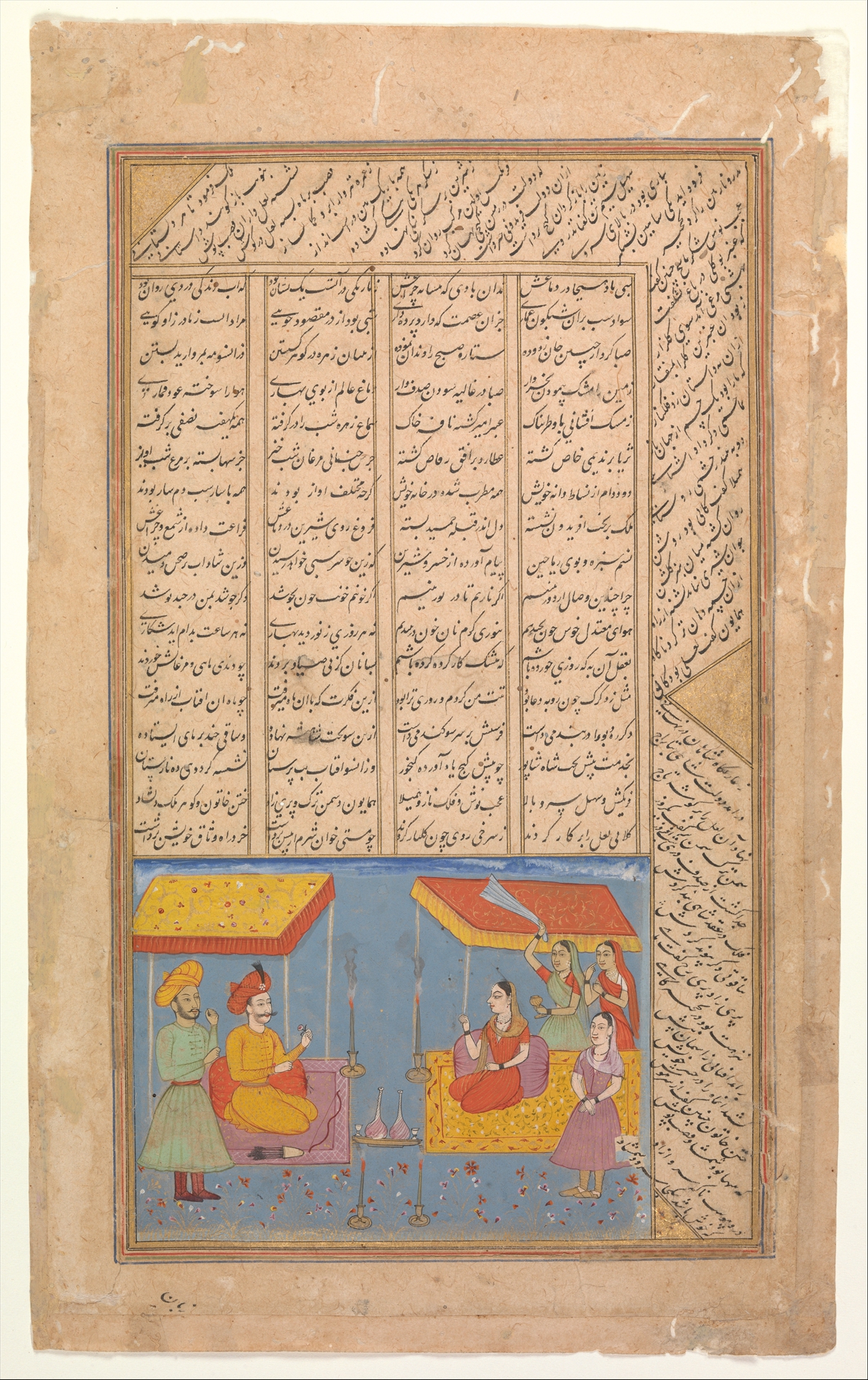

Layla and Majnun (1188)
Written at the request of Akhsitan, the Shirvanshah, this is the story of the Arab youth Qays, who goes mad with love for Layla when they are separated and wanders the desert among wild animals. Nizami says he finished it in under four months. It turned scattered Arabic anecdotes into a tragic romance of unfulfilled love. The story and its meanings are told in our article on Layla and Majnun.
Haft Paykar, The Seven Beauties (1197)
Dedicated to the Ahmadili ruler of Maragheh, Ala al-Din Korp Arslan, Haft Paykar follows the Sasanian king Bahram Gur. Bahram marries seven princesses from the seven climes of the world and visits each in her own domed pavilion, coloured for one of the seven planets, on one day of the week, and each princess tells him a story. The cycle moves from black to white, from darkness to light, and the king’s journey through the pavilions is a picture of the soul’s growth. Many readers consider it Nizami’s masterpiece. One of the princesses’ tales, of a cruel princess who sets riddles for her suitors, is often linked to the story that later reached Europe as Turandot.
The Book of Alexander (c. 1194–1202)
The last poem, Iskandar-nama, comes in two parts. The Sharaf-nama tells of Alexander the conqueror, following the Persian tradition in which he is half Iranian; the Iqbal-nama shows him as a philosopher and finally a prophet, in conversation with Greek sages. Its dedications are disputed among scholars.
His art
Nizami wrote in masnavi form, long rhyming couplets, as Ferdowsi had, but he aimed at something different from the Shahnameh. Where Ferdowsi told the deeds of kings and heroes, Nizami took a few episodes and explored the inner life of his characters: love, jealousy, grief and spiritual change. His style is dense, full of metaphor, wordplay and learned allusion, and is hard even for educated Iranians without notes. He also gave a large place to women: Shirin is clever, morally stronger than Khosrow and often the real centre of the story.
Imitators and painters
The Khamsa became a set form. Poets measured themselves by writing their own five poems in answer: Amir Khusraw in Delhi around 1300, Jami in Herat in the fifteenth century, and Ali-Shir Navai, who wrote his Khamsa in Chagatai Turkish. Fuzuli’s Leyli and Majnun in Azerbaijani Turkish, written in the sixteenth century, inspired the 1908 opera by Uzeyir Hajibeyov.
Royal libraries commissioned lavish illustrated copies. The scenes most painted include Khosrow seeing Shirin bathing, Farhad carrying Shirin and her horse, Majnun among the animals and Bahram in the seven pavilions. One of the most famous manuscripts, made for the Safavid Shah Tahmasp in the 1540s, is in the British Library. These manuscripts are discussed on the page on the history of Persian painting.
Nizami today
Nizami’s tomb stands outside Ganja, in today’s Republic of Azerbaijan, under a modern mausoleum. Because his city lies in Azerbaijan, he is honoured there as a national poet, while in Iran he is read as one of the classics of Persian literature; he wrote in Persian, and both traditions claim him. For readers learning the language, his couplets are difficult but rewarding, and many of his lines have become proverbs. His place among the Persian poets is traced on the page on the history of Persian poetry.
Persian words from this page
| نظامی | Nezâmi | Nizami |
| گنجه | Ganje | Ganja |
| خمسه | Khamse | the Quintet |
| پنج گنج | Panj ganj | Five Treasures |
| خسرو و شیرین | Khosrow o Shirin | Khosrow and Shirin |
| لیلی و مجنون | Leyli o Majnun | Layla and Majnun |
| هفت پیکر | Haft peykar | The Seven Beauties |
| فرهاد | Farhâd | Farhad |
Sources and further reading
- Nizami, The Haft Paykar: A Medieval Persian Romance, trans. Julie Scott Meisami (Oxford World’s Classics, 1995).
- Nizami, The Story of Layla and Majnun, trans. Rudolf Gelpke (Oxford, 1966).
- Peter J. Chelkowski, Mirror of the Invisible World: Tales from the Khamseh of Nizami (New York: Metropolitan Museum of Art, 1975).
- Encyclopaedia Iranica, “Nezami Ganjavi” (articles on his life and on each poem).
- Kamran Talattof and Jerome W. Clinton, eds., The Poetry of Nizami Ganjavi: Knowledge, Love, and Rhetoric (New York, 2000).
Want to learn Persian? Get the free Starter Pack
Get the 14-page printable Starter Pack (all 32 letters, a 7-day reading plan, 100 core words and 20 survival phrases) and a short 5-email course. Free.
More in Ghaznavids, Seljuks and Khwarazmshahs (977–1231)
- The Ghaznavid Empire
- Mahmud of Ghazni
- The Rise of the Seljuks
- The Battle of Dandanaqan (1040)
- Tughril Beg Enters Baghdad
- Alp Arslan
- Seljuk Architecture: Tomb Towers and Caravanserais
- The Battle of Manzikert (1071)
- Malik Shah I
- The Seljuks of Kerman
- Nizam al-Mulk and the Siyasatnama
- The Seljuk Domes of Isfahan’s Jameh Mosque
- Omar Khayyam: Poet and Scientist
- Al-Ghazali
- Sana’i of Ghazni
- Hassan-i Sabbah and the Fortress of Alamut
- The Nizari Ismailis and the “Assassins” Legend
- Sultan Sanjar and the Qara Khitai
- The Battle of Qatwan (1141)
- Anvari and Seljuk Court Poetry
- Seljuk Decline and the Atabegs
- The Ghurids
- Attar of Nishapur
- Nizami Ganjavi
- The Khwarazmian Empire
- Ala al-Din Muhammad II
- The Otrar Incident (1218): How Khwarazm Provoked Genghis Khan
- Jalal al-Din Mingburnu