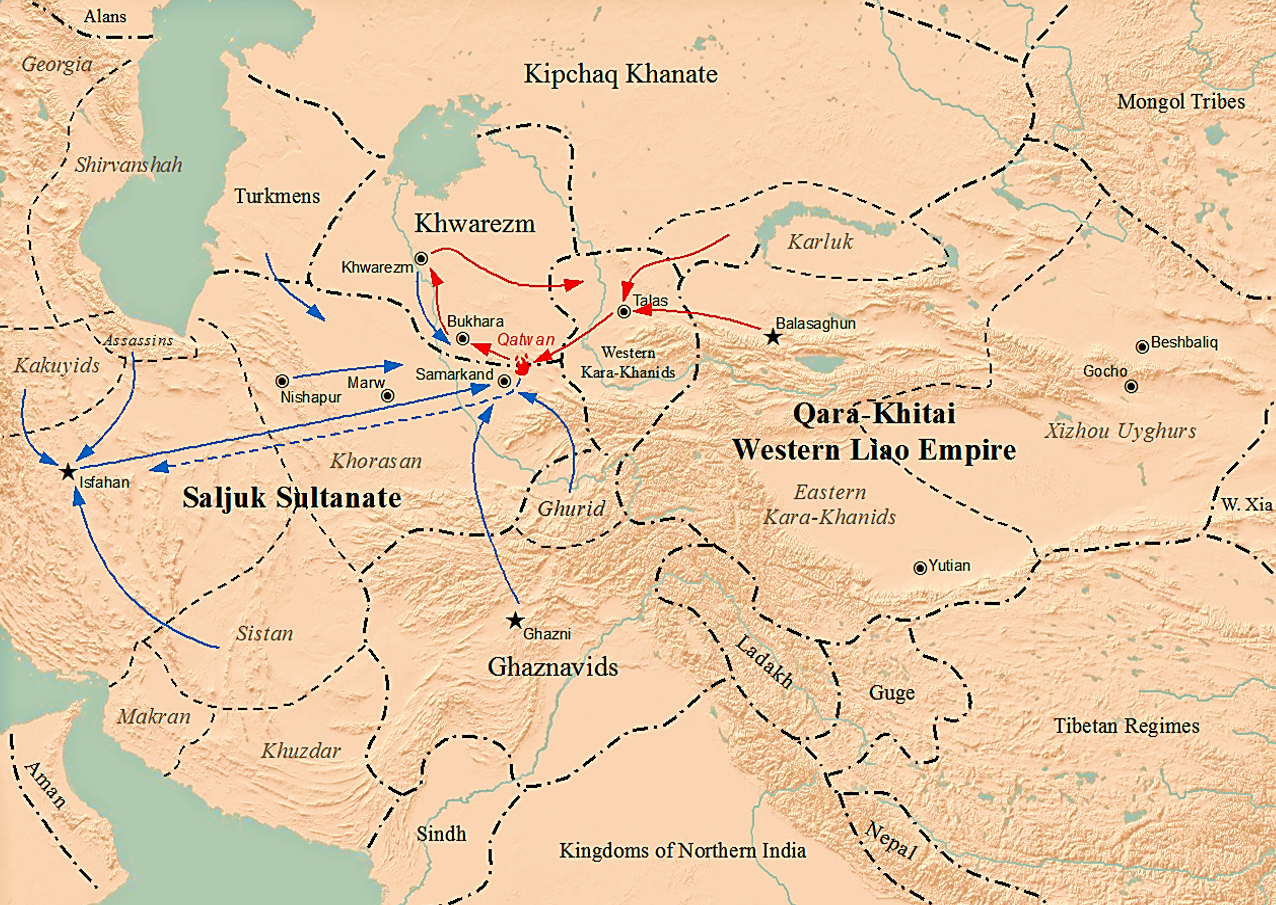
The Battle of Qatwan was fought on 9 September 1141 on the Qatwan steppe north of Samarkand, where the Qara Khitai, a people from northern China led by Yelü Dashi, destroyed the army of the Seljuk sultan Sanjar. It cost the Seljuks all of Transoxiana, turned the Khwarazmshahs and the Qarakhanids into vassals of a non-Muslim power, and marked the start of the long decline of the Great Seljuk Empire in the east.
| Date | 9 September 1141 (5 Safar 536 AH) |
|---|---|
| Place | Qatwan steppe, north of Samarkand (in today’s Uzbekistan) |
| Sides | Great Seljuk Sultanate with Qarakhanid allies against the Qara Khitai with Qarluq Turks |
| Commanders | Sultan Ahmad Sanjar; the gurkhan Yelü Dashi |
| Result | Decisive Qara Khitai victory; Transoxiana and Khwarazm pass under Qara Khitai overlordship |

Refugees from the Liao empire
The victors at Qatwan had come a very long way. The Khitans had ruled northern China and Mongolia as the Liao dynasty until the Jurchen Jin dynasty destroyed their state in 1125. A member of the royal clan, Yelü Dashi, led a body of followers west into Central Asia. He took Balasagun, the capital of the eastern Qarakhanids, in the Chu valley, and there built a new empire that Muslim writers called Qara Khitai and Chinese historians called the Western Liao. He ruled with the title gurkhan, “universal khan”.
The Qara Khitai kept Chinese-style administration at the top and left local Muslim dynasties in place underneath, so long as they paid tribute. To the Muslim world they were “infidels” from beyond the frontier, but their rule was generally light and tolerant.
Why Sanjar marched north
Transoxiana, the land between the Amu Darya and the Syr Darya with Samarkand and Bukhara, was ruled by the western Qarakhanids as vassals of Sanjar, who governed the Seljuk east from Merv (his career is told on the page on Sultan Sanjar and the Qara Khitai). In 1137 the Qara Khitai defeated the Qarakhanid ruler Mahmud II near Khujand. Mahmud, Sanjar’s nephew, appealed to his overlord.
A second quarrel brought matters to a head. The Qarluq Turks, nomads grazing their herds in Qarakhanid territory, fell out with Mahmud and with Sanjar and turned to the gurkhan for protection. Several Muslim writers, among them Ibn al-Athir, add that the Khwarazmshah Atsiz, Sanjar’s restless vassal on the lower Amu Darya, encouraged the Qara Khitai to attack. Whether or not that is true, Atsiz certainly profited from what followed.
In 1141 Sanjar crossed the Amu Darya and came to Samarkand with a large army drawn from Khorasan, Sistan, Ghazna and his other dependencies. Yelü Dashi’s letter asking him to pardon the Qarluqs was answered, according to the chroniclers, with an arrogant demand that the gurkhan convert to Islam.
The battle on the Qatwan steppe
The armies met on 9 September on open ground north of Samarkand. The sources give numbers that cannot be trusted: Sanjar is credited with around 100,000 men, while estimates for the Qara Khitai range from 20,000 to several hundred thousand, and some contemporary Muslim writers simply say the two sides were of equal size. The Qarluqs are said to have brought tens of thousands of horsemen.
The Qara Khitai attacked from several sides at once and drove the Seljuk centre into a valley called Dargham, about 12 kilometres from Samarkand, where it could neither manoeuvre nor escape. The army broke. Sadr al-Din al-Husayni, the Arabic chronicler of the Seljuks, blamed the lack of unity among Sanjar’s emirs, who began to give way soon after the fighting started. Figures for the dead run from about 11,000 to 100,000.
Al-Husayni tells a striking story about the escape. As the enemy closed in, Abu’l-Fadl, the ruler of Sistan, advised Sanjar to leave an ordinary soldier in his place and flee. Sanjar did, and got away across the Amu Darya with only a handful of riders. Abu’l-Fadl stayed with the stand-in until the end and was taken prisoner.
Prisoners and ransoms
Among the captives were Sanjar’s wife Terken Khatun and the commander Qumach with his son. Terken Khatun was later released for a ransom said to be 500,000 dinars and Qumach for 100,000. Abu’l-Fadl was freed without payment. According to al-Husayni the gurkhan admired his loyalty and declared that such a hero should not be executed. The same chronicler has Yelü Dashi refuse to cut off Sanjar’s retreat, on the principle that a beaten enemy with no way out fights to the death.
What Qatwan changed
Yelü Dashi spent about ninety days in Samarkand receiving the submission of the local nobility. He installed Mahmud’s brother Ibrahim as ruler of Samarkand and left the Burhan family, the hereditary religious leaders of Bukhara, in charge there. Transoxiana stayed under Qara Khitai overlordship for the next seventy years.
The Khwarazmshah gained most. While Sanjar was recovering, Atsiz raided Khorasan and plundered Merv and Nishapur in 1141 and 1142. He did not escape the new order for long: in 1142 a Qara Khitai force ravaged Khwarazm and Atsiz agreed to pay the gurkhan an annual tribute of 30,000 dinars. The Khwarazmian Empire grew up as a Qara Khitai tributary, and only Ala al-Din Muhammad II finally threw off that dependence around 1210.
For the Seljuks, Qatwan was the first great defeat suffered by Sanjar, who had dominated the eastern Islamic world for forty years. He kept Khorasan, but his prestige never recovered, and twelve years later the Oghuz revolt of 1153 finished what Qatwan had begun.
An echo in Europe
News of the battle travelled far. In 1145 Bishop Hugh of Jabala, visiting Pope Eugene III, reported that a Christian priest-king of the East had defeated the Muslims and would have marched to help Jerusalem if he had been able to cross the Tigris. The chronicler Otto of Freising recorded the story. Historians usually connect it with Yelü Dashi’s victory at Qatwan, and it is one of the roots of the medieval European legend of Prester John. Yelü Dashi was not a Christian, although there were Nestorian Christians among the peoples of Central Asia.
Persian words from this page
| قطوان | Qatvân | Qatwan |
| سمرقند | Samarqand | Samarkand |
| سنجر | Sanjar | Sanjar |
| قراختاییان | Qarâkhatâyiyân | the Qara Khitai |
| ماوراءالنهر | Mâvarâ’onnahr | Transoxiana (“what lies beyond the river”) |
| خوارزم | Khârazm | Khwarazm |
Read next: the court and poets that Sanjar’s defeat put at risk on the page on Anvari and Seljuk court poetry, and the fragmentation that followed in Seljuk decline and the atabegs.
Sources and further reading
- Ibn al-Athir, al-Kamil fi’l-Tarikh, account of the year 536 AH (English translation by D. S. Richards, The Chronicle of Ibn al-Athir for the Crusading Period, part 1).
- Sadr al-Din al-Husayni, Akhbar al-Dawla al-Saljuqiyya (English translation by C. E. Bosworth, The History of the Seljuq State).
- Michal Biran, The Empire of the Qara Khitai in Eurasian History: Between China and the Islamic World (Cambridge University Press, 2005).
- C. E. Bosworth, “The Political and Dynastic History of the Iranian World (A.D. 1000–1217)”, in The Cambridge History of Iran, vol. 5.
- W. Barthold, Turkestan down to the Mongol Invasion.
Want to learn Persian? Get the free Starter Pack
Get the 14-page printable Starter Pack (all 32 letters, a 7-day reading plan, 100 core words and 20 survival phrases) and a short 5-email course. Free.
More in Ghaznavids, Seljuks and Khwarazmshahs (977–1231)
- The Ghaznavid Empire
- Mahmud of Ghazni
- The Rise of the Seljuks
- The Battle of Dandanaqan (1040)
- Tughril Beg Enters Baghdad
- Alp Arslan
- Seljuk Architecture: Tomb Towers and Caravanserais
- The Battle of Manzikert (1071)
- Malik Shah I
- The Seljuks of Kerman
- Nizam al-Mulk and the Siyasatnama
- The Seljuk Domes of Isfahan’s Jameh Mosque
- Omar Khayyam: Poet and Scientist
- Al-Ghazali
- Sana’i of Ghazni
- Hassan-i Sabbah and the Fortress of Alamut
- The Nizari Ismailis and the “Assassins” Legend
- Sultan Sanjar and the Qara Khitai
- The Battle of Qatwan (1141)
- Anvari and Seljuk Court Poetry
- Seljuk Decline and the Atabegs
- The Ghurids
- Attar of Nishapur
- Nizami Ganjavi
- The Khwarazmian Empire
- Ala al-Din Muhammad II
- The Otrar Incident (1218): How Khwarazm Provoked Genghis Khan
- Jalal al-Din Mingburnu