The Ghurids were a dynasty of Iranian (Tajik) chiefs from Ghor, in the mountains of central Afghanistan, who rose in the twelfth century to destroy the Ghaznavids, fight the Khwarazmshahs for Khorasan and conquer northern India. Under the brothers Ghiyath al-Din and Mu’izz al-Din Muhammad (c. 1163–1206) their power reached from Nishapur to Bengal; their Indian conquests became the Delhi Sultanate, and they left behind the Minaret of Jam.
| Dynasty | Shansabani family of Ghor |
|---|---|
| Height of power | c. 1150–1206 |
| Capitals | Firuzkuh in Ghor (probably at or near Jam); Ghazni; later Lahore for the Indian conquests |
| Great rulers | Ala al-Din Husayn “Jahansuz” (d. 1161); Ghiyath al-Din Muhammad (r. 1163–1203); Mu’izz al-Din Muhammad (at Ghazni from 1173, sole ruler 1203–1206) |
| End | Lands absorbed by the Khwarazmshah Ala al-Din Muhammad II by 1215 |
| Main source | Juzjani, Tabaqat-i Nasiri (written in Delhi, c. 1260) |
A mountain people between Herat and Ghazni
Ghor is a high, broken country of valleys around the upper Hari Rud, east of Herat. It was among the last parts of the eastern Iranian world to accept Islam, and its people spoke a local form of Persian. Mahmud of Ghazni campaigned there in 1011, and for most of the eleventh century the local chiefs of the Shansabani family were Ghaznavid tributaries. Their historian Juzjani gave them a grand ancestry going back to Zahhak, the tyrant king of Iranian legend, which tells us more about their ambitions than their origins.
The world-burner
The quarrel that made the Ghurids a great power was a blood feud. In the 1140s the Ghaznavid sultan Bahram Shah had two Shansabani brothers killed. A third, Ala al-Din Husayn, marched on Ghazni around 1150, took the city and, according to Juzjani, let his men burn and plunder it for seven days. The fine Ghaznavid tombs were opened, the bodies of the sultans thrown out, with only Mahmud’s and two others spared. The deed earned him the name Jahansuz, “world-burner”. The last Ghaznavids fled to the Punjab (their story ends on the page on the Ghaznavid Empire).
Ala al-Din Husayn then refused tribute to the Seljuk sultan Sanjar and was defeated and captured by him in 1152. Sanjar released him, and after the Oghuz revolt of 1153 shattered Seljuk power in Khorasan, nothing stood between the Ghurids and the plains.

Two brothers, two directions
The dynasty’s high point came under two of Jahansuz’s nephews, who shared power with unusual loyalty. Ghiyath al-Din Muhammad ruled as senior sultan from Firuzkuh from 1163 and looked west to Khorasan. His younger brother Mu’izz al-Din Muhammad, often called Shihab al-Din or Muhammad of Ghor, was given Ghazni after it was recovered from Oghuz bands in 1173 and looked east to India.
Khorasan
Ghiyath al-Din took Herat in the mid-1170s and rebuilt its Friday Mosque around 1200. His real rivals were the Khwarazmshahs. When Tekish died in 1200 the Ghurids overran much of Khorasan, including Nishapur, but they could not hold it against his son Ala al-Din Muhammad II. In 1204 Mu’izz al-Din invaded Khwarazm itself and was badly beaten at Andkhud by a Khwarazmian and Qara Khitai army.
India
Mu’izz al-Din was more successful in the east. He took Multan in 1175, suffered a defeat by the Chaulukya kingdom of Gujarat in 1178, and in 1186 took Lahore from the last Ghaznavid, Khusraw Malik. At Tarain, north of Delhi, he was beaten by the Chauhan king Prithviraj in 1191 and came back the following year to win decisively. His generals then pushed far down the Ganges plain: Qutb al-Din Aybak took Delhi in 1193, and Muhammad Bakhtiyar Khalji raided Bihar and Bengal around 1200.
Death on the Jhelum and the fall
Ghiyath al-Din died in 1203. Mu’izz al-Din, now sole ruler, was murdered in March 1206 at his camp on the Jhelum, on his way back from fighting the Khokhars of the Punjab. The sources name different killers: Ismaili assassins in some accounts, Khokhar tribesmen in others.
The empire fell apart among his family and his former slave commanders. Taj al-Din Yildiz held Ghazni, Nasir al-Din Qubacha held Multan, and Aybak ruled from Lahore, founding what became the Delhi Sultanate. The Shansabani princes kept Firuzkuh for a few years more, but Ala al-Din Muhammad II took Herat, Ghor and finally Ghazni, and by 1215 the Ghurid state was gone. The Khwarazmian side of that story is on the page on Ala al-Din Muhammad II.
A Persian court in the mountains
Though their armies were full of Turkish slave soldiers, the Ghurids ran a Persian-speaking court. Nizami Aruzi dedicated his Chahar Maqala (“Four Discourses”), a famous handbook on secretaries, poets, astrologers and physicians, to a Ghurid prince of the Bamiyan branch. Ghiyath al-Din moved from the local Karrami sect to Shafi’i Sunnism and patronised the theologian Fakhr al-Din Razi. Juzjani, whose family served the dynasty, later wrote its history in exile in Delhi, which is why we know the Ghurids mainly through the eyes of an admirer.
The Minaret of Jam
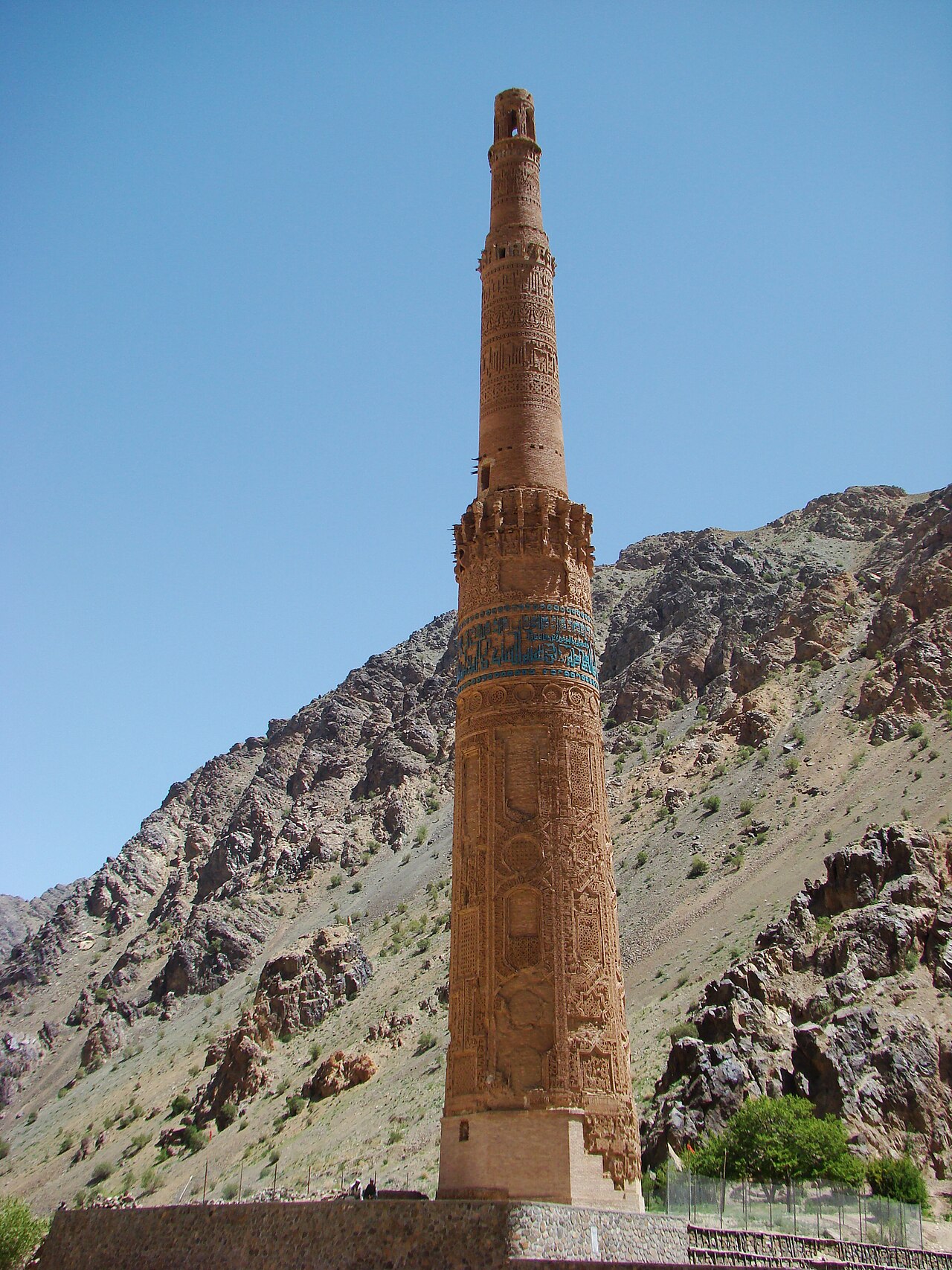
The Ghurids’ most famous building stands alone in a gorge where the Jam river meets the Hari Rud. The Minaret of Jam is about 65 metres tall, built entirely of fired brick and covered in bands of geometric ornament, Kufic and naskh inscriptions, and the whole of the Qur’anic sura of Maryam. Its inscriptions name Ghiyath al-Din. The date is usually read as 1193/94, though some scholars read 1174/75. Archaeologists working around it have found remains that suggest this was the site of Firuzkuh, the lost summer capital. It was inscribed on the UNESCO World Heritage List in 2002 and placed at once on the list of sites in danger.
Ghurid patrons also built the madrasa of Shah-i Mashhad in north-west Afghanistan, and in India Aybak began the Qutb Minar in Delhi around 1199, a tower in the same family as Jam.
Persian words from this page
| غوریان | Ghuriyân | the Ghurids |
| غور | Ghur | Ghor |
| فیروزکوه | Firuzkuh | Firuzkuh (“turquoise mountain”) |
| جهانسوز | jahânsuz | world-burner |
| منار جام | Monâr-e Jâm | Minaret of Jam |
| هرات | Harât | Herat |
The poet who flourished at Ghazni in the decades before the Ghurid sack is the subject of the page on Sana’i of Ghazni.
Sources and further reading
- Minhaj al-Siraj Juzjani, Tabaqat-i Nasiri, translated by H. G. Raverty.
- Encyclopaedia Iranica, “Ghurids” (C. E. Bosworth).
- C. E. Bosworth, The Later Ghaznavids: Splendour and Decay (Edinburgh University Press, 1977).
- UNESCO World Heritage Centre, “Minaret and Archaeological Remains of Jam”.
- Finbarr Barry Flood, Objects of Translation: Material Culture and Medieval “Hindu-Muslim” Encounter (Princeton University Press, 2009).
Want to learn Persian? Get the free Starter Pack
Get the 14-page printable Starter Pack (all 32 letters, a 7-day reading plan, 100 core words and 20 survival phrases) and a short 5-email course. Free.
More in Ghaznavids, Seljuks and Khwarazmshahs (977–1231)
- The Ghaznavid Empire
- Mahmud of Ghazni
- The Rise of the Seljuks
- The Battle of Dandanaqan (1040)
- Tughril Beg Enters Baghdad
- Alp Arslan
- Seljuk Architecture: Tomb Towers and Caravanserais
- The Battle of Manzikert (1071)
- Malik Shah I
- The Seljuks of Kerman
- Nizam al-Mulk and the Siyasatnama
- The Seljuk Domes of Isfahan’s Jameh Mosque
- Omar Khayyam: Poet and Scientist
- Al-Ghazali
- Sana’i of Ghazni
- Hassan-i Sabbah and the Fortress of Alamut
- The Nizari Ismailis and the “Assassins” Legend
- Sultan Sanjar and the Qara Khitai
- The Battle of Qatwan (1141)
- Anvari and Seljuk Court Poetry
- Seljuk Decline and the Atabegs
- The Ghurids
- Attar of Nishapur
- Nizami Ganjavi
- The Khwarazmian Empire
- Ala al-Din Muhammad II
- The Otrar Incident (1218): How Khwarazm Provoked Genghis Khan
- Jalal al-Din Mingburnu