The nationalisation of Iranian oil was the decision of Iran’s parliament in March 1951 to take over the oil industry run by the British-owned Anglo-Iranian Oil Company (AIOC). It led to a two-year confrontation with Britain, the shutdown of the giant Abadan refinery and an international boycott of Iranian oil, and it ended only with the coup of August 1953. Iranians still mark the day of the law, 29 Esfand (20 March), as a national holiday.
| Law passed | Majlis 15 March 1951; Senate 20 March 1951 (29 Esfand 1329) |
|---|---|
| Company affected | Anglo-Iranian Oil Company (formerly Anglo-Persian; from 1954 British Petroleum) |
| Leading figure | Mohammad Mosaddegh and the National Front |
| New operator | National Iranian Oil Company (NIOC) |
| Outcome | British staff left Abadan, October 1951; boycott of Iranian oil until 1954 |
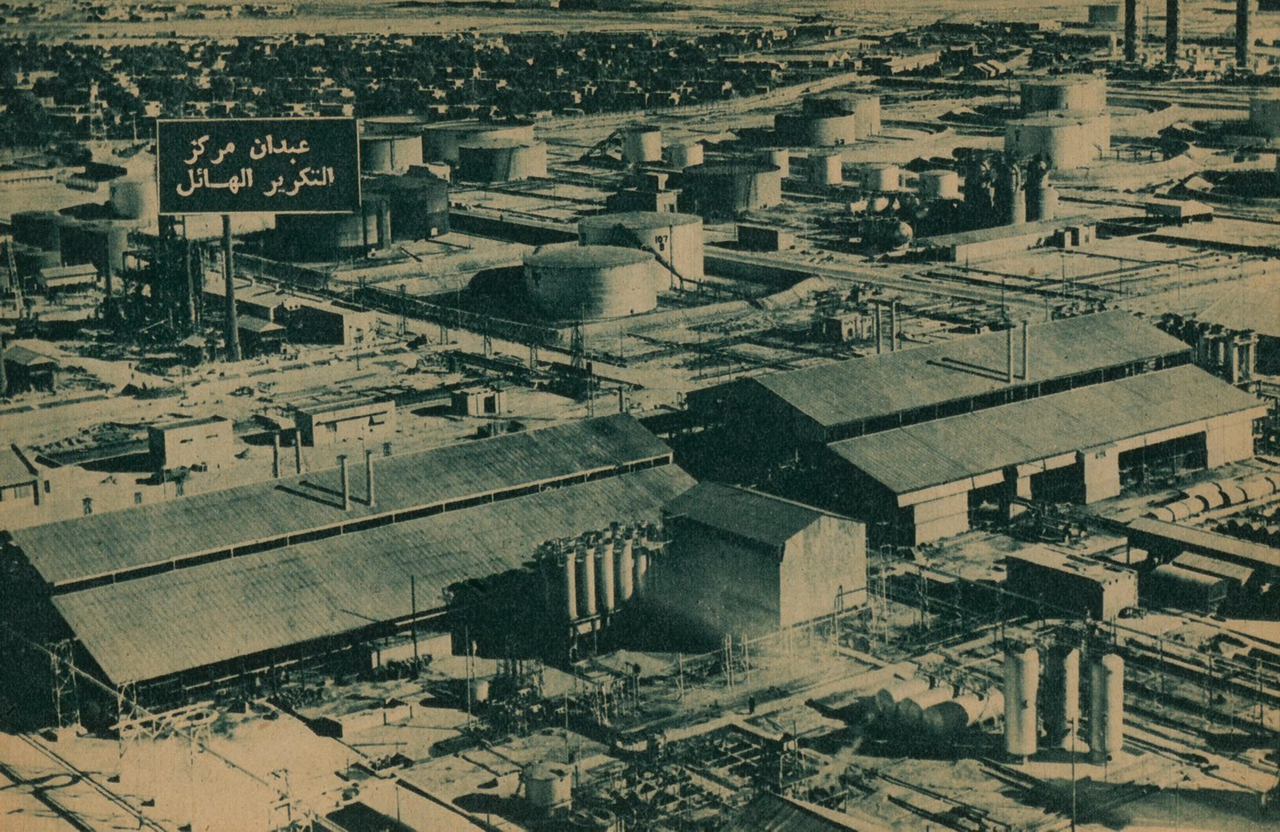

Forty years of a British concession
Oil was struck at Masjed Soleyman in 1908 under a concession granted in 1901 to William Knox D’Arcy. The Anglo-Persian Oil Company, formed in 1909, built a refinery on the island of Abadan in the Persian Gulf, and in 1914 the British government bought a controlling share so that the Royal Navy could switch from coal to oil. By the 1940s Abadan was one of the largest refineries in the world and the company was Britain’s biggest overseas investment.
Iranians had long complained about the terms. Reza Shah cancelled the D’Arcy concession in 1932, but the agreement that replaced it in 1933 extended the company’s rights to 1993. Royalties were small next to the company’s profits, and in some years AIOC paid more in tax to the British Treasury than it paid to Iran in royalties. Iranian workers in Khuzestan lived in crowded quarters a short walk from the lawns and clubs of the British staff, a contrast that many visitors noted and that the communist Tudeh party used in organising the 1946 oil strike.
From the Supplemental Agreement to the nationalisation law
In 1949 the company offered a Supplemental Agreement (the Gass–Golshayan agreement) that raised payments but did not change the basic structure. It arrived just as American companies in Saudi Arabia agreed, in December 1950, to share profits on a 50–50 basis. To Iranian deputies the British offer looked out of date before it was signed.
The Majlis oil committee, chaired by Mohammad Mosaddegh, rejected the agreement and called for nationalisation. Prime Minister Ali Razmara argued that Iran lacked the technicians to run the industry. On 7 March 1951 he was shot dead in a Tehran mosque by a member of the militant Fada’iyan-e Islam. Within days the Majlis voted for nationalisation, and the Senate followed on 20 March. Mosaddegh became prime minister at the end of April, and on 1 May the shah signed the law that set up the National Iranian Oil Company to take over the industry.
The Abadan crisis
Britain treated the law as a breach of contract. It sent warships to the Gulf, prepared a military plan to seize Abadan (which the Labour government of Clement Attlee did not carry out, in part because Washington opposed it) and took the case to the International Court of Justice. American mediation by Averell Harriman in July 1951, and a British mission under Richard Stokes in August, failed to bridge the gap: Iran would accept a buyer and paid technicians, but not a return of company control.
The last British staff left Abadan on 4 October 1951. Mosaddegh then flew to New York and defended Iran’s case at the UN Security Council, which declined to act. In July 1952 the International Court ruled that it had no jurisdiction, a result Iranians celebrated as a victory.
Boycott and economic squeeze
The real weapon was the market. AIOC warned that it would sue anyone who bought “its” oil, and the major companies raised output in Kuwait, Saudi Arabia and Iraq to replace Iranian supply. When the Italian-chartered tanker Rose Mary loaded Iranian oil in 1952, the Royal Navy forced it into Aden, where a court ruled the cargo belonged to AIOC. Exports fell almost to nothing.
The government tried to run an “economy without oil”, cutting imports and printing money. Historians such as Homa Katouzian argue that this held up better than expected for a while, but revenue losses, inflation and the strain on the budget fed the political crisis of 1952 and 1953. In October 1952 Iran broke off diplomatic relations with Britain, accusing British officials of plotting against the government. The story of how the crisis ended is told on the page on the 1953 coup.
- 1933 New AIOC concession agreed with Reza Shah, running to 1993
- 1949 Supplemental Agreement offered
- 7 March 1951 Prime Minister Razmara assassinated
- 15 and 20 March 1951 Majlis and Senate vote for nationalisation
- 1 May 1951 Nationalisation law signed; NIOC created
- 4 October 1951 Last British staff leave Abadan
- 22 July 1952 International Court of Justice declines jurisdiction
- October 1952 Britain and Iran break relations
Why historians disagree about it
Few events weigh more in Iranian memory. For Ervand Abrahamian, nationalisation was a classic clash between a nationalist movement and a declining empire, with oil at the centre. Other historians, including Katouzian, accept the justice of Iran’s case but argue that Mosaddegh missed realistic chances of a settlement, especially a World Bank proposal in 1952 and later American offers. British and American officials at the time often described the Iranian leadership as unreasonable; many later British accounts concede that the company’s own rigidity before 1951 did much to create the crisis.
There is also debate about the long-term result. Iran did not regain full operational control until 1973, and the immediate sequel was the 1954 oil consortium, which left foreign companies running production. Yet the principle that the oil belonged to the nation was never reversed, and later oil nationalisations elsewhere looked back to Iran’s example. For the man at the centre of the struggle, see the biography of Mohammad Mosaddegh; for the oil city itself, see Abadan and Khorramshahr.
Persian words from this page
| نفت | naft | oil |
| ملی شدن صنعت نفت | melli shodan-e san’at-e naft | nationalisation of the oil industry |
| آبادان | Âbâdân | Abadan |
| مجلس | Majles | parliament |
| جبهه ملی | Jebhe-ye Melli | National Front |
| شرکت ملی نفت ایران | Sherkat-e Melli-ye Naft-e Irân | National Iranian Oil Company |
Sources and further reading
- Ervand Abrahamian, The Coup: 1953, the CIA, and the Roots of Modern U.S.–Iranian Relations (The New Press, 2013).
- Homa Katouzian, Musaddiq and the Struggle for Power in Iran (I.B. Tauris, 1990).
- Mary Ann Heiss, Empire and Nationhood: The United States, Great Britain, and Iranian Oil, 1950–1954 (Columbia University Press, 1997).
- James Bamberg, The History of the British Petroleum Company, vol. 2: The Anglo-Iranian Years, 1928–1954 (Cambridge University Press, 1994).
- Encyclopaedia Iranica, “Anglo-Iranian Oil Company”.
Want to learn Persian? Get the free Starter Pack
Get the 14-page printable Starter Pack (all 32 letters, a 7-day reading plan, 100 core words and 20 survival phrases) and a short 5-email course. Free.
More in The Pahlavi Era (1925–1979)
- Reza Shah Pahlavi
- Reza Shah’s Reforms
- The Trans-Iranian Railway
- Why Persia Became “Iran” in 1935
- The Unveiling Decree of 1936 (Kashf-e Hijab)
- The Anglo-Soviet Invasion of Iran (1941)
- The Persian Corridor and the Tehran Conference
- The Iran Crisis of 1946
- Mohammad Reza Shah’s Early Reign (1941–1953)
- The Tudeh Party
- Mohammad Mosaddegh
- The Nationalisation of Iranian Oil (1951)
- The 1953 Coup in Iran
- Fazlollah Zahedi
- The 1954 Oil Consortium Agreement
- SAVAK: The Shah’s Security Service
- The White Revolution (1963)
- The Uprising of June 1963 and Khomeini’s Exile
- The Hoveyda Years (1965–1977)
- The 2,500-Year Celebration of the Persian Empire (1971)
- The Oil Boom of the 1970s
- Intellectuals and Opposition in the 1960s–70s
- Iran as a Regional Power under the Shah
- Women in Pahlavi Iran
- The Cinema Rex Fire (1978)
- Black Friday (September 1978)
- The Shah Leaves Iran (January 1979)
- Farah Pahlavi
- The Pahlavi Family
- Forough Farrokhzad and Modern Persian Poetry
- Iranian Cinema before 1979