Between December 2017 and November 2019 Iran saw two waves of nationwide protest driven by economic hardship. The first began in Mashhad on 28 December 2017 and spread to dozens of towns within days; the second broke out on 15 November 2019, when the government suddenly raised petrol prices, and was crushed within a week under a near-total internet shutdown. Rights groups describe the November 2019 crackdown as the deadliest in the Islamic Republic’s history up to that time.
| First wave | 28 December 2017 to early January 2018 (Dey 1396) |
|---|---|
| Deaths, 2017–2018 | At least 21 protesters and two security personnel by 2 January 2018 (various reports put the total at about 25) |
| Second wave | 15 to about 20 November 2019 (Aban 1398) |
| Trigger, 2019 | Petrol price raised overnight from 10,000 to 15,000 rials a litre for a monthly quota, and to 30,000 above it |
| Deaths, 2019 | Iranian officials: about 230; Amnesty International: at least 304; Reuters, citing three Interior Ministry officials: about 1,500 |

Why people came out
Both waves grew from economic grievance. Hopes raised by the 2015 nuclear deal (see Rouhani and the JCPOA) had faded; unemployment among the young was high; several unlicensed credit institutions had collapsed and taken people’s savings; and a leaked budget at the end of 2017 showed large sums for religious foundations alongside cuts to cash handouts. After the US withdrawal from the deal in 2018 and the return of sanctions, the rial fell sharply and prices of food and medicine soared.
What surprised observers was where the protests happened. Unlike 2009, the main protagonists were not the Tehran middle class but working-class and lower-middle-class people in provincial towns, places that had been considered loyal to the system.
Dey 1396: December 2017 to January 2018
The first protest, in Mashhad on 28 December 2017, was over high prices; some reports suggested conservative opponents of President Rouhani had encouraged it. Within days protests had spread to about eighty towns and cities, including Kermanshah, Izeh, Dorud and Qahderijan. The slogans quickly went beyond prices, attacking the Leader, the clergy and spending on wars in Syria and Lebanon, under chants such as “Neither Gaza nor Lebanon, my life for Iran”. Some protesters chanted in praise of the Pahlavi monarchy.
The authorities blocked Telegram and Instagram, the most popular messaging apps, and security forces dispersed crowds. A reformist MP, Mahmoud Sadeghi, said about 3,700 people had been arrested; official figures were lower. Several detainees died in custody, which officials described as suicides. Pro-government rallies were organised from 30 December, and by early January the wave had subsided.
The girls of Enqelab Street
On 27 December 2017, the day before the protests began, a young woman, Vida Movahed, stood on a utility box on Enqelab (Revolution) Street in Tehran, took off her white headscarf and waved it on a stick. Photos of her spread online, and in the following weeks other women copied her. The “girls of Enqelab Street” became an early sign of the protests over compulsory hijab that later grew into the 2022 Woman, Life, Freedom movement.
2018–2019: strikes and smaller protests
Unrest continued in other forms during 2018 and 2019: strikes by truck drivers, teachers and workers at the Haft Tappeh sugar factory, protests by bazaar merchants in Tehran in June 2018 as the currency fell, and local protests over water shortages in Khuzestan and Isfahan.
Aban 1398: the November 2019 uprising
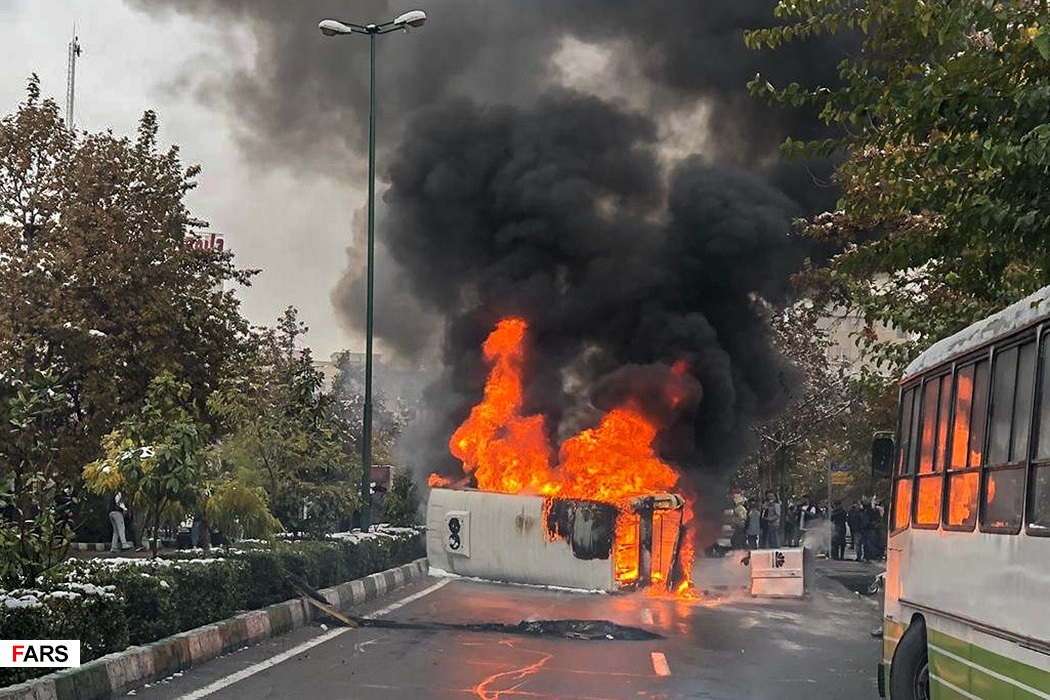
Just after midnight on Friday 15 November 2019, the government announced that the price of petrol would rise by 50 per cent for the first 60 litres a month and triple above that. The money, it said, would fund cash payments to poorer families. Within hours, drivers blocked roads, and protests spread to more than 100 cities. Some banks, petrol stations and government buildings were set on fire. On 16 November Leader Ali Khamenei backed the decision and described those attacking property as “thugs”.
That evening the authorities shut down almost all internet access across the country, cutting connectivity to a few per cent of normal levels for about a week, according to the monitoring group NetBlocks. Under this blackout security forces used live ammunition. Witnesses and rights groups described shootings in Tehran’s working-class suburbs, in Shiraz and in Khuzestan, where The New York Times reported that dozens of protesters were killed in marshland near the town of Mahshahr.
Counting the dead
The death toll of November 2019, known as آبان خونین (Aban-e khunin, Bloody Aban), is still disputed:
- An Iranian parliamentary official said in 2020 that about 230 people had been killed, including security personnel.
- Amnesty International documented at least 304 deaths, including children, by name and circumstance.
- Reuters reported in December 2019, citing three Interior Ministry officials, that about 1,500 people had been killed; the government called the figure false.
Thousands were arrested; an Iranian member of parliament put the figure at about 7,000. Amnesty International and Human Rights Watch reported torture in detention and death sentences for some protesters. Families of those killed, such as the parents of Pouya Bakhtiari, a young engineer shot in Karaj, were pressured not to hold public memorials.
How the protests are understood
The government blamed foreign enemies, the exiled opposition and the monarchists for organising violence, and said security forces had acted against armed rioters. Many analysts, including sociologists in Iran, saw instead a break between the state and the poorer groups it had long counted as its base, and a shift from demands for reform to rejection of the system. The two waves also showed the state’s growing reliance on internet controls. Two months later, the downing of Flight 752 brought students back onto the streets. For earlier protest movements, see 1999 and 2009.
Persian words from this page
| اعتراض | e’terâz | protest |
| بنزین | benzin | petrol |
| آبان خونین | Âbân-e khunin | Bloody Aban (November 2019) |
| دی | Dey | Dey (the tenth month; December–January) |
| گرانی | gerâni | rising prices |
| خیابان انقلاب | khiyâbân-e Enqelâb | Enqelab (Revolution) Street |
Sources and further reading
- Amnesty International, published findings on 304 deaths in the November 2019 crackdown (2020), and the report Trampling Humanity (September 2020).
- Reuters, “Special Report: Iran’s leader ordered crackdown on unrest, ‘Do whatever it takes to end it’” (23 December 2019).
- Human Rights Watch, reports on the November 2019 protests and their aftermath (2019–2020).
- NetBlocks, measurements of the Iran internet shutdown (November 2019).
Want to learn Persian? Get the free Starter Pack
Get the 14-page printable Starter Pack (all 32 letters, a 7-day reading plan, 100 core words and 20 survival phrases) and a short 5-email course. Free.
More in The Islamic Revolution and the Islamic Republic (1979–present)
- Causes of the 1979 Revolution
- Khomeini’s Return and the Fall of the Monarchy
- Ruhollah Khomeini
- The 1979 Referendum and the New Constitution
- The Iran Hostage Crisis (1979–1981)
- Power Struggles after the Revolution
- The Cultural Revolution and University Closures
- The Iran–Iraq War: Causes and Iraqi Invasion
- Khorramshahr: Fall and Liberation
- The Iran–Iraq War, 1982–1986
- The Basij and Child Soldiers in the Iran–Iraq War
- Chemical Weapons in the Iran–Iraq War
- The Tanker War and Iran Air Flight 655
- The Iran–Contra Affair
- The End of the Iran–Iraq War (1988)
- The 1988 Executions of Political Prisoners
- The Death of Khomeini and the Succession of Khamenei (1989)
- Ali Khamenei
- Rafsanjani and Post-War Reconstruction (1989–1997)
- Khatami and the Reform Era (1997–2005)
- The 1999 Student Protests (18 Tir)
- The Ahmadinejad Presidency (2005–2013)
- The 2009 Election and the Green Movement
- Iran’s Nuclear Program
- Sanctions on Iran
- Rouhani and the Nuclear Deal (JCPOA)
- The Protests of 2017–2018 and November 2019
- The Killing of Soleimani and Flight 752 (January 2020)
- Iran and the COVID-19 Pandemic
- The Raisi Presidency and His Death (2021–2024)
- The 2022 Mahsa Amini Protests: “Woman, Life, Freedom”
- Iran and Israel: From Allies to Open Conflict
- The Pezeshkian Presidency
- The Twelve-Day War of June 2025
- The Protests of Late 2025 and January 2026
- The 2026 War with the United States and Israel
- The Killing of Ali Khamenei (28 February 2026)
- Mojtaba Khamenei and the 2026 Succession
- The Iranian Diaspora
- Iran and Hezbollah
- Major Earthquakes in Modern Iran
- Iranian Cinema after 1979