The Grand Bazaar of Tehran (بازار بزرگ تهران, Bâzâr-e Bozorg) is the covered market at the old heart of the capital, a maze of brick-vaulted lanes, caravanserais, mosques and trading halls that grew mostly between the Safavid and Qajar periods. It is still a working wholesale market rather than a museum, and for two centuries it has also been a political force: merchants closing their shops have repeatedly shaped Iranian history.
| Persian name | Bâzâr-e Bozorg-e Tehrân |
|---|---|
| Location | District 12, south of Panzdah-e Khordad Street, central Tehran |
| Main period | Grew from the 16th century; most surviving fabric is 19th-century Qajar, with 20th-century additions |
| Size | Estimates put its lanes at more than 10 km in total |
| Protection | On Iran’s National Heritage List since 1977 |
| Nearest metro | Panzdah-e Khordad and Khayyam stations |
Our older post on the Tehran Bazaar gives a short overview of its sections. This page goes deeper into how the bazaar was built, why it matters politically, and how to find your way through it.

From a market outside the walls to the capital’s engine
Travellers in the early Islamic centuries already describe trade in the area of the present bazaar, but Tehran was then a village in the shadow of the great city of Rey (see the historic city of Rey). The first real growth came in the Safavid era, when Shah Tahmasp I had walls built around Tehran in the 1550s. European visitors in the 1660s still found the market largely open to the sky and only partly roofed.
The decisive change came when Agha Mohammad Khan, founder of the Qajar dynasty, made Tehran his capital in 1786. The court in the citadel, the Arg, sat just north-west of the market, and the bazaar grew to serve it. Most of the vaulted brick lanes, domed crossings (chahârsu) and inner courtyards that survive today belong to the 19th century. Fath-Ali Shah built the royal mosque at the bazaar’s northern edge, and under Naser al-Din Shah merchants and officials added new timcheh, the skylit, domed halls where wholesale trade in cloth, carpets and china was done.
In the 20th century the bazaar lost ground. Reza Shah’s new avenues cut through parts of the old fabric, and modern shops spread north. Newer sections were built in a different, plainer style, and the contrast with the old brickwork is easy to see as you walk.
Merchants, mosques and politics
The bazaar has never been only a place to shop. Its guilds, its merchants (bâzâri) and the clergy of its mosques were linked by money, marriage and charitable endowments. When they acted together, they could stop the economy of the capital.
- In the Tobacco Protest of 1891–1892, bazaar merchants joined the boycott against a British tobacco monopoly, and the shah cancelled the concession.
- During the Constitutional Revolution, merchants shut their shops in 1905–1906 and thousands took sanctuary (bast) to demand a parliament.
- In 1978 the bazaar was a centre of strikes and funding for the movement against Mohammad Reza Shah, whose economic policies many bazaaris felt left them behind.
- Most recently, strikes over the fall of the rial began in the bazaar on 29 December 2025 and became the starting point of a wider wave of protests.
Historians often describe the bazaar as a conservative force, but the record above shows something simpler: it is a network of people with shared interests, able to act quickly when those interests are threatened.
What to look at
Sabzeh Meydan and the main entrance
The usual way in is from Sabzeh Meydan, the old “green square” on the north side, close to Panzdah-e Khordad metro. From there the main spine runs south, and side lanes branch off by trade: gold and jewellery, copper, spices and dried fruit, fabrics, shoes, household goods, carpets. Many lanes carry the name of the trade or of the person who built them, such as Bazaar-e Amir.
The Emam Mosque
The Emam Mosque (مسجد امام), known before 1979 as the Soltani or Shah Mosque, was built for Fath-Ali Shah as a statement of the new dynasty’s piety. Its courtyard opens straight off the bazaar lanes, the two minarets were added under Naser al-Din Shah, and a small gilded dome tops the prayer hall. Outside prayer times visitors are usually welcome in the courtyard if dressed modestly.
The Jameh Mosque of the bazaar
Further into the bazaar is the Jameh (Friday) Mosque, generally considered the oldest mosque in Tehran. Its oldest prayer hall may go back to the 10th or 11th century, and the rest grew around it over centuries, so it is a good place to see how the city’s religious life was rooted in the market.
Timcheh and caravanserais
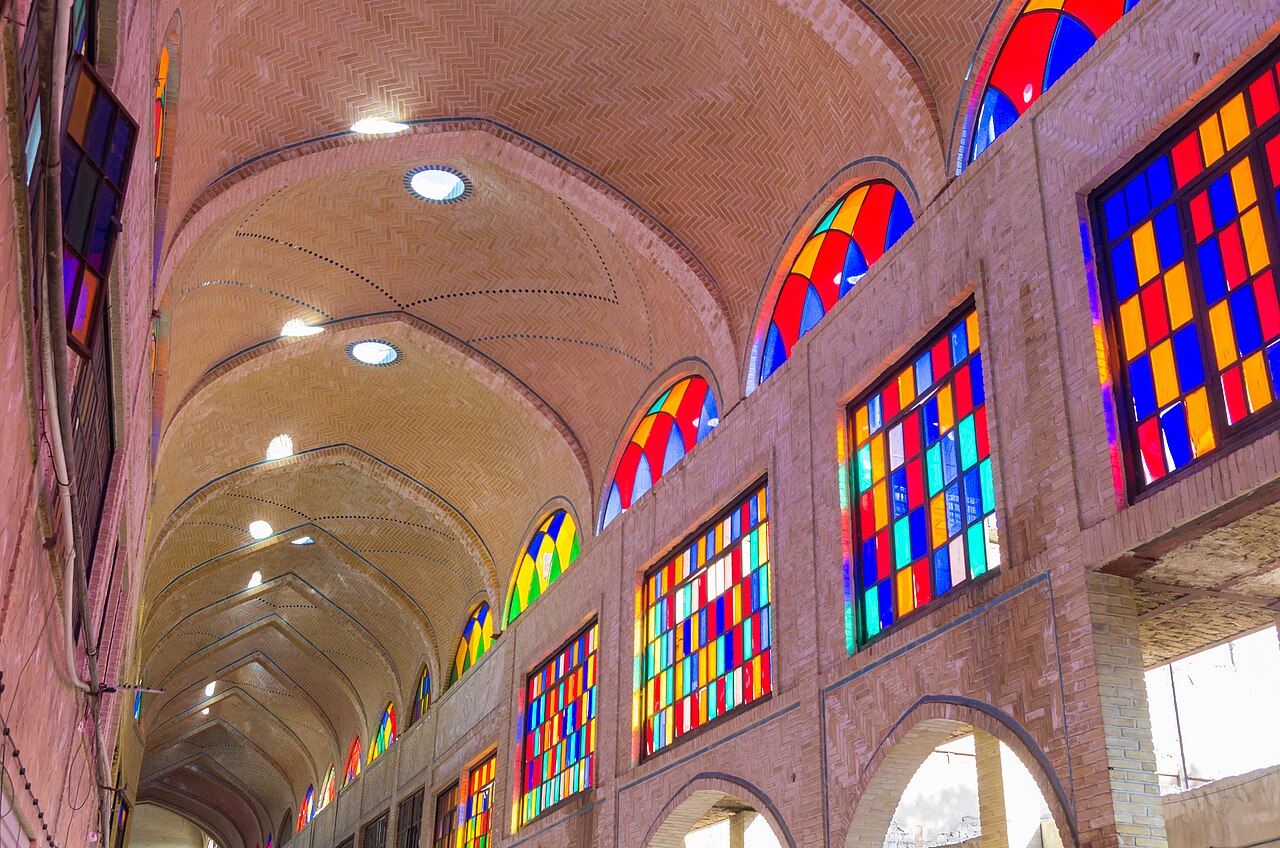
Look out for the timcheh: covered courts with high domes and skylights, built for wholesale trade. The Timcheh of Hajeb od-Dowleh, from the Naser al-Din Shah period, is one of the best known. Older two-storey caravanserais (sarâ) still house warehouses and offices around a courtyard, and climbing to the upper gallery shows how goods, porters and paperwork once moved through the building.
Small things worth noticing
Look up at the brick vaults and the round light holes in the domes, which let in light and let out heat. Watch the porters with their handcarts, who move most of the goods. And notice the tea houses and small shrines, such as Imamzadeh Zeid, tucked between the shops.
Practical notes for visiting
- When to go: mornings on working days are the busiest and most interesting. Much of the bazaar closes on Fridays and on religious holidays, and many shops close in the afternoon. Check current information before you go.
- Getting there: the metro is the easiest way; traffic around the bazaar is heavy. Combine the visit with Golestan Palace, a few minutes’ walk to the north-west.
- Getting around: the lanes are confusing and crowded. Agree on a meeting point, keep valuables close, and watch out for handcarts that do not slow down.
- Buying: many shops sell wholesale and may not want to sell single items. Bargaining is normal, but it is polite and good-humoured. Expect taarof: a seller saying “it’s nothing, be my guest” does not mean the item is free.
- Dress and photos: dress modestly, and ask before photographing people. Inside mosques, follow local custom.
- Safety: follow your own government’s current travel advice for Iran.
For more of the capital, see our guide to Tehran and the list of best places to visit in Tehran.
Persian words from this page
| بازار | bâzâr | market, bazaar |
| بازاری | bâzâri | bazaar merchant |
| تیمچه | timcheh | domed trading hall |
| چهارسو | chahârsu | domed crossing of four lanes |
| سرا | sarâ | caravanserai, trading court |
| سبزه میدان | Sabzeh Meydân | “green square” |
| بست | bast | sanctuary, sit-in |
Sources and further reading
- Encyclopaedia Iranica, “BĀZĀR ii. Organization and Function“.
- Encyclopaedia Iranica, “TEHRAN“.
- Ervand Abrahamian, Iran Between Two Revolutions (Princeton University Press, 1982), on the bazaar in the Constitutional Revolution and 1978.
- Arang Keshavarzian, Bazaar and State in Iran: The Politics of the Tehran Marketplace (Cambridge University Press, 2007).
- Abbas Amanat, Iran: A Modern History (Yale University Press, 2017).
Want to learn Persian? Get the free Starter Pack
Get the 14-page printable Starter Pack (all 32 letters, a 7-day reading plan, 100 core words and 20 survival phrases) and a short 5-email course. Free.
More in Top Places to Visit in Iran
- Naqsh-e Jahan Square
- Shah (Imam) Mosque, Isfahan
- Sheikh Lotfollah Mosque
- Ali Qapu Palace
- Jameh Mosque of Isfahan
- Si-o-se Pol and Khaju Bridge
- Vank Cathedral
- Hasht Behesht Palace
- Naqsh-e Rostam
- Eram Garden, Shiraz
- Nasir al-Molk (Pink) Mosque
- Tomb of Hafez (Hafezieh)
- Tomb of Saadi (Saadieh)
- Shah Cheragh Shrine
- Arg of Karim Khan
- Fin Garden, Kashan
- Historic Houses of Kashan
- Jameh Mosque of Yazd
- Yazd Fire Temple and Towers of Silence
- Dowlatabad Garden and Windcatcher
- Amir Chakhmaq Complex
- Golestan Palace
- National Museum of Iran
- Treasury of National Jewels
- Tehran Grand Bazaar
- Milad Tower
- Imam Reza Shrine, Mashhad
- Tomb of Ferdowsi, Tus
- Tomb of Omar Khayyam, Neyshabur
- Tomb of Avicenna, Hamadan
- Ganjnameh Inscriptions, Hamadan
- Behistun (Bisotun): Visiting the Site
- Taq-e Bostan: Visiting the Site
- Tabriz Historic Bazaar
- Takht-e Soleyman
- Armenian Monastic Ensembles of Iran
- Sheikh Safi al-Din Shrine, Ardabil
- Dome of Soltaniyeh
- Alamut Castle
- Falak-ol-Aflak Castle
- Shushtar Historical Hydraulic System
- Chogha Zanbil: Visiting the Ziggurat
- Susa Archaeological Site
- Arg-e Bam
- Ganjali Khan Complex, Kerman
- Shazdeh Garden, Mahan
- Rayen Castle
- Dasht-e Lut (Lut Desert)
- Maranjab Desert and Caravanserai
- Varzaneh Desert
- Mount Damavand
- Hyrcanian Forests
- Lake Urmia
- Badab-e Surt Springs
- Ali Sadr Cave
- The Kaluts of Shahdad
- Qeshm Geopark
- Hormuz Island Colours
- Visiting Persepolis: A Day Trip from Shiraz
- Visiting Pasargadae
- Persian Caravanserais
- The Qanat of Gonabad
- Meymand Village
- Sasanian Sites of Fars: Firuzabad, Bishapur and Sarvestan
- Gonbad-e Qabus: Visiting the Tower
- Zayandeh Rud and Isfahan’s Bridges
- Tochal and Darband: Hiking Above Tehran
- Mount Sabalan
- Skiing in Iran: Dizin and Shemshak
- Golestan National Park