Ayatollah Ruhollah Khomeini (1902–1989) was the Shi’a cleric who led the 1979 revolution and became the first Supreme Leader of the Islamic Republic of Iran. His theory of velayat-e faqih, government by the Islamic jurist, became the foundation of the state’s constitution. To his followers he is “the Imam” who freed Iran from foreign domination; to his critics he is the founder of a repressive theocracy.
| Born | 1902 (officially 24 September), Khomein, central Iran |
|---|---|
| Died | 3 June 1989, Tehran |
| Persian name | روحالله موسوی خمینی (Ruhollâh Musavi Khomeini) |
| Exile | 1964–1979: Turkey, Najaf in Iraq, then near Paris |
| Office | Leader of the Revolution and Supreme Leader, 1979–1989 |
| Successor | Ali Khamenei |
| Buried | Mausoleum near Behesht-e Zahra cemetery, south of Tehran |
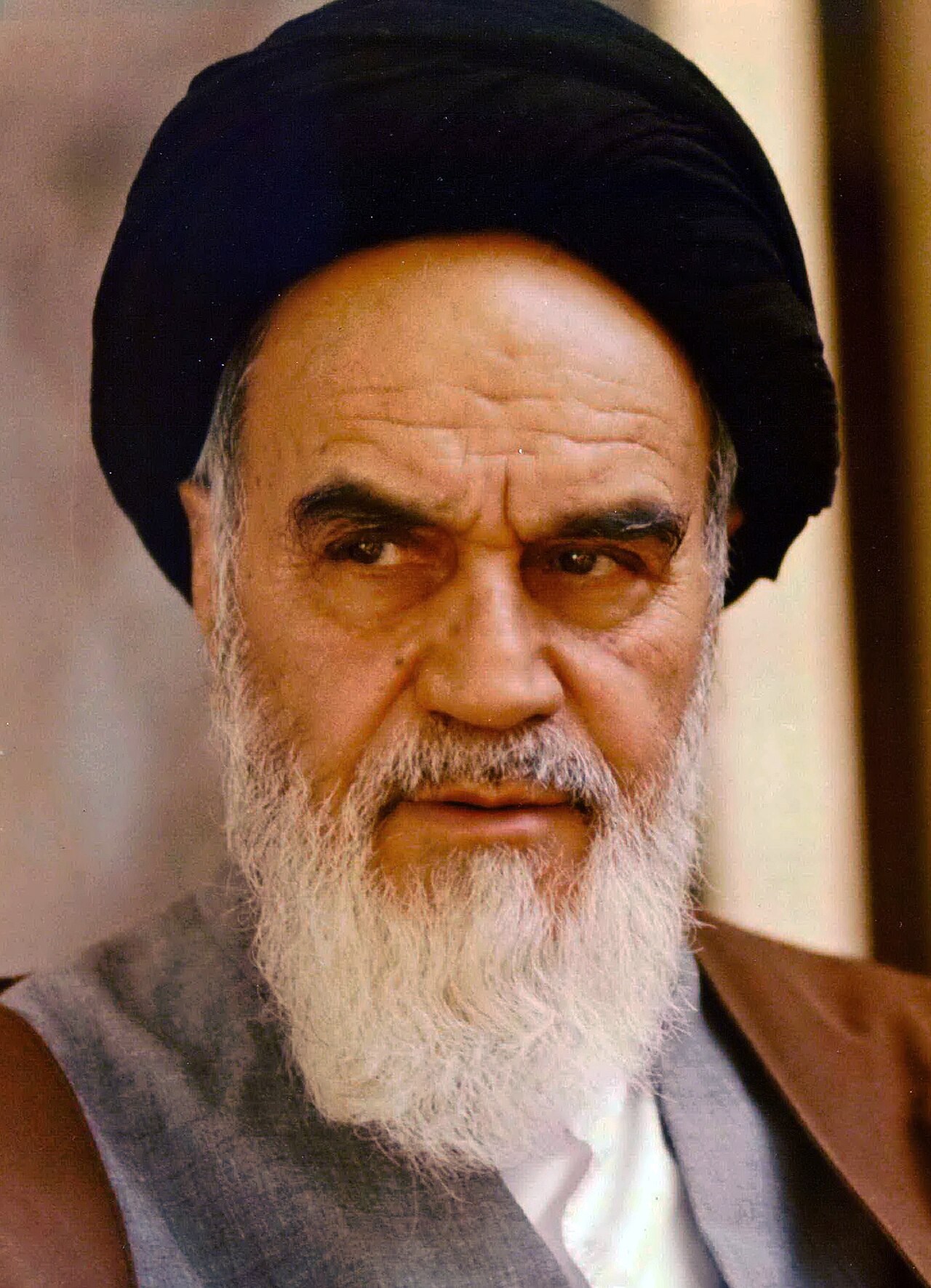

Childhood in Khomein and training in Qom
Ruhollah Musavi was born in the small town of Khomein, about 300 kilometres south-west of Tehran, into a family of clerics and seyyeds, descendants of the Prophet. His father was killed in a local dispute when Ruhollah was a baby, and he was raised by his mother and an aunt, both of whom died when he was a teenager. He studied with his elder brother and then in the town of Arak under Sheikh Abdolkarim Haeri Yazdi, whom he followed to Qom in the early 1920s. Haeri was turning Qom into a major centre of Shi’a learning, and Khomeini spent the next forty years there.
In Qom he became known less as a jurist than as a teacher of ethics, philosophy and erfan, Islamic mysticism, subjects that many conservative clerics viewed with suspicion. He also wrote mystical poetry, published only after his death. Baqer Moin, his most detailed biographer, argues that this mystical training, with its idea of the perfect man guiding others, shaped his later sense of mission.
From scholar to opponent of the shah
Khomeini’s first political book, Kashf al-Asrar (“Revealing of Secrets”, 1943), attacked Reza Shah’s secularising policies but did not yet call for clerical rule. He stayed largely out of politics while Grand Ayatollah Borujerdi, the dominant Shi’a authority of the time, preferred quiet relations with the court. After Borujerdi’s death in 1961, Khomeini emerged as one of several possible marja’s, senior jurists whom believers follow in religious matters, and the boldest of them.
In 1962–63 he campaigned against the shah’s reforms, including the White Revolution and a local elections law that allowed non-Muslims and women to take part. His sermon at the Feyziyeh seminary on Ashura in June 1963 attacked the shah personally, and his arrest two days later set off the uprising of 15 Khordad. In October 1964 he condemned a law giving American military personnel immunity from Iranian courts, saying it reduced Iranians below the status of an American dog. He was exiled the following month, first to Turkey and then, in 1965, to the shrine city of Najaf in Iraq.
Velayat-e faqih: the idea of government by the jurist
In Najaf in early 1970 Khomeini gave a series of lectures to students that were published as Hokumat-e Eslami (Islamic Government). Shi’a scholars had long accepted that a qualified jurist, the faqih, has guardianship over people who cannot manage their own affairs, such as orphans. Khomeini argued that in the absence of the hidden Twelfth Imam this guardianship extended to the whole community, and that the jurist should rule the state to apply Islamic law.
This was a minority position among the senior clergy. Grand Ayatollah Abol-Qasem Khoei in Najaf and Grand Ayatollah Kazem Shariatmadari in Qom were among those who rejected it. Said Amir Arjomand describes the theory as a genuine innovation in Shi’a political thought. Khomeini said little about it in public during 1978, when he spoke in general terms of freedom, independence and an Islamic republic, which made it easier for liberals and leftists to back him. After the revolution it was written into the 1979 constitution.
Leader of the revolution
Under pressure from the shah, Iraq expelled Khomeini in October 1978. He settled at Neauphle-le-Château near Paris, where access to the international press made him the voice of the revolution. The death of his elder son Mostafa in Najaf in 1977, which many Iranians blamed on SAVAK, had already made him a focus of mourning ceremonies inside Iran. He returned on 1 February 1979 (see Khomeini’s return and the fall of the monarchy).
As Leader he held no day-to-day government post, but he had the final word. He backed the students who seized the US embassy in November 1979, removed President Abolhassan Bani-Sadr in 1981, and approved the harsh suppression of the Mojahedin-e Khalq and other opposition groups. He lived simply, first in Qom and from 1980 in the Jamaran district of north Tehran, where he received visitors in a small hall beside his house.
During the war with Iraq he rejected peace offers for years, insisting on the fall of Saddam Hussein. In July 1988 he accepted the UN ceasefire, saying the decision was more deadly to him than drinking poison. Soon afterwards he ordered the special commissions that led to the 1988 executions of political prisoners, which Amnesty International and Human Rights Watch have described as crimes against humanity. His designated successor, Ayatollah Hossein-Ali Montazeri, protested against the killings and was dismissed in March 1989.
In February 1989 Khomeini issued a fatwa calling for the death of the British novelist Salman Rushdie over his novel The Satanic Verses, which caused a diplomatic crisis with Europe. He died on 3 June 1989 after surgery. His funeral drew vast crowds, and the Assembly of Experts chose Ali Khamenei to succeed him (see the death of Khomeini and the succession of Khamenei).
- 1902 Born in Khomein
- c. 1922 Moves to Qom with his teacher Abdolkarim Haeri Yazdi
- 1943 Publishes Kashf al-Asrar
- June 1963 Arrested after his Ashura sermon
- November 1964 Exiled to Turkey; to Najaf in 1965
- 1970 Lectures on Islamic government in Najaf
- October 1978 Moves to Neauphle-le-Château, France
- 1 February 1979 Returns to Iran
- July 1988 Accepts UN Resolution 598
- 3 June 1989 Dies in Tehran
Legacy and how he is judged
In Iran Khomeini’s image is everywhere: on banknotes, in offices and on murals. His tomb south of Tehran is a large shrine complex, and the anniversary of his death is a public holiday. The state presents him as the Imam who restored Islam to public life and won independence from both superpowers under the slogan “Neither East nor West”.
Historians judge him in very different ways. Ervand Abrahamian, in Khomeinism (1993), argues that he is better understood as a populist, comparable to leaders in Latin America, than as a traditional fundamentalist, since he adapted his ideas freely to political needs. Moin portrays a complex figure: a mystic and scholar of great personal discipline who could be ruthless in politics. Opponents, from monarchists to the secular left and many religious critics, point to the executions of the 1980s, the suppression of women’s rights and press freedom, and the prolonging of the war after 1982. Inside the clergy his legacy is also contested: reformists claim the populist and republican side of his thought, while hardliners stress the absolute authority of the jurist.
The system he built outlived him by decades. His successor, Ali Khamenei, led the country from 1989 until he was killed on 28 February 2026, after which the Assembly of Experts chose Mojtaba Khamenei as the third Supreme Leader. For the place of his ideas in the longer history of Shi’ism, see Shi’a Islam in Iranian history.
Persian words from this page
| امام | emâm | imam, the title used for Khomeini |
| ولایت فقیه | velâyat-e faqih | guardianship of the jurist |
| مرجع تقلید | marja’-e taqlid | source of emulation, senior jurist |
| حکومت اسلامی | hokumat-e eslâmi | Islamic government |
| عرفان | erfân | mysticism |
| جماران | Jamârân | district of north Tehran where he lived |
Sources and further reading
- Baqer Moin, Khomeini: Life of the Ayatollah (I.B. Tauris, 1999)
- Ervand Abrahamian, Khomeinism: Essays on the Islamic Republic (University of California Press, 1993)
- Said Amir Arjomand, The Turban for the Crown: The Islamic Revolution in Iran (Oxford University Press, 1988)
- Hamid Algar (trans.), Islam and Revolution: Writings and Declarations of Imam Khomeini (Mizan Press, 1981)
- Michael Axworthy, Revolutionary Iran: A History of the Islamic Republic (Allen Lane, 2013)
Want to learn Persian? Get the free Starter Pack
Get the 14-page printable Starter Pack (all 32 letters, a 7-day reading plan, 100 core words and 20 survival phrases) and a short 5-email course. Free.
More in The Islamic Revolution and the Islamic Republic (1979–present)
- Causes of the 1979 Revolution
- Khomeini’s Return and the Fall of the Monarchy
- Ruhollah Khomeini
- The 1979 Referendum and the New Constitution
- The Iran Hostage Crisis (1979–1981)
- Power Struggles after the Revolution
- The Cultural Revolution and University Closures
- The Iran–Iraq War: Causes and Iraqi Invasion
- Khorramshahr: Fall and Liberation
- The Iran–Iraq War, 1982–1986
- The Basij and Child Soldiers in the Iran–Iraq War
- Chemical Weapons in the Iran–Iraq War
- The Tanker War and Iran Air Flight 655
- The Iran–Contra Affair
- The End of the Iran–Iraq War (1988)
- The 1988 Executions of Political Prisoners
- The Death of Khomeini and the Succession of Khamenei (1989)
- Ali Khamenei
- Rafsanjani and Post-War Reconstruction (1989–1997)
- Khatami and the Reform Era (1997–2005)
- The 1999 Student Protests (18 Tir)
- The Ahmadinejad Presidency (2005–2013)
- The 2009 Election and the Green Movement
- Iran’s Nuclear Program
- Sanctions on Iran
- Rouhani and the Nuclear Deal (JCPOA)
- The Protests of 2017–2018 and November 2019
- The Killing of Soleimani and Flight 752 (January 2020)
- Iran and the COVID-19 Pandemic
- The Raisi Presidency and His Death (2021–2024)
- The 2022 Mahsa Amini Protests: “Woman, Life, Freedom”
- Iran and Israel: From Allies to Open Conflict
- The Pezeshkian Presidency
- The Twelve-Day War of June 2025
- The Protests of Late 2025 and January 2026
- The 2026 War with the United States and Israel
- The Killing of Ali Khamenei (28 February 2026)
- Mojtaba Khamenei and the 2026 Succession
- The Iranian Diaspora
- Iran and Hezbollah
- Major Earthquakes in Modern Iran
- Iranian Cinema after 1979