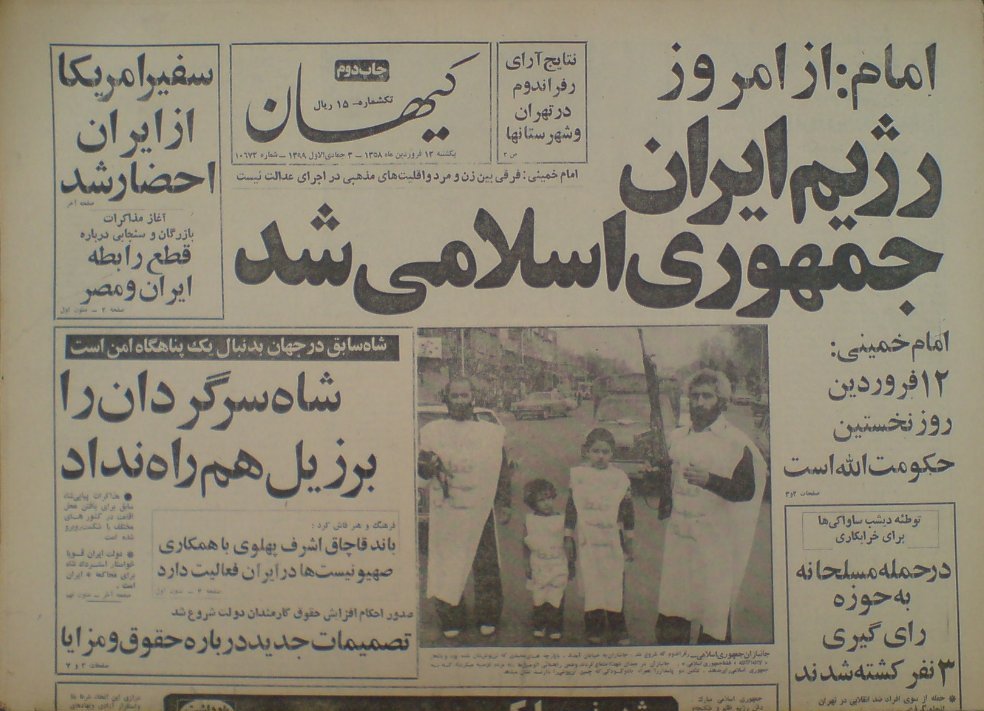
On 30 and 31 March 1979 Iranians voted in a referendum on a single question: should Iran become an Islamic Republic? The official result was 98.2 percent “yes”, and Khomeini proclaimed the Islamic Republic on 1 April. A constitution drafted that autumn, which placed a senior cleric at the top of the state under the principle of velayat-e faqih, was approved in a second referendum on 2 and 3 December 1979.
| First referendum | 30–31 March 1979 (10–11 Farvardin 1358): Islamic Republic, yes or no |
|---|---|
| Official result | 98.2% yes |
| Islamic Republic proclaimed | 1 April 1979 (12 Farvardin, now a national holiday) |
| Constitution drafted by | Assembly of Experts for the Constitution, elected August 1979 (73 members) |
| Constitutional referendum | 2–3 December 1979, officially 99.5% yes |
| Revised | 1989, approved by referendum on 28 July 1989 |
A vote with one question
Within weeks of the fall of the monarchy, Khomeini called a referendum on the new form of state. Voters were not asked to choose between options: the ballot offered an Islamic Republic, and voters marked “yes” or “no”. Several groups had asked for wider choices, such as a “democratic republic” or a “democratic Islamic republic”, and Khomeini rejected them, saying that the word “democratic” was a Western import and that “Islamic Republic, not one word more, not one word less” was what the nation wanted. The voting age was lowered to 16.
Ballot papers were green for yes and red for no, and critics pointed out that the colours made it easy for officials and neighbours to see how people voted. The National Democratic Front, some left-wing groups and Kurdish parties called for a boycott, and turnout was low in Kurdistan and among the Turkmens of the north-east. Elsewhere the “yes” vote reflected real enthusiasm: most historians, including Shaul Bakhash and Ervand Abrahamian, accept that a large majority of Iranians backed the idea of an Islamic Republic in spring 1979, even though few knew what institutions it would have.

From a liberal draft to velayat-e faqih
In June 1979 Prime Minister Mehdi Bazargan’s provisional government published a draft constitution. It borrowed heavily from the French Fifth Republic, with a strong elected president, and gave the clergy only a limited role in checking laws for conformity with Islam. It made no mention of rule by a jurist. Khomeini at first seemed ready to put the draft directly to a vote.
Liberals and the left, however, wanted it debated by an elected constituent assembly. Instead, a smaller Assembly of Experts for the Constitution was elected on 3 August 1979. The Islamic Republic Party (IRP), founded by clerics close to Khomeini, and its allies won a large majority of the 73 seats. Ayatollah Hossein-Ali Montazeri chaired the body, while Ayatollah Mohammad Beheshti, the IRP’s leading strategist, ran its debates.
The assembly transformed the draft. It wrote in the doctrine of velayat-e faqih, which Khomeini had set out in his Najaf lectures of 1970 (see Ruhollah Khomeini). Said Amir Arjomand calls the result a hybrid: a constitution that kept the outward form of a modern republic, with a president, parliament and elections, while placing above them a clerical Leader and appointed bodies able to overrule the voters. Bazargan and several of his ministers asked Khomeini in October to dissolve the assembly, without success.
What the 1979 constitution established
The Leader and the jurist’s authority
Article 5 declared that during the absence of the hidden Twelfth Imam, leadership of the community belongs to a just and pious jurist. The Leader, or a leadership council, commanded the armed forces, appointed the head of the judiciary and the commanders of the Revolutionary Guards, and could dismiss the president. Khomeini was named in the text as Leader for life.
The elected institutions
Iranians would elect a president, a parliament (the Majlis) and, from 1982, an Assembly of Experts charged with choosing and supervising the Leader. A prime minister, nominated by the president and approved by the Majlis, headed the cabinet.
The Guardian Council
A Guardian Council of twelve members, six clerics appointed by the Leader and six lawyers nominated by the judiciary and approved by parliament, was given power to veto any law it judged contrary to Islam or the constitution. It later took on the vetting of election candidates, which became one of the most criticised features of the system.
Religion and rights
The constitution made Twelver Shi’a Islam the official religion and required all laws to be based on Islamic criteria. It recognised Zoroastrians, Jews and Christians as religious minorities with reserved seats in parliament, and gave Sunni Muslims freedom in their own religious affairs. It did not recognise the Baha’i faith. Chapters on the rights of the people promised freedom of the press and assembly, but qualified them with phrases such as “unless detrimental to the fundamental principles of Islam”. For how these institutions work today, see how Iran is governed.
Opposition and the December vote
The seizure of the US embassy on 4 November 1979 (see the Iran hostage crisis) created an atmosphere of national mobilisation in which open criticism of the constitution looked like disloyalty. Bazargan’s government resigned two days later. The referendum went ahead on 2 and 3 December, and the official result was 99.5 percent in favour.
The most important religious objection came from Grand Ayatollah Kazem Shariatmadari, a senior jurist based in Qom with a large following in Azerbaijan. He argued that the articles on the Leader conflicted with the principle of national sovereignty. His supporters in the Muslim People’s Republican Party took over the radio station in Tabriz in December 1979 before the uprising was put down. Kurdish parties and many Sunnis boycotted the vote, as did the Mojahedin-e Khalq and secular nationalists. Asghar Schirazi, in his study of the constitution, argues that the tension between its religious and republican parts was built in from the start and has shaped Iranian politics ever since.
The 1989 revision
Shortly before his death in 1989 Khomeini ordered a review of the constitution. The amended text abolished the post of prime minister and strengthened the presidency, gave constitutional status to the Expediency Council, which settles disputes between parliament and the Guardian Council, and removed the requirement that the Leader be a marja’, one of the most senior jurists. That change allowed Ali Khamenei, then a mid-ranking cleric, to become Leader. The revised constitution was approved by referendum on 28 July 1989, the same day Akbar Hashemi Rafsanjani was elected president (see the death of Khomeini and the succession). This constitution still governs Iran: after Ali Khamenei was killed on 28 February 2026, the Assembly of Experts used its procedures to choose Mojtaba Khamenei as Leader.
Supporters of the system describe the 1979 referendums as the founding expression of popular will. Critics, including many who voted “yes” in March 1979, argue that they approved a general idea and were never offered a real choice about clerical rule.
Persian words from this page
| همهپرسی | hameh-porsi | referendum |
| جمهوری اسلامی | jomhuri-ye eslâmi | Islamic Republic |
| قانون اساسی | qânun-e asâsi | constitution |
| شورای نگهبان | Shurâ-ye Negahbân | Guardian Council |
| مجلس خبرگان | Majles-e Khobregân | Assembly of Experts |
| رهبر | rahbar | leader |
Sources and further reading
- Said Amir Arjomand, The Turban for the Crown: The Islamic Revolution in Iran (Oxford University Press, 1988)
- Shaul Bakhash, The Reign of the Ayatollahs: Iran and the Islamic Revolution (Basic Books, 1984)
- Asghar Schirazi, The Constitution of Iran: Politics and the State in the Islamic Republic (I.B. Tauris, 1997)
- Ervand Abrahamian, A History of Modern Iran (Cambridge University Press, 2008)
- Constitution of the Islamic Republic of Iran (1979, amended 1989), English translations published by the Iranian government and by Iran Chamber Society
Want to learn Persian? Get the free Starter Pack
Get the 14-page printable Starter Pack (all 32 letters, a 7-day reading plan, 100 core words and 20 survival phrases) and a short 5-email course. Free.
More in The Islamic Revolution and the Islamic Republic (1979–present)
- Causes of the 1979 Revolution
- Khomeini’s Return and the Fall of the Monarchy
- Ruhollah Khomeini
- The 1979 Referendum and the New Constitution
- The Iran Hostage Crisis (1979–1981)
- Power Struggles after the Revolution
- The Cultural Revolution and University Closures
- The Iran–Iraq War: Causes and Iraqi Invasion
- Khorramshahr: Fall and Liberation
- The Iran–Iraq War, 1982–1986
- The Basij and Child Soldiers in the Iran–Iraq War
- Chemical Weapons in the Iran–Iraq War
- The Tanker War and Iran Air Flight 655
- The Iran–Contra Affair
- The End of the Iran–Iraq War (1988)
- The 1988 Executions of Political Prisoners
- The Death of Khomeini and the Succession of Khamenei (1989)
- Ali Khamenei
- Rafsanjani and Post-War Reconstruction (1989–1997)
- Khatami and the Reform Era (1997–2005)
- The 1999 Student Protests (18 Tir)
- The Ahmadinejad Presidency (2005–2013)
- The 2009 Election and the Green Movement
- Iran’s Nuclear Program
- Sanctions on Iran
- Rouhani and the Nuclear Deal (JCPOA)
- The Protests of 2017–2018 and November 2019
- The Killing of Soleimani and Flight 752 (January 2020)
- Iran and the COVID-19 Pandemic
- The Raisi Presidency and His Death (2021–2024)
- The 2022 Mahsa Amini Protests: “Woman, Life, Freedom”
- Iran and Israel: From Allies to Open Conflict
- The Pezeshkian Presidency
- The Twelve-Day War of June 2025
- The Protests of Late 2025 and January 2026
- The 2026 War with the United States and Israel
- The Killing of Ali Khamenei (28 February 2026)
- Mojtaba Khamenei and the 2026 Succession
- The Iranian Diaspora
- Iran and Hezbollah
- Major Earthquakes in Modern Iran
- Iranian Cinema after 1979