Ali Khamenei (1939–2026) was the second Supreme Leader of the Islamic Republic of Iran, holding the post from June 1989 until he was killed in a US–Israeli strike on Tehran on 28 February 2026. Before that he was president for eight years. Over 36 years he turned the Leader’s office into the centre of Iranian power, and he shaped the country’s course on the nuclear issue, relations with the United States and the treatment of dissent.
| Full name | Seyyed Ali Hosseini Khamenei سید علی حسینی خامنهای |
|---|---|
| Born | 19 April 1939, Mashhad |
| Died | 28 February 2026, Tehran, aged 86 |
| President | October 1981 to August 1989 |
| Supreme Leader | 4 June 1989 to 28 February 2026 |
| Successor | His son, Mojtaba Khamenei, chosen in March 2026 |
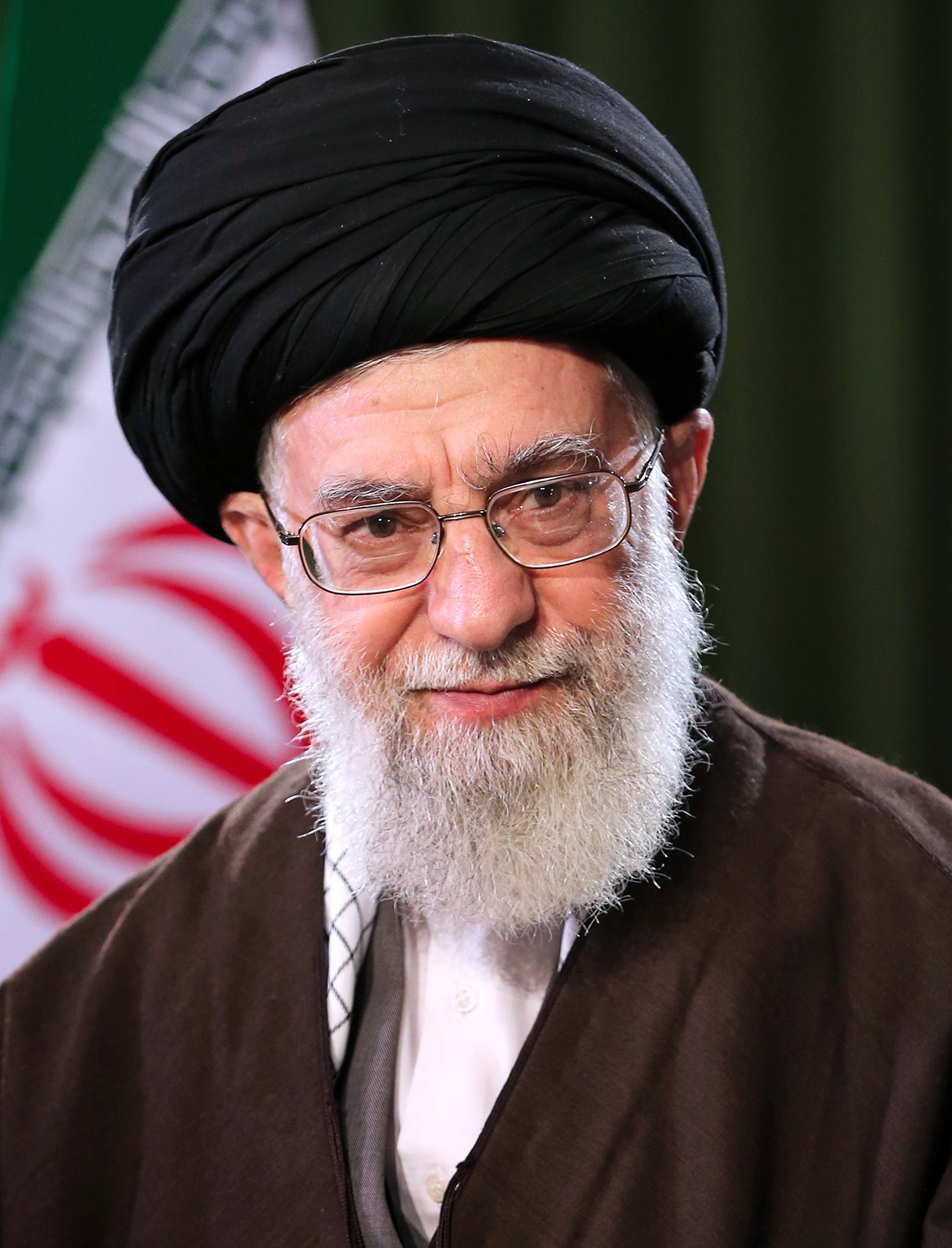

A cleric’s son from Mashhad
Khamenei was born in Mashhad, the shrine city of Imam Reza in north-east Iran, a son of Javad Khamenei, a modest cleric of Azerbaijani origin. The family name comes from Khameneh, a town near Tabriz. He studied in the seminaries of Mashhad, spent a short time in Najaf, and from 1958 studied in Qom, where Ruhollah Khomeini was among his teachers.
He returned to Mashhad in the mid-1960s and became known as a preacher who mixed religious teaching with politics, poetry and modern Islamist writing. He translated works by the Egyptian thinker Sayyid Qutb into Persian. His opposition to the shah brought several arrests by the security service SAVAK during the 1960s and 1970s, and in the late 1970s internal exile to Iranshahr in Baluchestan.
From the revolution to the presidency
After the revolution of 1979 Khamenei sat on the Revolutionary Council, helped found the Islamic Republican Party, served as a deputy defence official and became Friday prayer leader of Tehran. On 27 June 1981 a bomb hidden in a tape recorder exploded as he spoke at a mosque in Tehran. He survived, but lost the use of his right hand.
Weeks later, after President Mohammad-Ali Rajai was killed in another bombing, Khamenei was elected president in October 1981, the first cleric to hold the post. Real executive power then lay mostly with Prime Minister Mir-Hossein Mousavi, with whom he often clashed, while the war with Iraq dominated his two terms (see power struggles after the revolution).
Becoming Leader in 1989
When Khomeini died on 3 June 1989, the Assembly of Experts chose Khamenei the next day. He was not a senior religious authority, and the constitution had to be changed to allow his appointment. The circumstances, and the doubts about his religious standing, are set out on the page about Khomeini’s death and the succession. Seminary bodies later recognised him as a marja’, a claim that many senior clerics in Qom and Najaf did not accept.
How he built his power
At first Khamenei was overshadowed by President Rafsanjani. He strengthened his position by several means, which scholars such as Mehdi Khalaji and Karim Sadjadpour have described in detail:
- The security forces. He appointed the commanders of the Revolutionary Guards (IRGC), the army and the police, and the IRGC grew into a political and economic power that looked to him.
- The Leader’s office. His office, the بیت رهبری (beyt-e rahbari), grew into a large organisation with representatives in ministries, universities, the armed forces and the provinces.
- Appointments. He named the head of the judiciary, half of the Guardian Council (which vets election candidates), the head of state broadcasting and the heads of large foundations.
- Economic bodies. Large organisations under his authority, such as Setad (the Execution of Imam Khomeini’s Order), held extensive assets; a 2013 Reuters investigation estimated Setad’s holdings at about 95 billion dollars, a figure his office disputed.
Policies and positions
Khamenei described his aims as protecting the revolution and Iran’s independence. Several themes ran through his speeches over three decades:
- Distrust of the United States. He described the United States as the main enemy of the revolution and repeatedly said that negotiating with Washington brought no benefit, though he allowed talks at key moments.
- The nuclear programme. Iranian officials cite a religious ruling by Khamenei that nuclear weapons are forbidden. He backed enrichment as a national right, approved the 2013 talks under the slogan of “heroic flexibility”, and accepted the 2015 deal while warning against trusting the West (see Iran’s nuclear programme).
- The “resistance economy”. From 2014 he promoted self-reliance in the face of sanctions.
- Regional strategy. He oversaw support for allies such as Hezbollah, Syria’s government and armed groups in Iraq and Yemen, which supporters called deterrence and critics called destabilising interference.
- Culture. He warned often of a Western “cultural invasion” and supported the hijab law.
The Leader and the presidents
Every president of his time clashed with him at some point. He limited the reformist programme of Mohammad Khatami, backed Mahmoud Ahmadinejad after the disputed 2009 election and then fell out with him in 2011, and both supported and restrained Hassan Rouhani. Supporters saw this as the Leader acting as a referee above factions; critics saw it as the elected branches being kept weak.
Protests and repression
Khamenei faced repeated waves of protest: students in 1999, the Green Movement of 2009, the economic protests of 2017–2019, the “Woman, Life, Freedom” movement of 2022 and the protests of late 2025 and January 2026. In each case he described the unrest as stirred up by foreign enemies, and the security forces he commanded put it down. Human rights organisations, including Amnesty International, Human Rights Watch and Iran Human Rights, documented killings of protesters, mass arrests and executions, and UN investigators reported serious violations. His supporters argued that the state was defending itself against foreign-backed attempts at regime change. See the Green Movement, the 2022 protests and the protests of 2025–2026.
The last years and his death
In his final years Iran faced a direct war with Israel in June 2025, during which the United States bombed Iranian nuclear sites (see the Twelve-Day War), followed by mass protests at home. On 28 February 2026, on the first day of a joint US–Israeli air campaign, Khamenei was killed in a strike on Tehran; Iranian state media confirmed his death on 1 March. The attack and its aftermath are covered on the page about the killing of Ali Khamenei, the wider conflict on the 2026 war, and the succession on Mojtaba Khamenei and the 2026 succession.
How he is judged
Judgements of Khamenei divide sharply. To his supporters he was a steady guardian who kept Iran independent, survived sanctions, wars and unrest, and made the country a regional power. To his critics, including many Iranians at home and in exile, he blocked reform, centralised power in unelected hands, presided over severe repression and led the country into isolation, economic decline and finally war. Historians will be arguing for a long time about how much of the Islamic Republic’s path between 1989 and 2026 was his own choice.
Persian words from this page
| خامنهای | Khâmene’i | Khamenei (from the town of Khameneh) |
| رهبر انقلاب | rahbar-e enqelâb | Leader of the Revolution |
| ولی فقیه | vali-ye faqih | the guardian jurist |
| بیت رهبری | beyt-e rahbari | the Leader’s office |
| نرمش قهرمانانه | narmesh-e qahremânâne | heroic flexibility |
| اقتصاد مقاومتی | eqtesâd-e moqâvemati | resistance economy |
| مشهد | Mashhad | his birthplace |
Sources and further reading
- Karim Sadjadpour, Reading Khamenei: The World View of Iran’s Most Powerful Leader (Carnegie Endowment, 2008).
- Mehdi Khalaji, The Regent of Allah: Ali Khamenei’s Political Evolution in Iran (Rowman & Littlefield, 2023).
- Said Amir Arjomand, After Khomeini: Iran under His Successors (Oxford University Press, 2009).
- Reuters, “Assets of the Ayatollah” investigation series (November 2013).
- Reports of Amnesty International, Human Rights Watch and the UN Independent International Fact-Finding Mission on Iran.
Want to learn Persian? Get the free Starter Pack
Get the 14-page printable Starter Pack (all 32 letters, a 7-day reading plan, 100 core words and 20 survival phrases) and a short 5-email course. Free.
More in The Islamic Revolution and the Islamic Republic (1979–present)
- Causes of the 1979 Revolution
- Khomeini’s Return and the Fall of the Monarchy
- Ruhollah Khomeini
- The 1979 Referendum and the New Constitution
- The Iran Hostage Crisis (1979–1981)
- Power Struggles after the Revolution
- The Cultural Revolution and University Closures
- The Iran–Iraq War: Causes and Iraqi Invasion
- Khorramshahr: Fall and Liberation
- The Iran–Iraq War, 1982–1986
- The Basij and Child Soldiers in the Iran–Iraq War
- Chemical Weapons in the Iran–Iraq War
- The Tanker War and Iran Air Flight 655
- The Iran–Contra Affair
- The End of the Iran–Iraq War (1988)
- The 1988 Executions of Political Prisoners
- The Death of Khomeini and the Succession of Khamenei (1989)
- Ali Khamenei
- Rafsanjani and Post-War Reconstruction (1989–1997)
- Khatami and the Reform Era (1997–2005)
- The 1999 Student Protests (18 Tir)
- The Ahmadinejad Presidency (2005–2013)
- The 2009 Election and the Green Movement
- Iran’s Nuclear Program
- Sanctions on Iran
- Rouhani and the Nuclear Deal (JCPOA)
- The Protests of 2017–2018 and November 2019
- The Killing of Soleimani and Flight 752 (January 2020)
- Iran and the COVID-19 Pandemic
- The Raisi Presidency and His Death (2021–2024)
- The 2022 Mahsa Amini Protests: “Woman, Life, Freedom”
- Iran and Israel: From Allies to Open Conflict
- The Pezeshkian Presidency
- The Twelve-Day War of June 2025
- The Protests of Late 2025 and January 2026
- The 2026 War with the United States and Israel
- The Killing of Ali Khamenei (28 February 2026)
- Mojtaba Khamenei and the 2026 Succession
- The Iranian Diaspora
- Iran and Hezbollah
- Major Earthquakes in Modern Iran
- Iranian Cinema after 1979