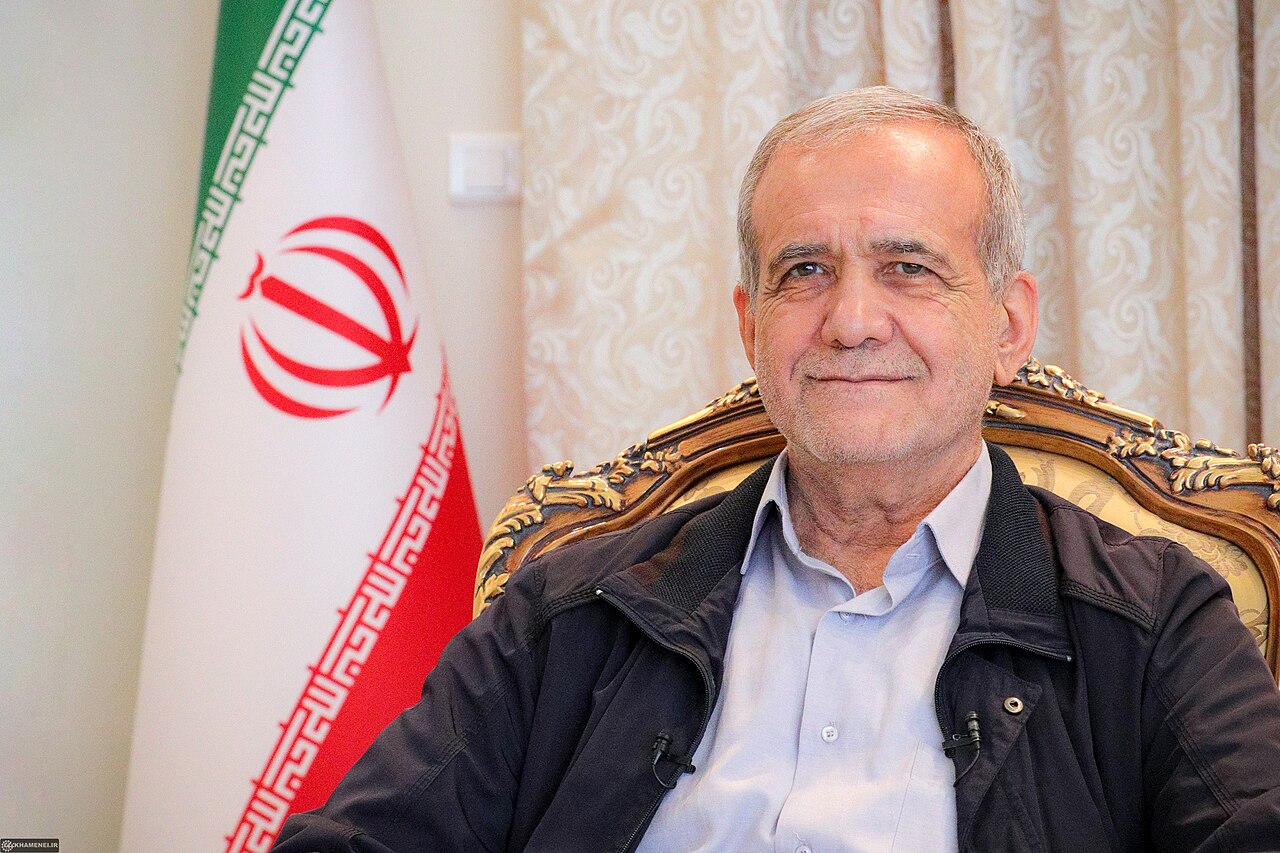
Masoud Pezeshkian, a heart surgeon and long-serving member of parliament from Tabriz, became Iran’s president in July 2024 after winning the early election called when Ebrahim Raisi died. The only reform-minded candidate allowed to run, he promised dialogue with the West, a softer approach to the hijab and an end to internet restrictions. His presidency has been overshadowed by war: the Twelve-Day War of June 2025 and the war that began in February 2026, in which Supreme Leader Ali Khamenei was killed.
| Born | 29 September 1954, Mahabad, West Azerbaijan province |
|---|---|
| Profession | Cardiac surgeon; health minister 2001–2005 under Khatami |
| Elected | 5 July 2024 run-off: 53.7% against Saeed Jalili (44.3%) |
| Took office | Endorsed 28 July, sworn in 30 July 2024 |
| Supreme Leaders | Ali Khamenei (to 28 February 2026); Mojtaba Khamenei (from March 2026) |
A doctor from the north-west
Pezeshkian was born in Mahabad to an Azerbaijani father and a Kurdish mother, and speaks Azerbaijani Turkish as well as Persian. He trained in medicine in Tabriz and served as a doctor at the front during the Iran–Iraq War, later specialising in cardiac surgery. In 1994 his wife and youngest son were killed in a car crash; he raised his other three children alone and never remarried, a fact he often mentioned in his campaign.
He was deputy health minister and then health minister under President Mohammad Khatami, and from 2008 was elected five times to parliament for Tabriz, serving as first deputy speaker from 2016 to 2020. He was known for plain speech, frequent quotation of the sayings of Imam Ali, and loyalty to the system alongside criticism of its methods. In 2022 he publicly questioned the handling of Mahsa Amini’s arrest.
The 2024 election
After Raisi’s death in May 2024, the Guardian Council approved six candidates, five of them conservatives. In the first round on 28 June turnout fell to 39.9 percent, the lowest for any presidential election in the Islamic Republic, and Pezeshkian came first. In the run-off on 5 July, with turnout of about 50 percent, he beat Saeed Jalili, a former nuclear negotiator from the hard-line camp, by 16.3 million votes to 13.5 million. Supporters said a reformist president could ease daily restrictions and reopen talks with the West; many Iranians boycotted the vote, arguing that real power lay elsewhere.

Cabinet and domestic policy
Pezeshkian presented a “national unity” cabinet with ministers from several factions, and parliament approved all nineteen nominees in August 2024, the first time since 2001 that a full cabinet had passed. It included Farzaneh Sadegh as minister of roads, only the second woman minister since the revolution, and Abbas Araghchi, a negotiator of the 2015 nuclear deal, as foreign minister. Mohammad Javad Zarif became vice president for strategic affairs, resigned, returned, and left for good in March 2025. The same month parliament impeached the economy minister, Abdolnaser Hemmati, blaming him for inflation and the fall of the rial.
On social issues his government made limited but visible changes. In December 2024 the Supreme National Security Council, which the president chairs, put on hold the new Hijab and Chastity law passed by parliament, and the authorities lifted the ban on WhatsApp and Google Play after more than two years. Other platforms stayed blocked. The economy remained the main burden: high inflation, energy shortages that forced power cuts and office closures in 2024 and 2025, and a currency that lost much of its value.
Foreign policy and the Twelve-Day War
Pezeshkian told the UN General Assembly in September 2024 that Iran was ready to engage with the West over its nuclear program, while defending the October 2024 missile strikes on Israel that followed the killings of Ismail Haniyeh in Tehran and Hassan Nasrallah in Beirut. In spring 2025 Iran and the United States held several rounds of indirect talks through Oman. A further round was due when, on 13 June 2025, Israel launched its air campaign against Iran. The United States bombed Iran’s main nuclear sites on 22 June, and a ceasefire followed on 24 June. Israeli strikes during the war reportedly targeted a building where Pezeshkian was meeting other officials; he escaped with minor injuries. Afterwards his government suspended cooperation with the International Atomic Energy Agency, and on 28 September 2025 UN sanctions were reimposed under the nuclear deal’s “snapback” mechanism. See the Twelve-Day War.
Protest, war and succession
Economic hardship fed a new wave of protests in late 2025 and January 2026, which security forces put down with heavy loss of life (see the protests of 2025–2026). On 28 February 2026 the United States and Israel began a joint air campaign in which Ali Khamenei was killed. Under the constitution, Pezeshkian joined the head of the judiciary, Gholam-Hossein Mohseni-Ejei, and the Guardian Council jurist Alireza Arafi on an interim leadership council until the Assembly of Experts chose a new Leader. In March 2026 the Assembly named Mojtaba Khamenei, the late Leader’s son. Pezeshkian has remained president through the war, though analysts and media reports describe the Revolutionary Guards as dominant on security decisions. The details are on the 2026 war, the killing of Ali Khamenei and Mojtaba Khamenei and the 2026 succession.
Assessments
Supporters credit Pezeshkian with honesty and with lowering tensions on social issues. Critics on the reformist side say he has delivered little and often admits that the presidency lacks the power to solve the country’s problems; conservatives say such admissions weaken the state. How Iran’s political system works, and why the president’s powers are limited, is explained on how Iran is governed.
Persian words from this page
| پزشکیان | Pezeshkiân | Pezeshkian (from pezeshk, doctor) |
| پزشک | pezeshk | doctor |
| انتخابات | entekhâbât | election |
| وفاق ملی | vefâgh-e melli | national consensus (his slogan) |
| مجلس | majles | parliament |
| تبریز | Tabriz | Tabriz |
Sources and further reading
- Iranian Ministry of Interior, official results of the 2024 presidential election (June–July 2024).
- Al Jazeera, “Iran to form interim council to oversee transition after Khamenei’s killing” (1 March 2026).
- International Atomic Energy Agency, Board of Governors reports on Iran (2025).
- UN Security Council, documents on the reimposition of sanctions on Iran (September 2025).
- Encyclopaedia Britannica, “Masoud Pezeshkian”.
Want to learn Persian? Get the free Starter Pack
Get the 14-page printable Starter Pack (all 32 letters, a 7-day reading plan, 100 core words and 20 survival phrases) and a short 5-email course. Free.
More in The Islamic Revolution and the Islamic Republic (1979–present)
- Causes of the 1979 Revolution
- Khomeini’s Return and the Fall of the Monarchy
- Ruhollah Khomeini
- The 1979 Referendum and the New Constitution
- The Iran Hostage Crisis (1979–1981)
- Power Struggles after the Revolution
- The Cultural Revolution and University Closures
- The Iran–Iraq War: Causes and Iraqi Invasion
- Khorramshahr: Fall and Liberation
- The Iran–Iraq War, 1982–1986
- The Basij and Child Soldiers in the Iran–Iraq War
- Chemical Weapons in the Iran–Iraq War
- The Tanker War and Iran Air Flight 655
- The Iran–Contra Affair
- The End of the Iran–Iraq War (1988)
- The 1988 Executions of Political Prisoners
- The Death of Khomeini and the Succession of Khamenei (1989)
- Ali Khamenei
- Rafsanjani and Post-War Reconstruction (1989–1997)
- Khatami and the Reform Era (1997–2005)
- The 1999 Student Protests (18 Tir)
- The Ahmadinejad Presidency (2005–2013)
- The 2009 Election and the Green Movement
- Iran’s Nuclear Program
- Sanctions on Iran
- Rouhani and the Nuclear Deal (JCPOA)
- The Protests of 2017–2018 and November 2019
- The Killing of Soleimani and Flight 752 (January 2020)
- Iran and the COVID-19 Pandemic
- The Raisi Presidency and His Death (2021–2024)
- The 2022 Mahsa Amini Protests: “Woman, Life, Freedom”
- Iran and Israel: From Allies to Open Conflict
- The Pezeshkian Presidency
- The Twelve-Day War of June 2025
- The Protests of Late 2025 and January 2026
- The 2026 War with the United States and Israel
- The Killing of Ali Khamenei (28 February 2026)
- Mojtaba Khamenei and the 2026 Succession
- The Iranian Diaspora
- Iran and Hezbollah
- Major Earthquakes in Modern Iran
- Iranian Cinema after 1979