Reza Shah’s reforms were a programme of state-building carried out between the mid-1920s and 1941: a conscript army, secular law codes and courts, a national school system, the University of Tehran, state banks and factories, and new rules on names, dress and language. They gave Iran the institutions of a modern centralised state within about fifteen years. They were imposed from above, often by force, and their benefits reached the towns far more than the countryside.
| Period | c. 1925–1941 |
|---|---|
| Key laws | Conscription (1925), civil code (from 1928), abolition of capitulations (1928), dress law (1928), university law (1934) |
| Key figures | Reza Shah; Ali-Akbar Davar (justice); Abdolhossein Teymourtash (court); Ali-Asghar Hekmat (education) |
| Persian term | نوسازی (nowsâzi), modernisation |
The army first
Everything else depended on the army. Before 1921 Iran had no national force, only the Cossack Brigade, the Swedish-officered gendarmerie, provincial levies and tribal horsemen. Reza Khan merged them into a single army while still minister of war, and in June 1925 the Majlis passed a conscription law making young men liable for two years of service. Exemptions for the well-connected and resistance in tribal areas meant it was applied unevenly, and conscription riots broke out in several towns in the late 1920s.
Officers were trained at a new military college in Tehran and some were sent to France. The army acquired aircraft and a small navy in the Persian Gulf. Its main work was internal: disarming tribes, collecting taxes and backing provincial governors. The page on Reza Shah discusses how the army also became the basis of his personal power.
Law and the courts
The legal reforms are linked above all to Ali-Akbar Davar, a Swiss-trained lawyer who became minister of justice in 1927. He dissolved the old ministry, dismissed its judges and reopened it with new staff. A civil code was published in three parts between 1928 and 1935. It drew heavily on Shi’a jurisprudence in family and property law, but placed it in a state code applied by state judges. Commercial and penal codes followed, largely modelled on French and other European law.
Step by step the religious courts lost their jurisdiction. Registration of deeds and contracts, once the business of local clerics, passed to state registry offices from 1928 and 1932. From 1936 judges were required to hold a degree from the new law faculty or a foreign university. In May 1928 Iran abolished the capitulations, the treaty privileges that had allowed foreigners to be tried by their own consuls since the Treaty of Turkmenchay a century earlier. For many educated Iranians this was the most popular measure of the reign.

Schools and the University of Tehran
The state took over and expanded education. Government primary and secondary schools spread to the provincial towns, with a uniform curriculum in Persian, and teacher-training colleges were founded to staff them. Missionary and foreign schools were brought under state control and, by the end of the 1930s, mostly taken over. From 1928 the government sent about a hundred students a year to Europe at public expense, and many of them returned as engineers, doctors and officials.
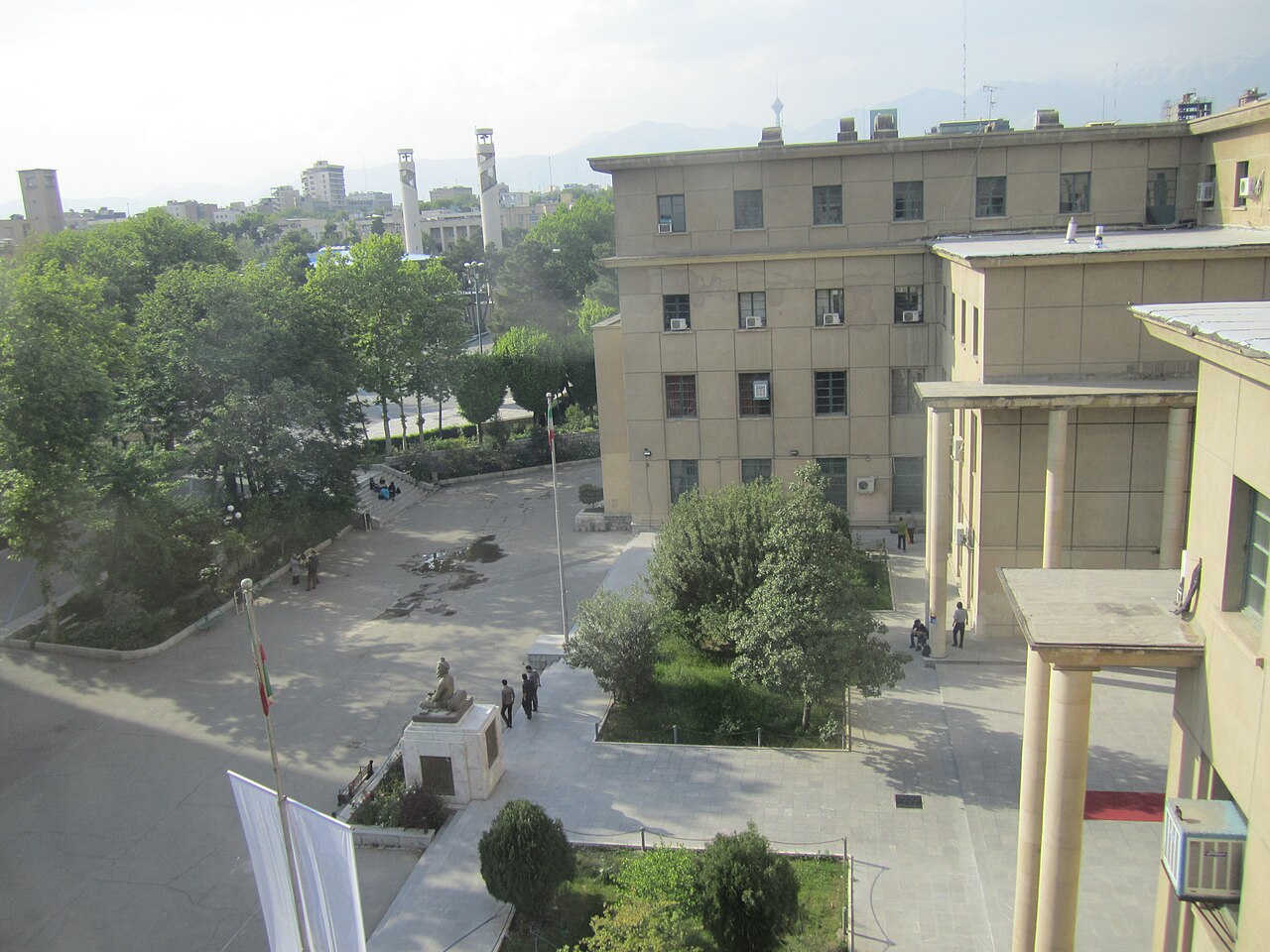
The University of Tehran, دانشگاه تهران, was founded by a law of 1934 that brought existing colleges of law, medicine, engineering and letters together under one institution, with a new campus in the north of the city. Women were admitted from 1936. The minister of education Ali-Asghar Hekmat directed much of this work. Abrahamian and Amanat both note that the expansion was real but uneven: by 1941 most Iranians, especially in villages and among women, were still unable to read.
Names, dress and language
Several laws aimed to make Iranians look and behave like citizens of a modern nation. A 1925 law required every family to register a surname and every person to carry an identity card, ending the old titles such as Saltaneh and Dowleh. The same year the solar calendar with Persian month names became official. The dress law of December 1928 required most men to wear Western-style clothes and the peaked Pahlavi cap; in 1935 the cap was replaced by the European brimmed hat. Clergy with recognised qualifications were exempt. The ban on the veil in 1936 is described on the page on the unveiling decree.
In 1935 the government founded the Farhangestan, the Academy of Iran, to replace Arabic, Turkish and French loanwords with Persian ones. Many of its words did not survive, but others became standard. The same nationalism shaped the international request to use the name Iran instead of Persia and the building of the tomb of Ferdowsi at Tus for the poet’s millennium in 1934 (see the Tomb of Ferdowsi).
The state as entrepreneur
Iran had little private capital for industry, so the state supplied it. Bank Melli, the national bank, opened in 1928 and took over the right to issue banknotes from the British-owned Imperial Bank of Persia. In 1931 foreign trade was made a state monopoly. Government and royal investment built textile mills, sugar refineries, cement works and match factories, mostly in Tehran, Mazandaran and Isfahan. New roads opened the country to motor transport, and the Trans-Iranian Railway was built without foreign loans.
The money came largely from indirect taxes, notably state monopolies on tea and sugar, and from oil royalties after the 1933 agreement. Historians point out that this placed much of the cost on ordinary consumers. Industrial workers remained few, trade unions were banned from the late 1920s, and the countryside, where most people lived, saw little investment.
How far did the reforms go
For admirers, the reforms created modern Iran: a national army, a professional judiciary, a university, a railway, a common school curriculum and a sense of national identity. Later governments, including the Islamic Republic, inherited and used these institutions.
Critics and many historians stress the costs and limits. Homa Katouzian describes the period as one of arbitrary rule combined with what he calls pseudo-modernism, a programme that copied European forms without the rule of law or political participation that came with them in Europe. Ervand Abrahamian points out that the new middle class created by the schools and offices was excluded from politics and later turned against the monarchy. Stephanie Cronin and the contributors to The Making of Modern Iran argue that reform was not simply imposed on a passive society: tribes, clergy, merchants and workers resisted, bargained and shaped the outcome. Abbas Amanat sees the reforms as a decisive break that set the agenda for the rest of the century, while also noting how much they depended on one man’s will.
The religious establishment lost most in this period: its courts, its schools, its control of endowments and its public dress. The tension between state and clergy that began here returned under Mohammad Reza Shah and in the revolution of 1979.
Persian words from this page
| نوسازی | nowsâzi | modernisation |
| دانشگاه تهران | Dâneshgâh-e Tehrân | University of Tehran |
| فرهنگستان | Farhangestân | Academy (of language) |
| دادگستری | dâdgostari | the judiciary, justice ministry |
| نظام وظیفه | nezâm-e vazife | military conscription |
| بانک ملی | Bânk-e Melli | National Bank |
Sources and further reading
- Ervand Abrahamian, A History of Modern Iran (Cambridge University Press, 2008), chapter 3.
- Stephanie Cronin (ed.), The Making of Modern Iran: State and Society under Riza Shah, 1921–1941 (Routledge, 2003).
- Stephanie Cronin, The Army and the Creation of the Pahlavi State in Iran, 1910–1926 (I.B. Tauris, 1997).
- Homa Katouzian, The Political Economy of Modern Iran: Despotism and Pseudo-Modernism, 1926–1979 (Macmillan, 1981).
- Abbas Amanat, Iran: A Modern History (Yale University Press, 2017).
- Encyclopaedia Iranica, articles “Davar, Ali-Akbar” and “Education” (iranicaonline.org).
Want to learn Persian? Get the free Starter Pack
Get the 14-page printable Starter Pack (all 32 letters, a 7-day reading plan, 100 core words and 20 survival phrases) and a short 5-email course. Free.
More in The Pahlavi Era (1925–1979)
- Reza Shah Pahlavi
- Reza Shah’s Reforms
- The Trans-Iranian Railway
- Why Persia Became “Iran” in 1935
- The Unveiling Decree of 1936 (Kashf-e Hijab)
- The Anglo-Soviet Invasion of Iran (1941)
- The Persian Corridor and the Tehran Conference
- The Iran Crisis of 1946
- Mohammad Reza Shah’s Early Reign (1941–1953)
- The Tudeh Party
- Mohammad Mosaddegh
- The Nationalisation of Iranian Oil (1951)
- The 1953 Coup in Iran
- Fazlollah Zahedi
- The 1954 Oil Consortium Agreement
- SAVAK: The Shah’s Security Service
- The White Revolution (1963)
- The Uprising of June 1963 and Khomeini’s Exile
- The Hoveyda Years (1965–1977)
- The 2,500-Year Celebration of the Persian Empire (1971)
- The Oil Boom of the 1970s
- Intellectuals and Opposition in the 1960s–70s
- Iran as a Regional Power under the Shah
- Women in Pahlavi Iran
- The Cinema Rex Fire (1978)
- Black Friday (September 1978)
- The Shah Leaves Iran (January 1979)
- Farah Pahlavi
- The Pahlavi Family
- Forough Farrokhzad and Modern Persian Poetry
- Iranian Cinema before 1979