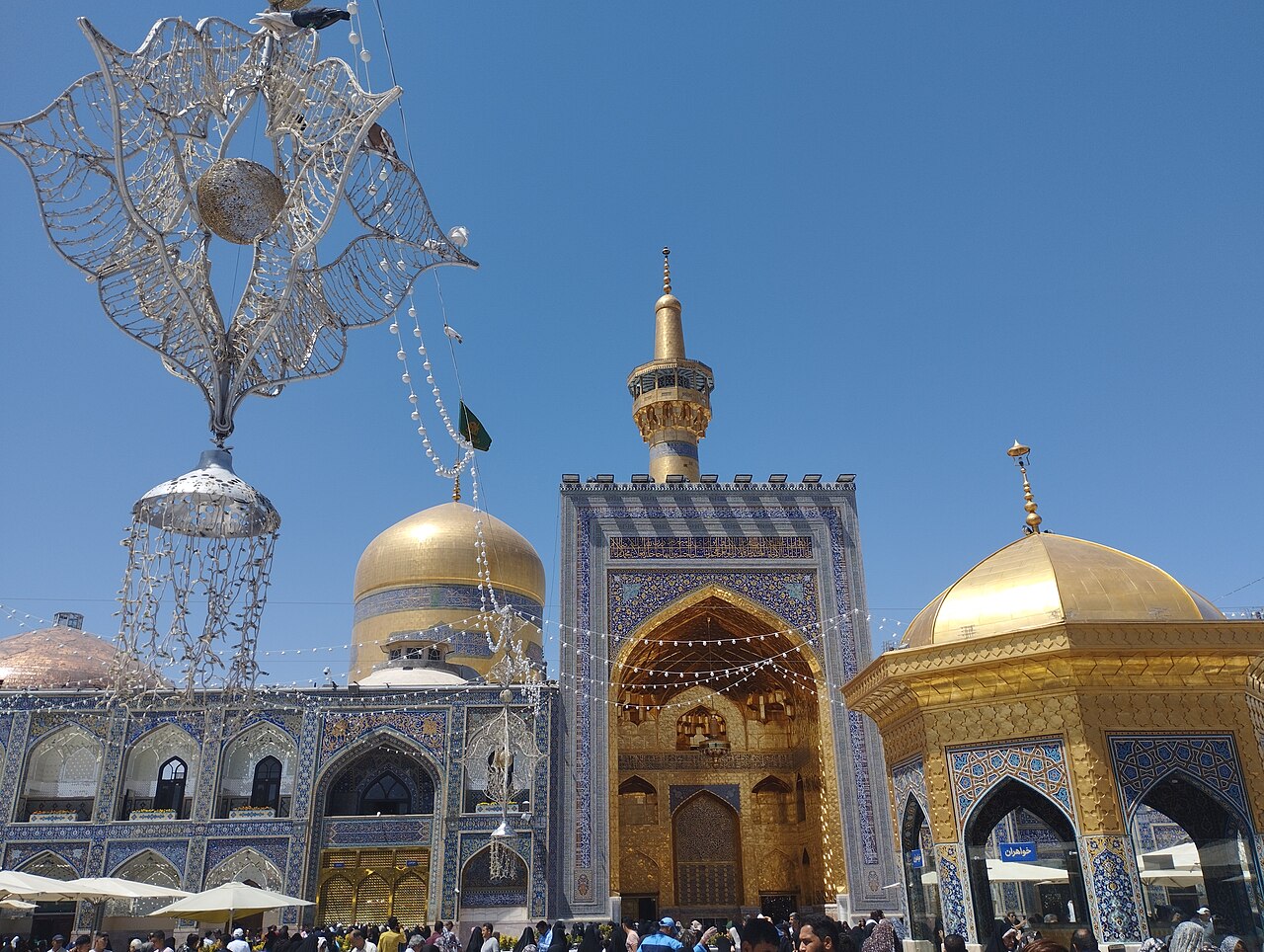
The Imam Reza shrine (حرم امام رضا, Haram-e Emâm Rezâ) in Mashhad is the tomb of Ali al-Reza, the eighth Imam of Twelver Shi’a Islam, who died nearby in 818. It is the holiest site in Iran and one of the most visited pilgrimage places in the Muslim world, a complex of courtyards, golden domes, mosques, libraries and museums that has grown around the tomb for more than a thousand years. The city of Mashhad, “the place of martyrdom”, takes its name from it.
| Persian name | Haram-e Motahhar-e Razavi, usually just “the Haram” |
|---|---|
| Who is buried here | Imam Ali al-Reza (died 818), eighth Shi’a Imam |
| Administered by | Astan Quds Razavi, the shrine’s endowment foundation |
| Oldest standing parts | Timurid (Goharshad Mosque, 1418) and Safavid courtyards |
| Visitors | Tens of millions of pilgrims a year (figures from the shrine; around 20–30 million are often cited) |
The story of the Imam’s life, the disputed account of his death and the growth of the town around his tomb is told on our history page Imam Reza and the Origins of Mashhad. This page is about the shrine as a place: what it looks like, how it grew, and how to visit with respect.

How the shrine grew
The Imam was buried in 818 in a garden at Sanabad, near Tus, beside the tomb of the Abbasid caliph Harun al-Rashid. A domed tomb existed by the 10th century. The shrine was damaged in local wars and rebuilt more than once: the Ghaznavid sultan Mahmud restored it in the early 11th century, and the Seljuk sultan Sanjar, a Sunni ruler, became one of its major patrons in the 12th. Its respect among Sunnis as well as Shi’is is an old part of its history.
Two women and two shahs did more than anyone to shape what you see today.
- Goharshad, wife of the Timurid ruler Shahrukh, paid for the great congregational mosque beside the tomb, finished in 1418, with its huge blue-tiled ayvân and turquoise dome.
- The Safavids made the shrine a centre of the new Shi’a state. Shah Abbas I walked from Isfahan to Mashhad on pilgrimage in 1601, enlarged the complex and had the dome regilded.
- Nader Shah in the 18th century and Naser al-Din Shah in the 19th each added a gilded ayvân, still named the Naderi and Naseri golden porches.
The shrine’s modern history has had violent moments, including the Russian bombardment of the complex in 1912 and the suppression of a protest in the Goharshad Mosque in 1935 under Reza Shah. Since 1979 the complex has been enlarged on a huge scale, with new courtyards, underground prayer halls and service buildings, so that it now covers well over a square kilometre.
What you will see
The courtyards
The shrine is organised around large open courtyards (sahn). The oldest, the Enqelab (Atiq, “old”) courtyard, is Safavid and holds the gilded Naderi porch, a domed water fountain (saqqâ-khâneh) and the Naqqareh-khaneh, a drum house where music has traditionally been played at sunrise and sunset. The Azadi courtyard faces the shrine through the Naseri golden porch. The Jomhuri-ye Eslami courtyard, the Goharshad courtyard in front of the Timurid mosque, and the vast newer Quds, Ghadir and Kowsar courtyards hold the crowds on holy days.
The golden dome
Above the tomb chamber rises the gilded dome, the image of Mashhad seen on stamps, banknotes and souvenirs. Beside it stand gilded minarets. At night the dome is lit and the courtyards fill with families, pilgrims and people simply sitting on carpets.
Inside the sanctuary
The tomb itself lies under the dome inside a cage-like enclosure (zarih), surrounded by halls covered in mirror work, gilding and tile. Pilgrims touch and kiss the zarih and recite prayers of visitation (ziyârat-nâmeh). Men and women usually enter by separate doors.
Museums and library
The Astan Quds Razavi museums hold Qur’an manuscripts, carpets, coins, earlier versions of the zarih and many gifts made to the shrine over the centuries. The Central Library has one of the largest collections of Persian and Arabic manuscripts in Iran.
Visiting respectfully
This is an active holy place first, and a monument second. Pilgrims, many of whom have travelled a long way, come here to pray and grieve. Keep your voice down, do not block people at the doors, and take your cue from those around you.
- Non-Muslim visitors: non-Muslims are usually allowed into the courtyards and museums, often accompanied by a guide from the shrine’s office for international visitors, but not into the inner sanctuary around the tomb. Rules can change, so ask at the gate.
- Dress: modest dress is required. Women are normally asked to wear a chador, which can usually be borrowed at the entrance; men should wear long trousers and avoid short sleeves.
- Security: bags are checked, and large bags, and sometimes cameras, must be left at a depository. Phone photography in the courtyards is common, but do not photograph people praying.
- Busy times: the shrine is busiest on Thursday evenings and Fridays, on the anniversaries of the Imam’s birth and death, and during Nowruz. Hours and access rules for events change; check current information.
- Safety: follow your own government’s travel advice for Iran.
For the city around the shrine, see our guide to Mashhad and the older post on Mashhad. Many visitors combine the shrine with the Tomb of Ferdowsi at Tus and the Tomb of Omar Khayyam in Neyshabur.
Persian words from this page
| حرم | haram | sanctuary, shrine |
| زیارت | ziyârat | pilgrimage, visit to a shrine |
| زائر | zâer | pilgrim |
| صحن | sahn | courtyard |
| ضریح | zarih | enclosure over a saint’s tomb |
| گنبد طلا | gonbad-e talâ | golden dome |
| چادر | châdor | full-length cloak worn by women |
Sources and further reading
- Encyclopaedia Iranica, “ʿALĪ AL-REŻĀ“.
- Encyclopaedia Iranica, “GOWHAR-ŠĀD ĀḠĀ“.
- Charles Melville, “Shah ‘Abbas and the Pilgrimage to Mashhad”, in C. Melville (ed.), Safavid Persia (I.B. Tauris, 1996).
- Robert Hillenbrand, Islamic Architecture: Form, Function and Meaning (Edinburgh University Press, 1994), on shrine and mosque architecture.
Want to learn Persian? Get the free Starter Pack
Get the 14-page printable Starter Pack (all 32 letters, a 7-day reading plan, 100 core words and 20 survival phrases) and a short 5-email course. Free.
More in Top Places to Visit in Iran
- Naqsh-e Jahan Square
- Shah (Imam) Mosque, Isfahan
- Sheikh Lotfollah Mosque
- Ali Qapu Palace
- Jameh Mosque of Isfahan
- Si-o-se Pol and Khaju Bridge
- Vank Cathedral
- Hasht Behesht Palace
- Naqsh-e Rostam
- Eram Garden, Shiraz
- Nasir al-Molk (Pink) Mosque
- Tomb of Hafez (Hafezieh)
- Tomb of Saadi (Saadieh)
- Shah Cheragh Shrine
- Arg of Karim Khan
- Fin Garden, Kashan
- Historic Houses of Kashan
- Jameh Mosque of Yazd
- Yazd Fire Temple and Towers of Silence
- Dowlatabad Garden and Windcatcher
- Amir Chakhmaq Complex
- Golestan Palace
- National Museum of Iran
- Treasury of National Jewels
- Tehran Grand Bazaar
- Milad Tower
- Imam Reza Shrine, Mashhad
- Tomb of Ferdowsi, Tus
- Tomb of Omar Khayyam, Neyshabur
- Tomb of Avicenna, Hamadan
- Ganjnameh Inscriptions, Hamadan
- Behistun (Bisotun): Visiting the Site
- Taq-e Bostan: Visiting the Site
- Tabriz Historic Bazaar
- Takht-e Soleyman
- Armenian Monastic Ensembles of Iran
- Sheikh Safi al-Din Shrine, Ardabil
- Dome of Soltaniyeh
- Alamut Castle
- Falak-ol-Aflak Castle
- Shushtar Historical Hydraulic System
- Chogha Zanbil: Visiting the Ziggurat
- Susa Archaeological Site
- Arg-e Bam
- Ganjali Khan Complex, Kerman
- Shazdeh Garden, Mahan
- Rayen Castle
- Dasht-e Lut (Lut Desert)
- Maranjab Desert and Caravanserai
- Varzaneh Desert
- Mount Damavand
- Hyrcanian Forests
- Lake Urmia
- Badab-e Surt Springs
- Ali Sadr Cave
- The Kaluts of Shahdad
- Qeshm Geopark
- Hormuz Island Colours
- Visiting Persepolis: A Day Trip from Shiraz
- Visiting Pasargadae
- Persian Caravanserais
- The Qanat of Gonabad
- Meymand Village
- Sasanian Sites of Fars: Firuzabad, Bishapur and Sarvestan
- Gonbad-e Qabus: Visiting the Tower
- Zayandeh Rud and Isfahan’s Bridges
- Tochal and Darband: Hiking Above Tehran
- Mount Sabalan
- Skiing in Iran: Dizin and Shemshak
- Golestan National Park