Kashf-e hijab, “the removal of the veil”, was Reza Shah’s ban on the chador and face veil in public, launched on 8 January 1936 (17 Dey 1314) when the queen and two princesses appeared unveiled at a ceremony in Tehran. Police enforced it, sometimes by pulling veils off women in the street, until the shah’s abdication in 1941. It came months after troops crushed a protest against Western dress at the Goharshad Mosque in Mashhad, and it remains one of the most argued-over acts of the Pahlavi era.
| Date | 8 January 1936 (17 Dey 1314) |
|---|---|
| Occasion | Graduation ceremony at the Tehran Teachers’ Training College (Dâneshsarâ-ye Moqaddamâti), attended by Reza Shah, Queen Tadj ol-Molouk and princesses Shams and Ashraf |
| Legal form | No Majlis law; government orders and police enforcement |
| Prelude | Brimmed-hat order and Goharshad Mosque protest, Mashhad, July 1935 |
| Enforcement ended | After Reza Shah’s abdication, September 1941 |
| Persian name | کشف حجاب (kashf-e hejâb) |
Dress as state policy
Changing how people dressed was part of Reza Shah’s programme from the start. The dress law of 1928 put most men into Western jackets and trousers and the peaked “Pahlavi cap”. The reforms of the same years brought girls into state schools and, from 1936, women into the University of Tehran. Debate about the veil was older: Qajar-era writers and poets had argued over it, and a few women, most famously Tahirih in 1848, had defied it. Early Iranian women’s journals and societies campaigned for education more than for unveiling, but some of their members welcomed the state’s move.
The decision to act seems to have followed Reza Shah’s visit to Turkey in the summer of 1934, where he saw Atatürk’s reforms at first hand, although Turkey itself never formally banned the veil. In 1935 the government set up the Ladies’ Centre, کانون بانوان (Kânun-e Bânovân), with the shah’s daughter Shams as its honorary head, and women teachers and schoolgirls were told to stop wearing the chador.
The Goharshad Mosque protest, July 1935
In June 1935 the government ordered men to replace the Pahlavi cap with the European brimmed hat, a change that many religious Iranians found offensive because the brim made it hard to touch the forehead to the ground in prayer. Rumours spread that the unveiling of women would follow. In Mashhad, a preacher, Sheikh Mohammad-Taqi Bohlul, spoke against the measures, and in July 1935 crowds gathered in the Goharshad Mosque, part of the shrine complex of Imam Reza. After several days of sit-in, troops stormed the mosque in mid-July and opened fire on the crowd.
The number killed is disputed and unknown. Figures cited range from around a hundred, in reports passed to British diplomats, to several thousand in later accounts by religious opponents of the dynasty. The custodian of the shrine, Mohammad Vali Asadi, a former ally of the shah, was blamed for the unrest and executed later that year. The shrine is described on our page on the Imam Reza Shrine in Mashhad.
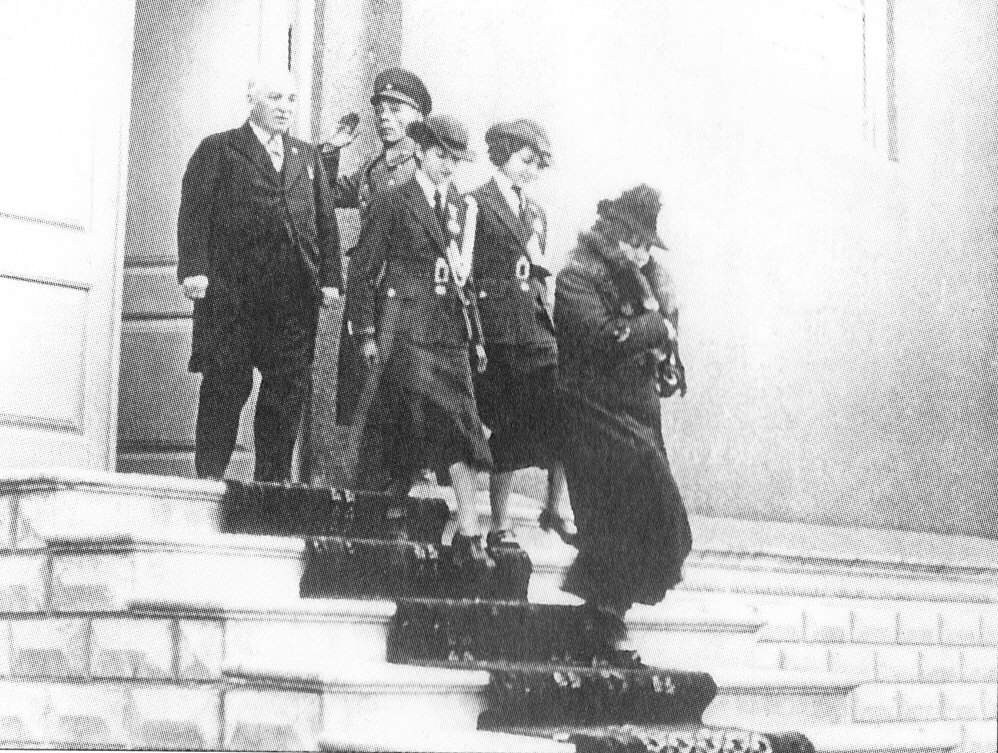

17 Dey 1314: the ceremony in Tehran
On 8 January 1936 Reza Shah attended the graduation ceremony of the teachers’ training college in Tehran. Queen Tadj ol-Molouk and their daughters Shams and Ashraf came with him in European coats and hats, without the chador. Officials had been told to bring their wives unveiled. In his speech the shah spoke of women as half the nation, whose seclusion had kept the country backward. The day was commemorated each year until 1979 as Women’s Emancipation Day.
No law was put to the Majlis. Instead the government issued instructions to ministries, governors and the police. Civil servants could lose their jobs if their wives appeared veiled in public; public places, cinemas, baths and shops were told not to admit women in chadors; and in towns police officers stopped veiled women and in many reported cases tore off their veils. Headscarves and hats were allowed; the full chador and face veil were not.
How women experienced it
Experiences differed sharply by class, place and belief. For some educated urban women the ban opened schools, offices and public life that had been closed to them, and some remembered 1936 as a liberation. The poet Parvin E’tesami wrote verses celebrating the occasion. For many others, especially older and devout women, appearing unveiled in public felt like being stripped. Accounts collected by historians tell of women who did not leave home for years, who went to the baths at night or were carried in sacks, or who stopped visiting relatives and shrines. Families who could not afford Western clothes faced special hardship.
Houchang Chehabi, in his study of dress codes under Reza Shah, and Camron Michael Amin, in The Making of the Modern Iranian Woman (2002), describe how the policy tied women’s bodies to the state’s image of a modern nation, with women’s own choices given little room either way. Hamideh Sedghi and others note that the state that unveiled women did not give them the vote or political freedom; independent women’s organisations were closed down in the 1930s.
After 1941 and the long argument
When Reza Shah abdicated after the Anglo-Soviet invasion, enforcement stopped. Many women went back to the chador; others, particularly in the middle classes, never did. Under Mohammad Reza Shah veiling was neither banned nor required, though the unveiled woman remained the official image of modern Iran. After the 1979 revolution the policy was reversed and hijab became compulsory in public, enforced in its own turn by the state.
For this reason kashf-e hijab is read today through present arguments. Supporters of the monarchy present it as the start of women’s emancipation in Iran. Religious critics have long condemned it as an assault on faith and modesty. Many historians and feminist writers see a common thread linking 1936 and the 1980s: in both, the state decided what women should wear and enforced the decision with police power. The broader story is covered on our page on women in Iranian history.
Persian words from this page
| کشف حجاب | kashf-e hejâb | removal of the veil |
| حجاب | hejâb | veil, modest dress |
| چادر | châdor | full-length cloak worn over the head |
| روسری | rusari | headscarf |
| مسجد گوهرشاد | Masjed-e Gowharshâd | Goharshad Mosque |
| کانون بانوان | Kânun-e Bânovân | Ladies’ Centre (1935) |
Sources and further reading
- Encyclopaedia Iranica, article “Kašf-e ḥejāb” (iranicaonline.org).
- Houchang E. Chehabi, “Staging the Emperor’s New Clothes: Dress Codes and Nation-Building under Reza Shah”, Iranian Studies 26 (1993).
- Camron Michael Amin, The Making of the Modern Iranian Woman: Gender, State Policy, and Popular Culture, 1865–1946 (University Press of Florida, 2002).
- Stephanie Cronin (ed.), The Making of Modern Iran: State and Society under Riza Shah, 1921–1941 (Routledge, 2003).
- Ervand Abrahamian, A History of Modern Iran (Cambridge University Press, 2008).
Want to learn Persian? Get the free Starter Pack
Get the 14-page printable Starter Pack (all 32 letters, a 7-day reading plan, 100 core words and 20 survival phrases) and a short 5-email course. Free.
More in The Pahlavi Era (1925–1979)
- Reza Shah Pahlavi
- Reza Shah’s Reforms
- The Trans-Iranian Railway
- Why Persia Became “Iran” in 1935
- The Unveiling Decree of 1936 (Kashf-e Hijab)
- The Anglo-Soviet Invasion of Iran (1941)
- The Persian Corridor and the Tehran Conference
- The Iran Crisis of 1946
- Mohammad Reza Shah’s Early Reign (1941–1953)
- The Tudeh Party
- Mohammad Mosaddegh
- The Nationalisation of Iranian Oil (1951)
- The 1953 Coup in Iran
- Fazlollah Zahedi
- The 1954 Oil Consortium Agreement
- SAVAK: The Shah’s Security Service
- The White Revolution (1963)
- The Uprising of June 1963 and Khomeini’s Exile
- The Hoveyda Years (1965–1977)
- The 2,500-Year Celebration of the Persian Empire (1971)
- The Oil Boom of the 1970s
- Intellectuals and Opposition in the 1960s–70s
- Iran as a Regional Power under the Shah
- Women in Pahlavi Iran
- The Cinema Rex Fire (1978)
- Black Friday (September 1978)
- The Shah Leaves Iran (January 1979)
- Farah Pahlavi
- The Pahlavi Family
- Forough Farrokhzad and Modern Persian Poetry
- Iranian Cinema before 1979