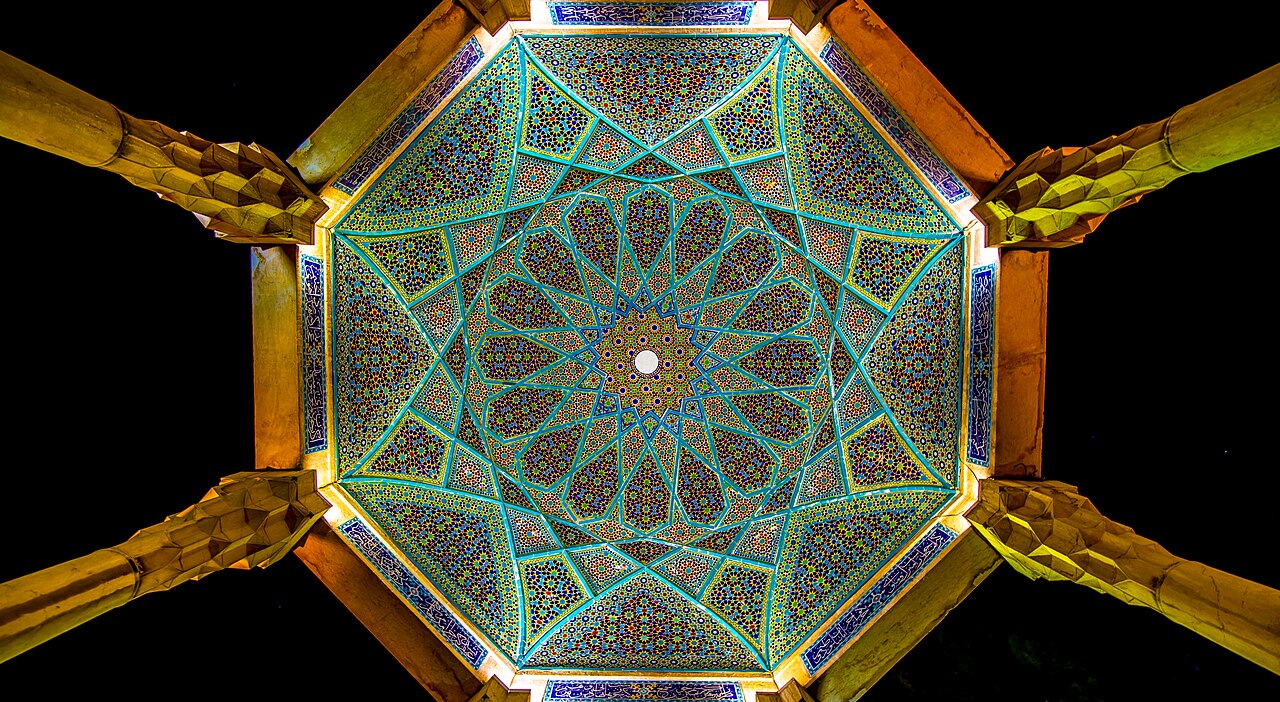
The Tomb of Hafez, the Hafezieh (حافظیه), is the garden in northern Shiraz where the poet Hafez was buried after his death in about 1389–1390. Over his grave stands an open pavilion of eight columns under a copper dome, designed by André Godard and completed in 1935. It is not a museum but a place where Iranians come, especially in the evening, to read his poems, recite them aloud and open his Divan for an omen.
| Persian name | Ârâmgâh-e Hâfez, popularly Hâfeziye |
|---|---|
| Poet | Khwaja Shams al-Din Mohammad Hafez, c. 1315–1390, of Shiraz |
| Site | The Mosalla gardens, north of the old city of Shiraz |
| Buildings | Tombstone and garden from the time of Karim Khan Zand (1770s); pavilion by André Godard, 1935 |
| Best time | Late afternoon to evening |
| Hafez Day | 20 Mehr in the Iranian calendar (11 or 12 October) |

Why Iranians come here
Hafez wrote ghazals, short lyric poems about love, wine, the beloved, hypocrisy and the passing of time, and they are known to Iranians of every background. Many households keep a copy of his Divan next to the Qur’an and the Shahnameh. Lines of his poems are used in everyday speech, at weddings, on Nowruz and on Yalda night. His life, the politics of the Shiraz he lived in, and how his poems have been read are told in Hafez of Shiraz and The Injuids and Muzaffarids of Shiraz.
The tomb is therefore a place of affection more than of pilgrimage. People touch the tombstone, read a poem under their breath, sit on the steps with friends, or take a photograph with the pavilion behind them. It is one of the few places in Iran where you can hear poetry recited aloud by strangers.
Hafez’s own Mosalla
Hafez was buried in the Mosalla, an area of gardens on the edge of medieval Shiraz that he praised in his poems. The best-known lines come from the ghazal that begins with the “Turk of Shiraz”:
بده ساقی می باقی که در جنت نخواهی یافت
کنار آب رکنآباد و گلگشت مصلا را
bedeh sâqi mey-e bâqi ke dar jannat nakhâhi yâft / kenâr-e âb-e Roknâbâd o golgasht-e Mosallâ râ
“Pour, cupbearer, the wine that is left, for in paradise you will not find the banks of the Roknabad stream and the rose-walks of the Mosalla.” Reading these lines in the place they describe is part of the visit. More of his poems, with translations and notes, are in our collection of Hafez quotes.
From a grave in a garden to Godard’s pavilion
For centuries the grave was a modest one in a garden cemetery, visited by poets and travellers. In the 1770s Karim Khan Zand, who made Shiraz his capital, laid out a garden and built a hall here, and had a new tombstone placed over the grave, carved with verses of Hafez. That stone is still the one you see today.
In the 1930s, as part of a wider effort by the Pahlavi government to honour Iran’s national poets (the tomb of Ferdowsi at Tus was rebuilt at the same time), the site was redesigned. The French archaeologist and architect André Godard, then director of Iran’s archaeological service, designed the present pavilion, completed in 1935. The tomb was raised on a platform reached by steps, and the garden was laid out again with pools and orange trees.
What to look at
- The pavilion. Eight slender stone columns carry a dome sheathed in copper, shaped, it is often said, like the hat of a dervish. The design combines a modern clarity with the Persian tradition of the open garden pavilion.
- The ceiling. Look up inside the dome: it is lined with fine tile mosaic in blues, greens and gold, in a star pattern.
- The tombstone. The stone of the Zand period lies at the centre of the platform, carved with poems of Hafez in Persian script. Visitors often rest their hand on it while they read.
- Inscriptions around the site. Many verses are carved or written on the walls and gates of the garden. If you are learning Persian, try reading a line or two: Hafez’s vocabulary is a good test, and people nearby are usually happy to help.
- The garden. Orange trees, cypresses and pools, with benches and steps where people sit at dusk.
Fal-e Hafez at the tomb
Around the entrance and the garden you will see people offering a fâl-e Hâfez, an omen from the poems. Some hold a small bird, usually a canary or budgerigar, that picks a printed card with a ghazal from a box; others sell cards or open a copy of the Divan for you. Iranians also take a fal by opening the Divan at random themselves, after making a silent wish, and reading the poem that appears. How it is done, what to say and how to read the answer are explained in our guide to fal-e Hafez.
Visiting
- When: come in the late afternoon and stay until dark. The pavilion is lit at night, the garden fills with people, and the atmosphere is very different from the morning, when it is quiet and better for photographs.
- Busy days: Nowruz, Yalda (the longest night, around 21 December) and Hafez Day on 20 Mehr bring large crowds and special readings.
- Time to allow: an hour, more if you sit for tea. There is usually a traditional teahouse in the garden.
- Combining it: the tomb of Saadi is a short taxi ride to the east (see Tomb of Saadi), and the Qur’an Gate and Eram Garden are also in the north of the city. Many visitors make an afternoon of Eram, Saadi and then Hafez at dusk.
- Opening hours and tickets change; check current information locally.
For the rest of the city, see our Shiraz city guide.
Persian words from this page
| حافظ | Hâfez | Hafez; one who knows the Qur’an by heart |
| آرامگاه | ârâmgâh | tomb, resting place |
| دیوان | divân | collected poems |
| غزل | ghazal | lyric poem |
| فال | fâl | omen, fortune |
| ساقی | sâqi | cupbearer |
| مصلا | Mosallâ | place of prayer; the gardens where Hafez is buried |
Sources and further reading
- Hafez, Divan, ed. Mohammad Qazvini and Qasem Ghani (Tehran, 1941 and later printings).
- Encyclopaedia Iranica, “Hafez” (article series, including the poet’s life and his tomb).
- Dick Davis, Faces of Love: Hafez and the Poets of Shiraz (Mage, 2012).
- Encyclopaedia Iranica, “Godard, André”.
Love Persian poetry? Learn to read it: free Starter Pack
Get the 14-page printable Starter Pack (all 32 letters, a 7-day reading plan, 100 core words and 20 survival phrases) and a short 5-email course. Free.
More in Top Places to Visit in Iran
- Naqsh-e Jahan Square
- Shah (Imam) Mosque, Isfahan
- Sheikh Lotfollah Mosque
- Ali Qapu Palace
- Jameh Mosque of Isfahan
- Si-o-se Pol and Khaju Bridge
- Vank Cathedral
- Hasht Behesht Palace
- Naqsh-e Rostam
- Eram Garden, Shiraz
- Nasir al-Molk (Pink) Mosque
- Tomb of Hafez (Hafezieh)
- Tomb of Saadi (Saadieh)
- Shah Cheragh Shrine
- Arg of Karim Khan
- Fin Garden, Kashan
- Historic Houses of Kashan
- Jameh Mosque of Yazd
- Yazd Fire Temple and Towers of Silence
- Dowlatabad Garden and Windcatcher
- Amir Chakhmaq Complex
- Golestan Palace
- National Museum of Iran
- Treasury of National Jewels
- Tehran Grand Bazaar
- Milad Tower
- Imam Reza Shrine, Mashhad
- Tomb of Ferdowsi, Tus
- Tomb of Omar Khayyam, Neyshabur
- Tomb of Avicenna, Hamadan
- Ganjnameh Inscriptions, Hamadan
- Behistun (Bisotun): Visiting the Site
- Taq-e Bostan: Visiting the Site
- Tabriz Historic Bazaar
- Takht-e Soleyman
- Armenian Monastic Ensembles of Iran
- Sheikh Safi al-Din Shrine, Ardabil
- Dome of Soltaniyeh
- Alamut Castle
- Falak-ol-Aflak Castle
- Shushtar Historical Hydraulic System
- Chogha Zanbil: Visiting the Ziggurat
- Susa Archaeological Site
- Arg-e Bam
- Ganjali Khan Complex, Kerman
- Shazdeh Garden, Mahan
- Rayen Castle
- Dasht-e Lut (Lut Desert)
- Maranjab Desert and Caravanserai
- Varzaneh Desert
- Mount Damavand
- Hyrcanian Forests
- Lake Urmia
- Badab-e Surt Springs
- Ali Sadr Cave
- The Kaluts of Shahdad
- Qeshm Geopark
- Hormuz Island Colours
- Visiting Persepolis: A Day Trip from Shiraz
- Visiting Pasargadae
- Persian Caravanserais
- The Qanat of Gonabad
- Meymand Village
- Sasanian Sites of Fars: Firuzabad, Bishapur and Sarvestan
- Gonbad-e Qabus: Visiting the Tower
- Zayandeh Rud and Isfahan’s Bridges
- Tochal and Darband: Hiking Above Tehran
- Mount Sabalan
- Skiing in Iran: Dizin and Shemshak
- Golestan National Park