The Sheikh Safi al-Din Khanegah and Shrine Ensemble in Ardabil is the burial place of Sheikh Safi al-Din Ardabili (1252–1334), the Sufi master whose descendants founded the Safavid dynasty. Built up from the 14th to the 17th century, it combines a working Sufi lodge, tombs, a mosque and a hall built for Shah Abbas I’s Chinese porcelain, and has been a UNESCO World Heritage Site since 2010.
| Persian name | مجموعه آرامگاه و خانقاه شیخ صفیالدین |
|---|---|
| Location | Old centre of Ardabil, north-west Iran |
| Main building periods | 14th century (tomb tower) to 17th century (Chini-khaneh) |
| Buried here | Sheikh Safi al-Din, Shah Ismail I and members of the Safavid family |
| UNESCO | World Heritage List, 2010 |

A Sufi lodge that became a dynastic shrine
Sheikh Safi al-Din led a Sufi order in Ardabil that drew followers across Azerbaijan, Anatolia and beyond. After his death in 1334 his son Sadr al-Din Musa built a tomb for him beside the lodge, and the place became the headquarters of the order. The story of how a mystical brotherhood turned into a militant movement is told on our page on the Safaviyya order of Ardabil.
When the young sheikh Ismail took Tabriz in 1501 and crowned himself shah, Ardabil became the spiritual home of a ruling house. Shah Ismail I was buried here in 1524, and later shahs treated the shrine as the family sanctuary, adding buildings, endowing land and sending gifts. Shah Abbas I was its greatest patron. Around 1611 he endowed the shrine with his collection of Chinese porcelain, books and other treasures, and remodelled the hall that still bears the name Chini-khaneh, the “China house”.
Walking through the ensemble
The complex is entered through a long garden that leads to a gateway and then to a small, enclosed inner courtyard, about 31 by 16 metres. Guides often explain the route as a passage through stages: the path to the tomb is divided into seven sections, said to mirror the seven stages of the Sufi path, and eight gates separate its parts. It is a lovely idea; whether the builders planned it as a symbol or it was read into the layout later is hard to prove.
The Allah-Allah tower
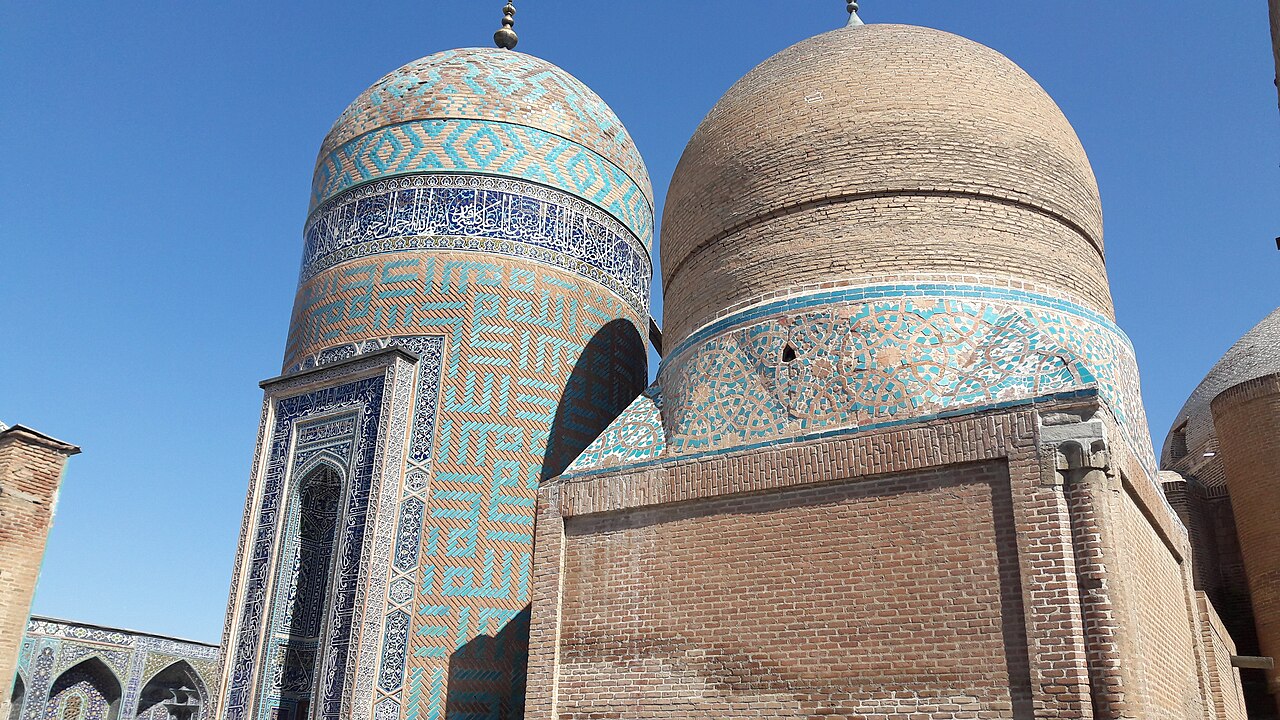
The tomb of Sheikh Safi is a tall cylindrical tower, about 17 metres high, under a short dome. Its blue glazed bricks are laid to spell the word Allah again and again around the drum, which is why it is known as the Allah-Allah dome (گنبد الله الله). Inside, the sheikh’s cenotaph sits under a richly painted vault, surrounded by inscriptions in fine Safavid calligraphy.
Other tombs and the Dar al-Hoffaz
Next to the tower is a second domed chamber that holds the tomb of Shah Ismail I, with a cenotaph of inlaid wood. Several other members of the family and Qizilbash followers were buried in the complex. The Dar al-Hoffaz, the hall where Qur’an reciters once read in shifts, links the tombs and has some of the best tile and gilt work in the shrine. Look also for the carved wooden doors and the silver-plated doors given by the shahs.
The Chini-khaneh
The China house is the most unusual room in the complex. Its walls and dome are lined with hundreds of carved niches, each shaped to hold a single dish, bowl or vase. When full, the hall displayed the shah’s porcelain as both a gift to the saint and a statement of royal wealth. Many pieces were Chinese blue-and-white wares of the 14th to 16th centuries. Most of the collection was later moved to Tehran and is now in the National Museum of Iran, so the niches are now largely empty, but the room itself, with its painted and gilded stucco, is worth the visit.
The Jannatsara mosque
The large octagonal hall called Jannatsara, probably begun in the 16th century, served as a mosque and gathering hall for the dervishes. Today it is used as a museum space with objects from the shrine, including manuscripts, textiles and carpets.
Treasures that left Ardabil
Two famous groups of objects from the shrine are now abroad. The first is the shrine library: Russian forces removed many of its manuscripts during the Russo-Persian war of 1826–1828, and they ended up in St Petersburg. The second is the pair of carpets known as the Ardabil carpets, dated by their inscription to 946 AH (1539–1540) and signed by Maqsud of Kashan. They are believed to have been made for the shrine in the reign of Shah Tahmasp. One is in the Victoria and Albert Museum in London and the other in the Los Angeles County Museum of Art. For more on Safavid carpets and painting, see Safavid art: carpets, miniatures and tiles.
Practical notes
- The shrine is in the centre of Ardabil, within walking distance of the bazaar. Allow one to two hours.
- It is a religious site still visited by pilgrims. Dress modestly; women may be asked to wear a chador in the tomb chambers, and these are usually available at the entrance.
- Ardabil sits at about 1,350 metres and is cold in winter; late spring to early autumn is the most comfortable time to visit.
- Opening hours and tickets change, so check current information locally or with Iran’s cultural heritage authorities before you go.
Persian words from this page
| شیخ صفیالدین | Sheykh Safi od-Din | Sheikh Safi al-Din |
| اردبیل | Ardabil | Ardabil |
| خانقاه | khâneghâh | Sufi lodge |
| چینیخانه | chini-khâne | China house |
| گنبد | gonbad | dome |
| صفوی | Safavi | Safavid |
Sources and further reading
- UNESCO World Heritage Centre, Sheikh Safi al-din Khānegāh and Shrine Ensemble in Ardabil.
- Kishwar Rizvi, The Safavid Dynastic Shrine: Architecture, Religion and Power in Early Modern Iran (London, 2011).
- John Alexander Pope, Chinese Porcelains from the Ardebil Shrine (Washington, 1956).
- Victoria and Albert Museum, collection record for the Ardabil Carpet.
- Encyclopaedia Iranica, “Ardabīl” (monuments section).
Want to learn Persian? Get the free Starter Pack
Get the 14-page printable Starter Pack (all 32 letters, a 7-day reading plan, 100 core words and 20 survival phrases) and a short 5-email course. Free.
More in Top Places to Visit in Iran
- Naqsh-e Jahan Square
- Shah (Imam) Mosque, Isfahan
- Sheikh Lotfollah Mosque
- Ali Qapu Palace
- Jameh Mosque of Isfahan
- Si-o-se Pol and Khaju Bridge
- Vank Cathedral
- Hasht Behesht Palace
- Naqsh-e Rostam
- Eram Garden, Shiraz
- Nasir al-Molk (Pink) Mosque
- Tomb of Hafez (Hafezieh)
- Tomb of Saadi (Saadieh)
- Shah Cheragh Shrine
- Arg of Karim Khan
- Fin Garden, Kashan
- Historic Houses of Kashan
- Jameh Mosque of Yazd
- Yazd Fire Temple and Towers of Silence
- Dowlatabad Garden and Windcatcher
- Amir Chakhmaq Complex
- Golestan Palace
- National Museum of Iran
- Treasury of National Jewels
- Tehran Grand Bazaar
- Milad Tower
- Imam Reza Shrine, Mashhad
- Tomb of Ferdowsi, Tus
- Tomb of Omar Khayyam, Neyshabur
- Tomb of Avicenna, Hamadan
- Ganjnameh Inscriptions, Hamadan
- Behistun (Bisotun): Visiting the Site
- Taq-e Bostan: Visiting the Site
- Tabriz Historic Bazaar
- Takht-e Soleyman
- Armenian Monastic Ensembles of Iran
- Sheikh Safi al-Din Shrine, Ardabil
- Dome of Soltaniyeh
- Alamut Castle
- Falak-ol-Aflak Castle
- Shushtar Historical Hydraulic System
- Chogha Zanbil: Visiting the Ziggurat
- Susa Archaeological Site
- Arg-e Bam
- Ganjali Khan Complex, Kerman
- Shazdeh Garden, Mahan
- Rayen Castle
- Dasht-e Lut (Lut Desert)
- Maranjab Desert and Caravanserai
- Varzaneh Desert
- Mount Damavand
- Hyrcanian Forests
- Lake Urmia
- Badab-e Surt Springs
- Ali Sadr Cave
- The Kaluts of Shahdad
- Qeshm Geopark
- Hormuz Island Colours
- Visiting Persepolis: A Day Trip from Shiraz
- Visiting Pasargadae
- Persian Caravanserais
- The Qanat of Gonabad
- Meymand Village
- Sasanian Sites of Fars: Firuzabad, Bishapur and Sarvestan
- Gonbad-e Qabus: Visiting the Tower
- Zayandeh Rud and Isfahan’s Bridges
- Tochal and Darband: Hiking Above Tehran
- Mount Sabalan
- Skiing in Iran: Dizin and Shemshak
- Golestan National Park