The Qizilbash were the Turkmen tribal warriors who followed the Safavid Sufi masters of Ardabil and carried Shah Ismail I to power in 1501. Named for their red caps, they formed the army and the ruling elite of the early Safavid state, fought each other in two long civil wars, and were brought under royal control only by Shah Abbas I around 1600.
| Name | Turkish qızılbaş, “red head”; Persian قزلباش Qezelbâsh |
|---|---|
| Origin | Turkmen tribes of eastern Anatolia, northern Syria and Azerbaijan |
| Leading tribes | Ustajlu, Shamlu, Rumlu, Takkalu, Zulqadr, Afshar, Qajar |
| Height of power | 1501 to the 1580s |
| Badge | Red cap with twelve gores, the tâj-e Heydari |
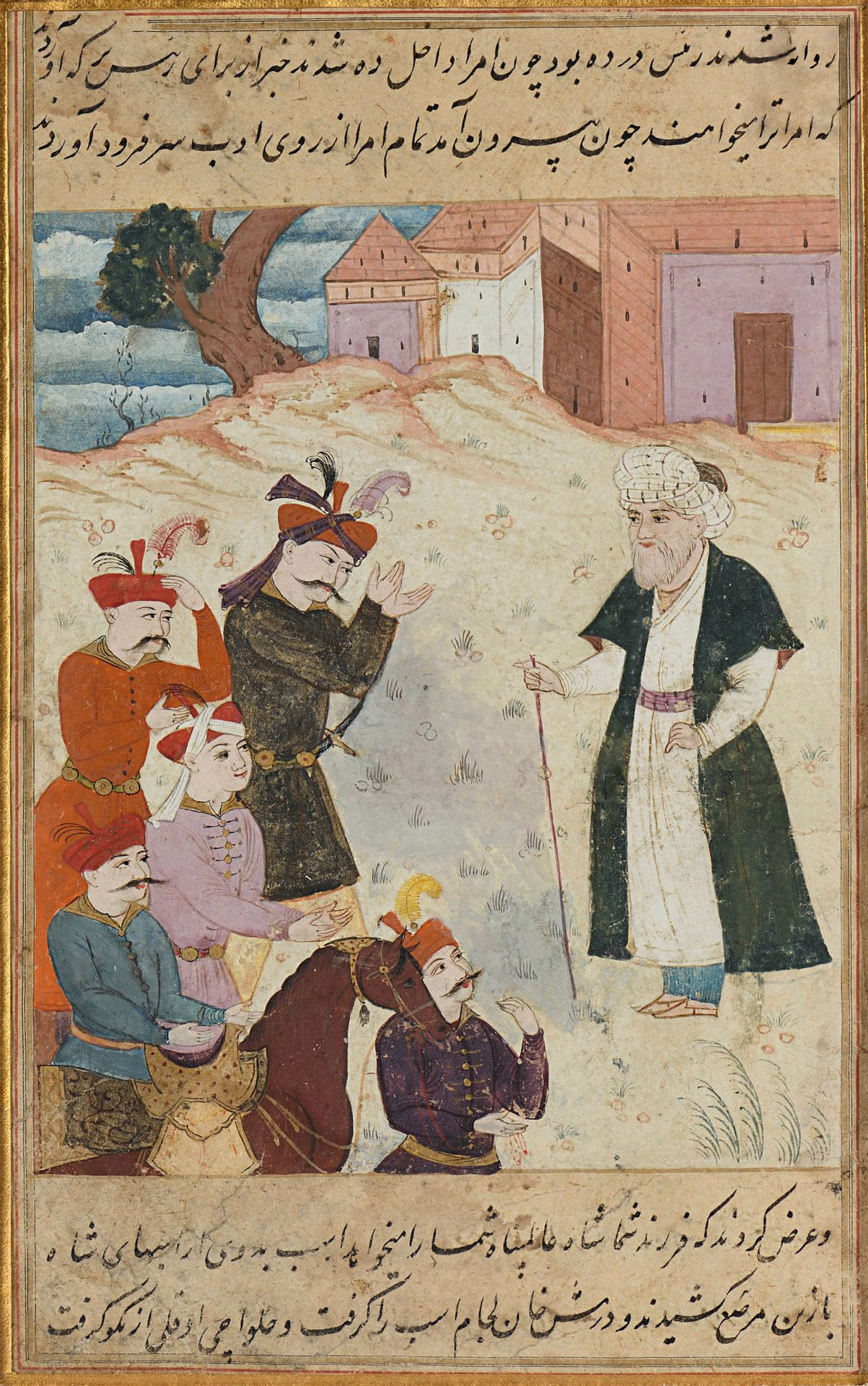

Disciples of the Ardabil sheikhs
The Safavids began as a Sufi order founded by Sheikh Safi al-Din of Ardabil, who died in 1334 (see the Safaviyya Sufi order of Ardabil). In the fifteenth century the order’s leaders, Junayd and then his son Haydar, turned it into a militant movement with a large following among the Turkmen tribes of Anatolia and the Caucasus borderlands. These nomads and semi-nomads lived beyond the reach of Ottoman and Aq Qoyunlu tax collectors, and many held beliefs that mixed Sufi devotion, Shi’a reverence for Ali and older Turkic traditions.
Haydar, who died in battle in 1488, gave his followers their emblem: a red felt cap wound with a turban and rising in a baton with twelve folds or gores, for the twelve imams of Shi’a Islam. Their enemies, the Ottomans above all, called them qızılbaş, “red heads”, and the name stuck. The followers accepted it.
Warriors for a living saint
What bound the Qizilbash together was devotion to the head of the order, whom they called morshed-e kâmel, the perfect guide. For many, the young Ismail was more than a guide. His own Turkic poems, written under the pen name Khata’i, speak of him in terms that suggest a divine presence, and Qizilbash fighters went into battle without armour, trusting in his protection. In 1500 Ismail, then about thirteen, gathered several thousand tribesmen at Erzincan in eastern Anatolia. Within a year they had beaten the Aq Qoyunlu and taken Tabriz, as told in Shah Ismail I.
The Ottomans regarded the Qizilbash in their own lands as a dangerous fifth column. A Qizilbash rising in Anatolia in 1511, the Şahkulu revolt, alarmed Istanbul, and Sultan Selim I had large numbers of suspected sympathisers killed or deported before his campaign of 1514. Ottoman chroniclers give a figure of 40,000, which modern historians treat with caution. The defeat at Chaldiran that year ended the belief that Ismail could not lose, and Qizilbash zeal never fully recovered.
Tribes as the state
In the early Safavid state the great Qizilbash chiefs held most of the military and provincial posts. Each tribe had its leaders, its pastures and its fighting men, and governorships were in effect tribal fiefs. The court spoke Turkic as much as Persian. Persian-speaking bureaucrats, the “Tajiks” in Safavid usage, ran the treasury and chancery, and the tension between Turkmen soldiers and Persian administrators ran through the dynasty’s first century.
Two civil wars
The system worked badly when the shah was weak. After Ismail’s death in 1524 his ten-year-old son Tahmasp became a prize for the tribes. For a decade, from 1524 to about 1533, Rumlu, Ustajlu, Takkalu and Shamlu leaders fought for control of the young shah, and some of the fighting took place in the royal camp itself. Tahmasp emerged from it determined to rule himself, as described in Shah Tahmasp I.
A second round followed Tahmasp’s death in 1576. Qizilbash factions backed rival princes, helped kill Ismail II’s opponents and then, in 1579, murdered Mahd-e Olya, the powerful wife of the near-blind Mohammad Khodabanda. In 1587 an Ustajlu chief, Morshed Qoli Khan, put the teenage Abbas on the throne at Qazvin, expecting to rule through him.
Abbas and the taming of the tribes
Abbas had Morshed Qoli Khan killed in 1589 and spent his reign reducing Qizilbash power. He built a standing army of gholâms, slave soldiers of Georgian, Armenian and Circassian origin, and a corps of musketeers paid from crown lands; the details are in Shah Abbas’s military reforms. Gholams replaced tribal chiefs in many governorships. Abbas also called on men from every tribe to show personal loyalty to him as shâhsevan, “those who love the shah”, rather than to their tribal leaders.
The Qizilbash did not disappear. Tribal contingents still made up much of the army, and families such as the Shamlu and Zulqadr kept high office through the seventeenth century. But they no longer decided who ruled. By then “Qizilbash” was often used loosely for the whole Turkic military class of the empire.
A long afterlife
Two later dynasties came out of Qizilbash tribes. Nader Shah was an Afshar, and the Qajars, who ruled Iran from 1789 to 1925, took their name from the Qajar tribe that had marched with Ismail. In Anatolia, the descendants of Qizilbash communities who stayed under Ottoman rule became the Alevis of modern Turkey, and the word Kızılbaş was long used of them, often as an insult. In Afghanistan, the Qizilbash of Kabul descend from soldiers settled there by Nader Shah.
Historians now treat the Qizilbash less as fanatical tribesmen and more as a political class with its own interests. Kathryn Babayan’s work on their beliefs, and Masashi Haneda’s on their military organisation, show a movement whose messianic religion was gradually tamed into the Twelver Shi’ism of the state (see Twelver Shi’ism becomes Iran’s state religion).
Persian words from this page
| قزلباش | Qezelbâsh | Qizilbash |
| تاج حیدری | tâj-e Heydari | Haydar’s crown, the red cap |
| مرشد کامل | morshed-e kâmel | the perfect guide |
| غلام | gholâm | slave soldier |
| شاهسون | shâhsevan | lover of the shah |
| ایل | il | tribe |
Sources and further reading
- Encyclopaedia Iranica, “Qezelbāš”.
- Roger Savory, Iran under the Safavids (Cambridge, 1980).
- Kathryn Babayan, Mystics, Monarchs, and Messiahs: Cultural Landscapes of Early Modern Iran (Cambridge, MA, 2002).
- Masashi Haneda, Le Châh et les Qizilbâš: le système militaire safavide (Berlin, 1987).
- Andrew J. Newman, Safavid Iran: Rebirth of a Persian Empire (London, 2006).
Want to learn Persian? Get the free Starter Pack
Get the 14-page printable Starter Pack (all 32 letters, a 7-day reading plan, 100 core words and 20 survival phrases) and a short 5-email course. Free.
More in The Safavid Empire (1501–1736)
- Shah Ismail I
- The Qizilbash
- Twelver Shi’ism Becomes Iran’s State Religion
- The Battle of Marv and the Uzbeks
- The Battle of Chaldiran (1514)
- Shah Tahmasp I
- The Ottoman–Safavid War and the Peace of Amasya
- Humayun’s Exile in Persia
- Qazvin: The Second Safavid Capital
- Ismail II and Mohammad Khodabanda
- Shah Abbas the Great
- Shah Abbas’s Military Reforms and the Ghulams
- The Sherley Brothers in Persia
- Isfahan: “Half the World”
- The Building of Naqsh-e Jahan Square
- Shah Abbas Retakes the West: The Ottoman Wars of 1603–1618
- The Capture of Hormuz from the Portuguese (1622)
- New Julfa and the Armenian Merchants
- The Safavid Silk Trade and Europe
- Sheikh Baha’i
- Reza Abbasi
- Shah Safi and the Treaty of Zuhab
- Shah Abbas II
- The Fight for Kandahar
- Chehel Sotoun Palace and Its War Paintings
- Shah Suleiman
- European Travellers in Safavid Persia
- Shah Soltan Hoseyn
- Safavid Art: Carpets, Miniatures and Tiles
- Mulla Sadra and the School of Isfahan
- The Afghan Revolt and the Battle of Gulnabad
- The Siege and Fall of Isfahan (1722)
- Peter the Great’s Persian Campaign (1722–1723)
- Tahmasp II and Hotaki Rule (1722–1732)
- Women of the Safavid Court
- The Safavid Legacy