Ardabil is the capital of Ardabil province in north-western Iran, a cool upland city of about 530,000 people below the volcanic peak of Mount Sabalan. It is the home town of the Safavid dynasty: the Sufi master Sheikh Safi al-Din (1252–1334) taught and was buried here, his descendants founded the Safavid state in 1501, and his shrine became a UNESCO World Heritage Site in 2010.
| Persian name | اردبیل (Ardabil) |
|---|---|
| Province | Ardabil (capital) |
| Population | 529,374 (city, 2016 census, Statistical Centre of Iran) |
| Elevation | About 1,350 m |
| Climate | Cool summers; long, cold, snowy winters |
| Main language | Azerbaijani Turkish, with Persian |
| UNESCO site | Sheikh Safi al-Din Khanegah and Shrine Ensemble (2010) |
| Distance | About 210 km east of Tabriz; about 70 km from the Caspian coast at Astara |

Before the Safavids
Ardabil is old. It is generally thought to have been a Sasanian town, and in the first centuries of Islam it was the capital of the province of Azerbaijan, a garrison and market on the routes between the Caspian, the Caucasus and the plateau. Arab geographers of the tenth century describe a large walled city. Its importance passed to Tabriz in the Seljuk and Mongol periods, and the Mongols sacked Ardabil in 1220 on their first raid into north-western Iran.
Sheikh Safi and the Safavid order
Safi al-Din Ardabili was born in 1252 and became the disciple and son-in-law of a Sufi master, Sheikh Zahed Gilani. After Zahed’s death he led the order from Ardabil for more than thirty years, and by his death in 1334 it had followers across Azerbaijan, Anatolia and beyond, with gifts and land flowing to his lodge, the خانقاه (khânegâh).
Under his descendants the Safaviyya changed character. In the fifteenth century the sheikhs Junayd and Haydar turned it into a militant movement, backed by Turkmen tribesmen known as the Qizilbash (“red heads”) after their red caps. In 1501 Haydar’s son Ismail, still a teenager, took Tabriz and proclaimed himself shah, and declared Twelver Shi’ism the religion of the state. How a Sufi order became a royal dynasty is told on the pages about the Safaviyya order of Ardabil and Shah Ismail I.
The shrine ensemble
Ardabil remained the family’s sacred centre, and later shahs, especially Tahmasp I and Abbas I, enlarged the shrine into a complex of courtyards, a mosque, a library, a kitchen, a hospital and tombs. It was listed by UNESCO in 2010 as an example of a Sufi khanegah that combined religious, social and charitable functions.
What is there
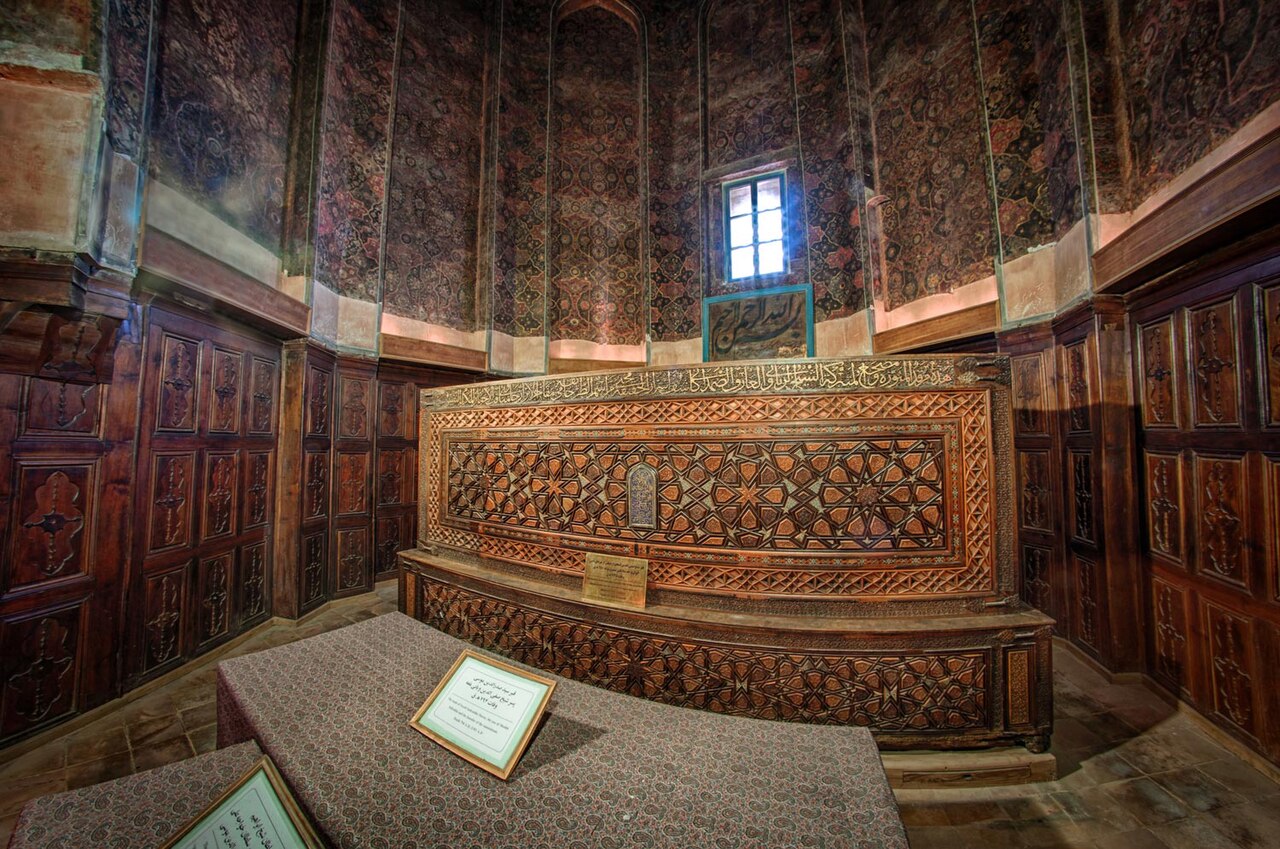
- The tall cylindrical tomb tower of Sheikh Safi, its dome covered in turquoise tiles with the name of God repeated in brick and glaze.
- The tomb of Shah Ismail I, who was buried beside his ancestor in 1524.
- The Chini-khaneh (“porcelain house”), a hall lined with hundreds of small niches made to display the Chinese porcelain that Shah Abbas I gave to the shrine in 1611. Much of the collection is now in the National Museum of Iran in Tehran.
- Courtyards, gateways and the Jannat Sara, an octagonal hall.
For a fuller visitor description, see Sheikh Safi al-Din Shrine, Ardabil.
Treasures that left Ardabil
Two of the shrine’s most famous possessions are now abroad. The Ardabil Carpet, a pair of enormous wool and silk carpets dated 946 AH (1539–40) and signed by Maqsud Kashani, left Iran in the nineteenth century; the better-preserved one is in the Victoria and Albert Museum in London and the other in the Los Angeles County Museum of Art. The shrine’s library of manuscripts was taken by Russian troops in 1828, at the end of the Russo-Persian war, and is now in St Petersburg. See Safavid art: carpets, miniatures and tiles.
Mount Sabalan and the hot springs
West of the city rises سبلان (Sabalân), an extinct volcano about 4,800 m high with a small crater lake near the summit, the third-highest mountain in Iran. Its slopes are summer pasture for the Shahsevan nomads, and it is a popular climb in July and August. The town of Sarein, about 30 km from Ardabil, is built around hot mineral springs from the volcano’s heat and is full of bathhouses and spa hotels. See Mount Sabalan.
Life in Ardabil
Ardabil is one of the coldest provincial capitals in Iran, and many Iranians come in summer to escape the heat of the plateau. The city’s speech is Azerbaijani Turkish. It is a trading town for the dairy and honey of the Sabalan pastures, and its best-known dish is ash-e dugh, a soup of yoghurt drink, herbs, rice and chickpeas. Ardabil is also known for its Muharram ceremonies and for rugs and kilims woven in the surrounding villages.
Inside the city, the Friday Mosque has remains from the Seljuk and Ilkhanid periods, and the bazaar was rebuilt in the Zand and Qajar eras. The Shurabil lake on the southern edge of town is a park where families come on summer evenings.
Getting there
Ardabil has an airport with flights from Tehran and is linked by road to Tabriz, to Astara on the Caspian and down through the forested Heyran pass to the coast. Winter can bring heavy snow. For schedules, opening hours and safety, check current official information and your own government’s travel advice.
Persian words from this page
| اردبیل | Ardabil | Ardabil |
| شیخ | sheykh | sheikh, Sufi master |
| خانقاه | khânegâh | Sufi lodge |
| صفوی | Safavi | Safavid |
| چینی | chini | porcelain; Chinese |
| قالی | ghâli | carpet |
| آب گرم | âb-e garm | hot water, hot spring |
| آش دوغ | âsh-e dugh | yoghurt and herb soup |
Sources and further reading
- UNESCO World Heritage List, Sheikh Safi al-Din Khānegāh and Shrine Ensemble in Ardabil (whc.unesco.org/en/list/1345).
- Encyclopaedia Iranica, “Ardabīl” and “Ardabīl Carpets”.
- Andrew J. Newman, Safavid Iran: Rebirth of a Persian Empire, I.B. Tauris, 2006.
- Sheila Canby, Shah ‘Abbas: The Remaking of Iran, British Museum Press, 2009, on the shrine and the porcelain gift.
- Statistical Centre of Iran, General Population and Housing Census 2016 (1395).
Want to learn Persian? Get the free Starter Pack
Get the 14-page printable Starter Pack (all 32 letters, a 7-day reading plan, 100 core words and 20 survival phrases) and a short 5-email course. Free.
More in Cities of Iran
- Tehran: Iran’s Capital
- Mashhad
- Isfahan
- Shiraz
- Tabriz
- Yazd
- Kashan
- Kerman
- Hamadan
- Qom
- Ahvaz
- Rasht
- Kermanshah
- Urmia
- Ardabil
- Zanjan
- Qazvin
- Sanandaj
- Khorramabad
- Bandar Abbas
- Bushehr
- Zahedan
- Birjand
- Gorgan
- Sari
- Semnan
- Arak
- Ilam
- Yasuj
- Shahr-e Kord
- Bojnurd
- Karaj
- Abadan and Khorramshahr
- Kish Island
- Qeshm Island
- Hormuz Island
- Masuleh
- Abyaneh
- Kandovan
- Bam
- Neyshabur (Nishapur)
- Shush (Susa) Today