Arak is the capital of Markazi (“Central”) province, about 280 km south-west of Tehran on a high plain at roughly 1,750 m. Unlike most Iranian cities it was founded in a known year: in 1808 the Qajar commander Yusef Khan Gorji built a walled garrison town here called Soltanabad. In the decades that followed it became the hub of a great carpet trade, known in the West through the name of the nearby village of Saruq, and in the twentieth century it grew into one of Iran’s main industrial cities.
| Persian name | اراک (Arâk) |
|---|---|
| Former name | Soltanabad (سلطانآباد) |
| Founded | 1808, under Fath-Ali Shah |
| Province | Markazi (capital) |
| Population | 520,944 (city, 2016 national census) |
| Elevation | about 1,720 to 1,750 m |

Soltanabad: a garrison town by design
At the end of the eighteenth century the plain of Farahan and the country around it were disputed between the new Qajar state and local tribes. Yusef Khan Gorji, a Georgian convert who served the Qajars as a military commander, settled troops in the area in the 1790s and, in 1808, under Fath-Ali Shah, built a fortified town. It was laid out on a regular plan: a square enclosure with a thick wall, eight towers and a deep moat, the governor’s buildings in the north, and straight streets crossing at right angles. Visitors still notice that central Arak feels more like a grid than the winding lanes of older cities.
The town was called Soltanabad, “built by the sultan”. Under Reza Shah, in the 1930s, it took the name Arak, from the old name of the region, Iraq-e Ajam, “Persian Iraq”, which medieval geographers used for the central and western plateau.
The bazaar and the Sepahdar mosque
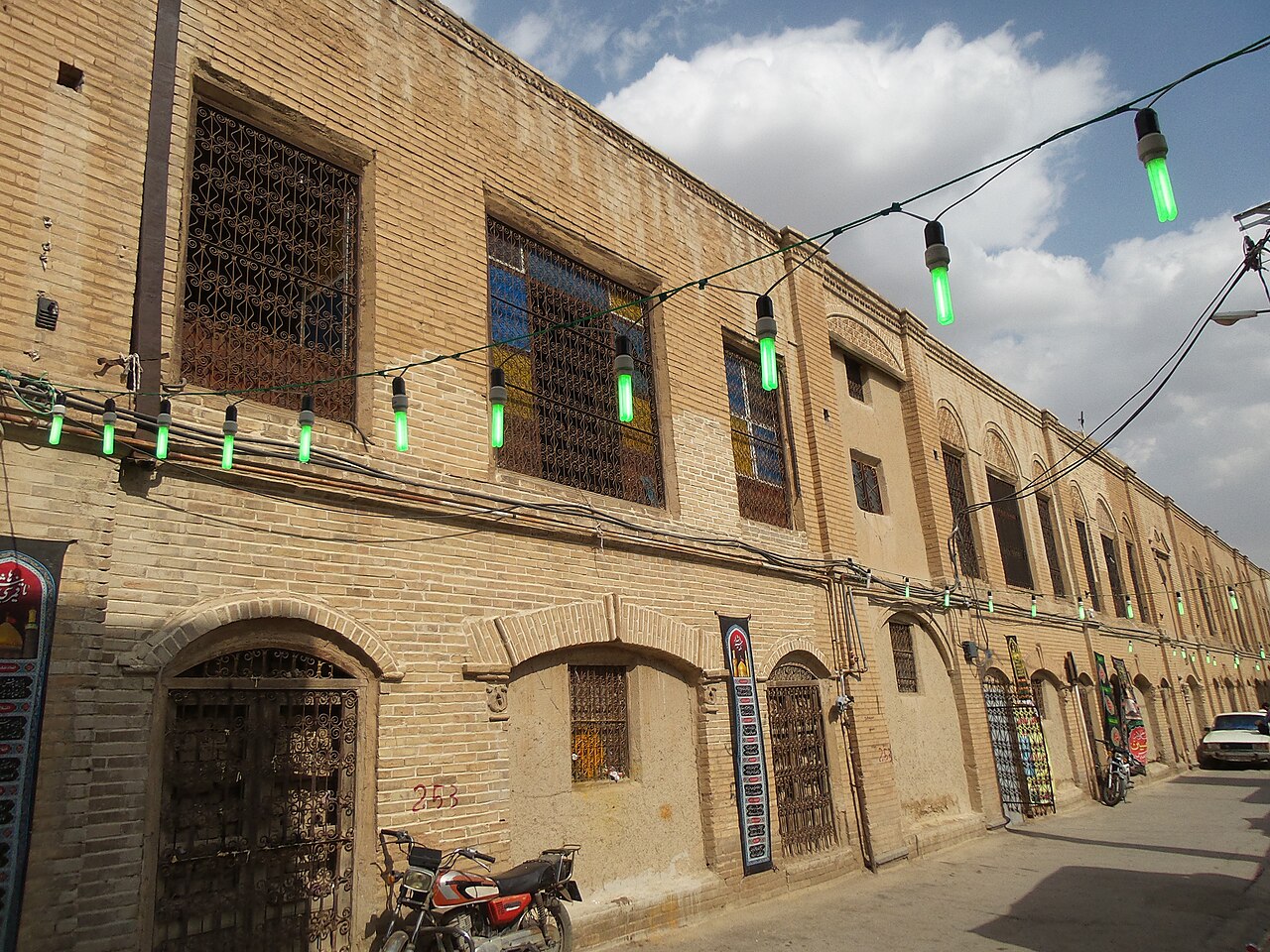
The bazaar (بازار) was built at the same time as the town, along its main axis. Its brick vaults, domed crossings and caravanserais are an unusually complete example of a single-period Qajar bazaar, and it is still the commercial heart of the old city. Nearby stands the Sepahdar mosque and school, a Qajar religious complex with a tiled courtyard. Hours for the historic buildings vary, so check locally.
Farahan: the home of two prime ministers
The rural district of Farahan (فراهان), north of the city, produced two of the most important statesmen of the Qajar period. Mirza Abolqasem Qa’em-Maqam Farahani (1779 to 1835) was chief minister to Mohammad Shah and is remembered for his clear Persian prose, which broke with the ornate court style. Mirza Taqi Khan, known as Amir Kabir (1807 to 1852), the reforming chief minister of Naser al-Din Shah who founded the Dar al-Funun college in Tehran, was born in the Farahan village of Hezaveh, where his father worked in the household of the Qa’em-Maqam family.
Sarouk and the carpet boom
The villages around Arak had woven carpets for generations, but the scale changed in the 1880s. European demand was rising, and the Manchester firm of Ziegler and Company set up a weaving and export business in Soltanabad in 1883, supplying designs and dyed wool to village weavers and shipping the finished rugs abroad. American and other European firms followed. Rugs from the region were sold under names such as Sultanabad, Mahal, Ziegler and, for the finest, Sarouk, after the village of Saruq (ساروق). Sarouk rugs, often with a deep rose-red field and dense floral designs, became especially popular in the United States in the early twentieth century.
The carpet trade has declined since then, but weaving continues in the villages of the province. For the wider craft, see our page on Iranian handicrafts.
An industrial city
From the 1960s onward, Arak was chosen as a site for heavy industry. Large plants for machinery, aluminium, rolling stock and petrochemicals were built around the city, which is often called Iran’s industrial capital. The growth brought jobs and migrants, and also some of the worst air pollution of any Iranian city in winter, when cold air traps smoke over the plain. The economy is covered more broadly on our page on the economy of Iran.
Around Arak
Arak lies between better-known destinations: Hamadan to the north-west, Qom to the east, Kashan beyond it, and Khomein, the birthplace of Ayatollah Khomeini, to the south. The city sits on the Tehran to Ahvaz railway and is a natural stop between Tehran and the Zagros.
Persian words from this page
| اراک | Arâk | Arak |
| سلطانآباد | Soltânâbâd | Soltanabad |
| مرکزی | Markazi | central (the province) |
| فرش | farsh | carpet |
| بازار | bâzâr | bazaar, market |
| فراهان | Farâhân | Farahan |
| کارخانه | kârkhâne | factory |
Sources and further reading
- Encyclopaedia Iranica, “Arak”.
- Encyclopaedia Iranica, “Amir Kabir”.
- Encyclopaedia Iranica, “Carpets” (sections on the Qajar and Pahlavi periods and the export trade).
- Abbas Amanat, Iran: A Modern History (Yale University Press, 2017).
- Statistical Centre of Iran, National Population and Housing Census 2016 (1395).
Want to learn Persian? Get the free Starter Pack
Get the 14-page printable Starter Pack (all 32 letters, a 7-day reading plan, 100 core words and 20 survival phrases) and a short 5-email course. Free.
More in Cities of Iran
- Tehran: Iran’s Capital
- Mashhad
- Isfahan
- Shiraz
- Tabriz
- Yazd
- Kashan
- Kerman
- Hamadan
- Qom
- Ahvaz
- Rasht
- Kermanshah
- Urmia
- Ardabil
- Zanjan
- Qazvin
- Sanandaj
- Khorramabad
- Bandar Abbas
- Bushehr
- Zahedan
- Birjand
- Gorgan
- Sari
- Semnan
- Arak
- Ilam
- Yasuj
- Shahr-e Kord
- Bojnurd
- Karaj
- Abadan and Khorramshahr
- Kish Island
- Qeshm Island
- Hormuz Island
- Masuleh
- Abyaneh
- Kandovan
- Bam
- Neyshabur (Nishapur)
- Shush (Susa) Today