Under the Safavids (1501–1736) Iranian art reached one of its high points: royal workshops produced illustrated manuscripts such as the Shahnameh of Shah Tahmasp, knotted carpets such as the Ardabil carpet of 1539–1540, and the tiled domes and portals of Isfahan. Over two centuries the style moved from the crowded, jewel-like painting of Tabriz to the free single figures of Reza Abbasi and the large-scale, export-minded production of the Isfahan workshops.
| Main centres | Tabriz, Qazvin, Mashhad, Isfahan, Kashan, Kerman |
|---|---|
| Key manuscript | Shahnameh of Shah Tahmasp, c. 1522–1540s, 258 paintings |
| Key carpet | Ardabil carpets, dated 946 AH (1539–1540), signed Maqsud Kashani |
| Leading painters | Soltan Mohammad, Aqa Mirak, Mir Mosavvar, Reza Abbasi, Mo’in Mosavver, Mohammad Zaman |
| Tile techniques | Cut-tile mosaic (mo’arraq) and painted seven-colour tiles (haft-rang) |
Painting at the court of Tabriz
When Shah Ismail I took Tabriz in 1501 he inherited the workshop traditions of the Turkmen rulers of western Iran, and when his armies took Herat in 1510 he gained access to the Timurid school of painting there. The meeting of the two produced the early Safavid style. In 1522 Ismail appointed the Herat master Kamal al-Din Behzad, whose work is described on Behzad and Persian miniature painting, as head of the royal library in Tabriz.
The Shahnameh of Shah Tahmasp
The greatest product of the Tabriz workshop was a copy of Ferdowsi’s Shahnameh, begun for the young Tahmasp in the 1520s. It contains 258 paintings, the work of several generations of artists, among them Soltan Mohammad, Aqa Mirak, Mir Mosavvar and Dust Mohammad. The paintings are crowded with detail: rocks that hide faces, gold skies, figures in brilliantly patterned robes. Soltan Mohammad’s “Court of Gayumars”, which shows the first king of the Iranian legend surrounded by his people in a landscape of shimmering rocks, is often called the finest Persian painting.
In 1568 Tahmasp sent the book to the Ottoman sultan Selim II as a gift. It stayed in Istanbul until the early twentieth century, passed into the Rothschild collection and then to the American collector Arthur Houghton, who split it up and sold many pages. In 1994 Iran recovered most of the remaining manuscript in an exchange of artworks. The poem itself is introduced in our article on the Shahnameh.
Tahmasp turns away
From the 1540s Tahmasp lost interest in painting, and in 1556 he issued an edict of repentance against forbidden pleasures. Royal patronage of painting shrank. Some artists moved to the court of his nephew Ebrahim Mirza in Mashhad, where they illustrated a celebrated copy of Jami’s Haft Owrang between 1556 and 1565, now in the Freer Gallery in Washington. Others, such as Mir Sayyid Ali and Abd al-Samad, followed the Mughal emperor Humayun to India and helped found Mughal painting, a link discussed on Humayun’s exile in Persia.
The single page and the album
From the late sixteenth century in Qazvin and then in Isfahan, painters worked less on large manuscripts for the shah and more on single pages for a wider circle of buyers: courtiers, merchants and collectors who mounted them in albums, the moraqqa’. Subjects changed too. Instead of epic battles, painters drew elegant youths, lovers, dervishes, shepherds and portraits.
The master of this new style was Reza Abbasi (d. 1635), court painter to Shah Abbas I, whose quick, swelling line and soft colouring influenced Iranian art for a century. His life is told on the Reza Abbasi page. His pupil Mo’in Mosavver worked on into the 1690s. In the later seventeenth century painters such as Mohammad Zaman and the Jabbadar family adopted European shading, perspective and subjects, a manner known as farangi-sâzi, “in the Frankish manner”. The large wall paintings of the Chehel Sotoun palace, discussed on Chehel Sotoun and its war paintings, show painting on an architectural scale.

Carpets: from tent floor to court art
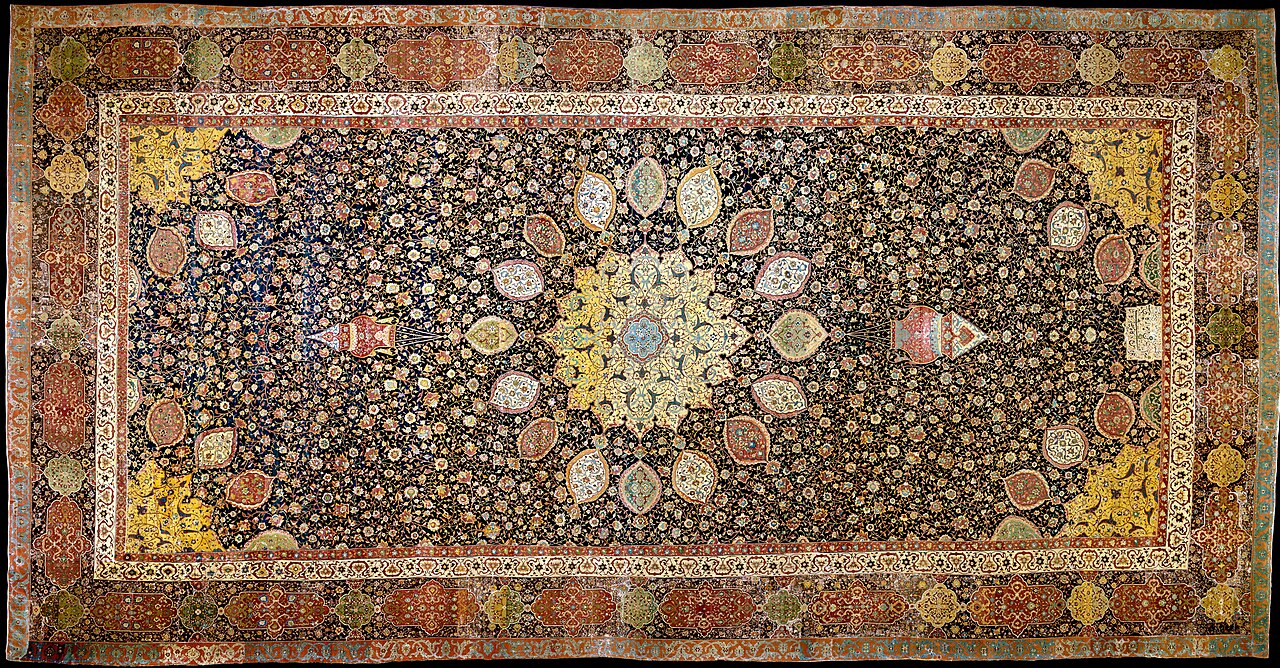
Knotted carpets were woven in Iran long before the Safavids, but under them carpet weaving became a court art. Designers trained in the book workshops drew full-scale patterns, and weavers in royal or royal-supported workshops in Tabriz, Kashan, Isfahan and Kerman translated them into wool and silk. Carpets with central medallions, garden designs, hunting scenes and flowering vases appeared.
The Ardabil carpets
The most famous are a pair of carpets made for the shrine of Sheikh Safi al-Din, the dynasty’s ancestor, at Ardabil. One carries an inscription with a couplet of Hafez, the signature of Maqsud Kashani and the date 946 of the Islamic calendar, that is 1539–1540. The larger, now in the Victoria and Albert Museum in London, measures about 10.5 by 5.3 metres and has a golden central medallion on a dark blue field, with two mosque lamps hanging from it. Its twin, partly used to repair it in the nineteenth century, is in the Los Angeles County Museum of Art. The shrine itself is described on the Sheikh Safi al-Din Shrine page.
Silk carpets for kings
Under Abbas I the workshops of Isfahan and Kashan wove carpets of silk brocaded with silver and gold thread, made as royal gifts and for sale abroad. Many reached Europe; because several were found in Polish noble collections and were shown in Paris in 1878, they became known as “Polonaise” carpets, though they are Iranian. The Safavid silk economy behind them is explained in the Safavid silk trade and Europe. For the living craft today see Iranian handicrafts.
Tiles and ceramics
Safavid builders covered their mosques, shrines and palaces in glazed tile. Two techniques were used. In cut-tile mosaic, mo’arraq, each colour is fired separately and cut into small pieces fitted together like a puzzle: slow, costly and brilliant. In haft-rang (“seven-colour”) tiles, a whole design is painted on a square tile and fired at once: faster and cheaper, if less luminous. The Sheikh Lotfollah Mosque in Isfahan uses fine mosaic on its portal; the vast surfaces of the Shah Mosque are mostly haft-rang, as described on the building of Naqsh-e Jahan Square.
Potters, meanwhile, competed with Chinese porcelain. In 1611 Shah Abbas gave his collection of Chinese porcelain to the Ardabil shrine, and workshops in Kerman and Mashhad produced blue-and-white wares in the Chinese manner, which the Dutch East India Company sometimes shipped to Europe when Chinese supplies ran short.
How the art is judged
Older art historians tended to see the Tabriz Shahnameh as the peak and the later Isfahan work as a decline into prettiness and mass production. More recent scholars, such as Sheila Canby, stress that the single-page painting, the export carpet and the European-influenced style were creative responses to new patrons and markets. The Safavid period also fixed many of the forms that Iranians still think of as classical: the medallion carpet, the tiled dome, the nastaliq script set beside a slender painted figure.
Persian words from this page
| قالی | qâli | carpet |
| نگارگری | negârgari | miniature painting |
| کاشی | kâshi | tile |
| هفترنگ | haft-rang | seven-colour tile |
| معرق | mo’arraq | cut-tile mosaic |
| مرقع | moraqqa’ | album |
| شاهنامه | Shâhnâme | Book of Kings |
Sources and further reading
- Sheila R. Canby, The Golden Age of Persian Art 1501–1722, British Museum Press, 1999.
- Sheila R. Canby, The Shahnama of Shah Tahmasp: The Persian Book of Kings, Metropolitan Museum of Art, 2014.
- Stuart Cary Welch, A King’s Book of Kings: The Shah-nameh of Shah Tahmasp, Metropolitan Museum of Art, 1972.
- Jon Thompson and Sheila R. Canby (eds.), Hunt for Paradise: Court Arts of Safavid Iran 1501–1576, Skira, 2003.
- Victoria and Albert Museum, collection record for the Ardabil Carpet (museum number 272-1893).
Want to learn Persian? Get the free Starter Pack
Get the 14-page printable Starter Pack (all 32 letters, a 7-day reading plan, 100 core words and 20 survival phrases) and a short 5-email course. Free.
More in The Safavid Empire (1501–1736)
- Shah Ismail I
- The Qizilbash
- Twelver Shi’ism Becomes Iran’s State Religion
- The Battle of Marv and the Uzbeks
- The Battle of Chaldiran (1514)
- Shah Tahmasp I
- The Ottoman–Safavid War and the Peace of Amasya
- Humayun’s Exile in Persia
- Qazvin: The Second Safavid Capital
- Ismail II and Mohammad Khodabanda
- Shah Abbas the Great
- Shah Abbas’s Military Reforms and the Ghulams
- The Sherley Brothers in Persia
- Isfahan: “Half the World”
- The Building of Naqsh-e Jahan Square
- Shah Abbas Retakes the West: The Ottoman Wars of 1603–1618
- The Capture of Hormuz from the Portuguese (1622)
- New Julfa and the Armenian Merchants
- The Safavid Silk Trade and Europe
- Sheikh Baha’i
- Reza Abbasi
- Shah Safi and the Treaty of Zuhab
- Shah Abbas II
- The Fight for Kandahar
- Chehel Sotoun Palace and Its War Paintings
- Shah Suleiman
- European Travellers in Safavid Persia
- Shah Soltan Hoseyn
- Safavid Art: Carpets, Miniatures and Tiles
- Mulla Sadra and the School of Isfahan
- The Afghan Revolt and the Battle of Gulnabad
- The Siege and Fall of Isfahan (1722)
- Peter the Great’s Persian Campaign (1722–1723)
- Tahmasp II and Hotaki Rule (1722–1732)
- Women of the Safavid Court
- The Safavid Legacy