Persian painting, called negârgari in Persian and often “Persian miniature” in English, is the tradition of small, brilliantly coloured paintings made to illustrate manuscripts of poetry and history. It took shape at the Mongol court in Tabriz around 1300, reached its classic form in Timurid Herat and Safavid Tabriz in the 15th and 16th centuries, and continued through Qajar portraiture and coffeehouse painting into the modern art of Iran.

Before the book: walls, silver and Mani
Iran had painters long before it had illustrated books. Fragments of wall painting survive from Parthian and Sasanian sites, and Sasanian silver plates show kings hunting in a style later painters echoed (see Sasanian art). In Persian literature the greatest painter of the past is Mani, the 3rd-century prophet who illustrated his scriptures; poets call him the master painter, and fragments of Manichaean book painting have been found in Central Asia. Very little painting survives from the first Islamic centuries in Iran, though pottery and metalwork of the Seljuk period show figures and stories in a lively style.
The Mongol beginning
The Persian illustrated book, as a major art, begins under the Ilkhans. In Tabriz around 1300 the vizier Rashid al-Din ran a workshop that copied and illustrated his world history, the Jami al-Tawarikh. Chinese scroll painting, brought west by the Mongols, taught artists new ways to draw landscapes, clouds, rocks and trees. In the 1330s the same court produced the Great Mongol Shahnameh, dramatic large pictures now scattered across museums (see Ilkhanid art and the Great Mongol Shahnameh). The Shahnameh of Ferdowsi would remain the text most often illustrated for the next five centuries. Under the Jalayirids in Baghdad and Tabriz at the end of the 14th century, painters such as Junayd created the delicate, balanced style that later artists built on.
Timurid Herat and Behzad
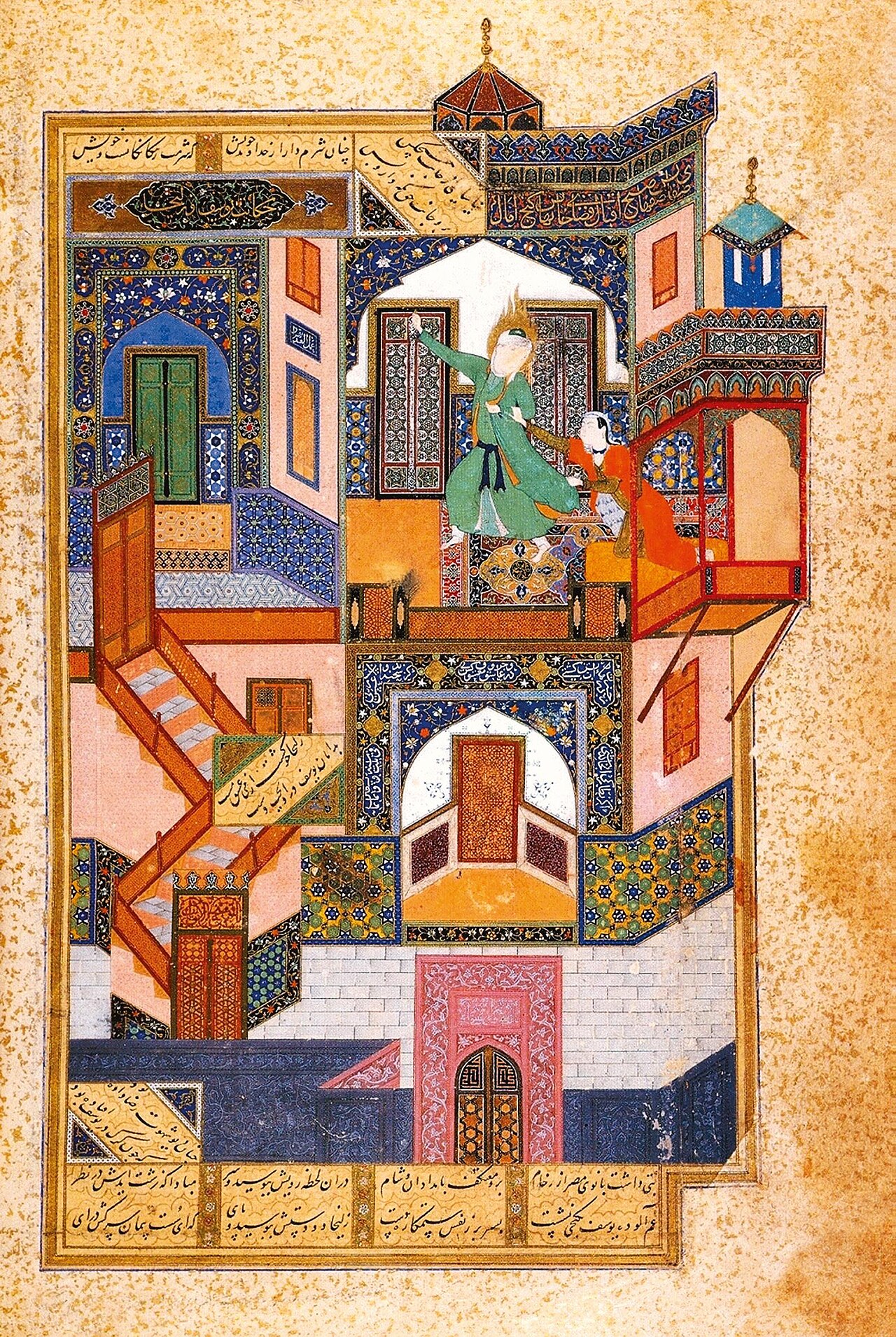
In the 15th century the Timurid princes made painting a court art of the highest prestige. In Herat, Baysunghur, a son of Shahrukh, ran a royal workshop, the kitâbkhâne (“library”), where calligraphers, illuminators, painters and bookbinders worked together; its Shahnameh of 1430 is one of the treasures of the Golestan Palace library. At the end of the century, under Sultan Husayn Bayqara, worked Kamal al-Din Behzad, the most celebrated Persian painter. In his scenes, such as the Yusuf and Zulaikha above, figures move through crowded architecture with natural gestures, and the composition guides the eye through the story.
Safavid Tabriz and the royal Shahnameh
When the Safavids took Herat, Behzad moved to Tabriz, where in 1522 he was named head of the royal library. The Tabriz workshop combined the Herat style with the bold colour of the Turkmen court, and produced its greatest work for the young Shah Tahmasp: a Shahnameh with 258 paintings by artists such as Sultan Muhammad and Aqa Mirak, made over about two decades. Tahmasp later sent it to the Ottoman sultan as a gift. In the 20th century it became known as the Houghton Shahnameh after a collector who broke it up and sold many pages, which are now in museums around the world.
When Tahmasp lost interest in painting in the 1540s, some of his artists left. Mir Sayyid Ali and Abd al-Samad went to India with the Mughal emperor Humayun, who had stayed at Tahmasp’s court (see Humayun’s exile in Persia), and they helped found Mughal painting.
Isfahan: the single page
By 1600 patrons were buying single paintings and drawings to collect in albums, not only illustrated books. In Isfahan under Shah Abbas I, Reza Abbasi made this the main form: elegant young men and women, dervishes and workers, drawn with a calligraphic line. Murals in palaces such as Chehel Sotoun show the same taste at a larger scale. In the later 17th century artists like Muhammad Zaman began to borrow European shading and perspective. Our page on Safavid art looks at painting alongside carpets and tiles.
Qajar oils, lithographs and coffeehouse painting
The Qajars favoured large oil portraits of the shah and court, painted in a style that joined Persian ideals of beauty to European techniques; Fath Ali Shah’s long black beard and narrow waist became an emblem of the dynasty. In the mid-19th century Abu’l-Hasan Ghaffari, known as Sani ol-Molk, led a team illustrating a huge Persian Thousand and One Nights for Naser al-Din Shah and introduced lithographic illustration; his nephew Kamal-ol-Molk later taught academic realism. At the other end of society, “coffeehouse painting” (naqqâshi-ye qahvekhâne) appeared: large canvases of Shahnameh heroes and the martyrs of Karbala, painted by self-taught artists such as Hossein Qollar-Aghasi for storytellers to point at. These developments are covered on our page on Qajar art, photography and society.
Modern revival
In the 20th century the old manuscript style was revived as a national art, taught in schools in Tehran and Isfahan. Its best-known modern master, Mahmoud Farshchian (1930–2025), developed a sweeping, colourful version of it. At the same time artists of the Saqqakhaneh movement of the 1960s, among them Parviz Tanavoli and Charles Hossein Zenderoudi, used calligraphy, talismans and folk images in modern art. For the crafts that share this heritage, from illumination to lacquer, see Iranian handicrafts.
- c. 1300–1314 Rashid al-Din’s Tabriz workshop illustrates the Jami al-Tawarikh
- 1330s Great Mongol Shahnameh
- 1430 Baysunghur Shahnameh, Herat
- 1488 Behzad’s paintings for Saadi’s Bustan
- 1522 Behzad heads the Safavid royal library in Tabriz
- c. 1520s–1540s Shah Tahmasp’s Shahnameh
- c. 1600–1635 Reza Abbasi in Isfahan
- 1850s Sani ol-Molk’s Thousand and One Nights
Persian words from this page
| نگارگری | negârgari | Persian painting |
| نقاشی | naqqâshi | painting |
| کتابخانه | ketâbkhâne | library, royal workshop |
| تذهیب | tazhib | illumination (gilding) |
| شاهنامه | Shâhnâme | Book of Kings |
| قهوهخانه | qahvekhâne | coffeehouse |
Sources and further reading
- Sheila R. Canby, Persian Painting, British Museum Press, 1993.
- Basil Gray, Persian Painting, Skira, 1961.
- Stuart Cary Welch, A King’s Book of Kings: The Shah-nameh of Shah Tahmasp, Metropolitan Museum of Art, 1972.
- Encyclopaedia Iranica, “Behzād, Kamāl-al-Dīn”.
- Thomas W. Lentz and Glenn D. Lowry, Timur and the Princely Vision, 1989.
Want to learn Persian? Get the free Starter Pack
Get the 14-page printable Starter Pack (all 32 letters, a 7-day reading plan, 100 core words and 20 survival phrases) and a short 5-email course. Free.
More in Themes Across Iranian History (3000 BCE–today)
- A History of the Persian Language
- Zoroastrianism through the Ages
- Shi’a Islam in Iranian History
- The Jews of Iran
- The Armenians of Iran
- Christians of Iran
- The Baha’i Faith in Iran
- The Kurds in Iranian History
- Azerbaijanis in Iranian History
- The History of the Iranian Calendar
- Nowruz through History
- The Persian Garden (Pardis) through History
- Qanats: Iran’s Ancient Water Tunnels
- A History of Persian Carpets
- A History of Persian Architecture
- A History of Persian Painting
- A History of Persian Music
- Science in Iranian History
- Women in Iranian History
- Iran and the Silk Road
- Iran and China through History
- Iran and India through History
- Iran and Greece: Perceptions and Exchanges
- Persia and Rome: Seven Centuries of Rivalry
- Iran and the Ottoman Empire
- Iran and Russia through History
- Iran and Britain through History
- Iran and the United States
- How Iran’s Borders Changed
- The Capitals of Iran through History
- Coins of Iran through History: From the Daric to the Rial
- Flags and Symbols of Iran through History
- Myth and History in the Shahnameh: The Epic’s Kings and the Real Past
- Timeline of Iranian History: Key Dates from Elam to Today
- A History of Persian Cuisine: From Royal Banquets to Chelow Kabab
- A History of Persian Poetry: From Rudaki to Forough
- Wine in Iranian History: From Hajji Firuz to Hafez and Prohibition
- Sports in Iranian History: Polo, the Zurkhaneh and Wrestling
- List of Iranian Dynasties and Rulers